


Hey there 👋 I’m Lavinia, and each Sunday I write about modern ways of running L&D. If you want to learn more: Offbeat Fellowship | Offbeat Sparks | Offbeat Fest. Here are my favorite L&D people to follow, a list of L&D books you might want to check out, and a list of L&D conferences all around the world.
A few weeks back, we brought in Ajay Jacob as a guest in the Offbeat Fellowship to explore the intersection of storytelling and L&D. I honestly walked in with a very basic understanding of how the two can be connected. Little did I know I would leave so inspired!
I haven’t given storytelling much thought before. So my starting point was very basic. I knew of it as a technique to pack things in a way that would leave people with something they’d actually remember. We could use it to have a narrative around our data, or support stakeholders in role modeling behaviors by sharing their stories in marketing or behavioral science campaigns.
Both of these uses are real. But our session brought me two more layers to storytelling that are way deeper.
Layer 1: learning is what rewrites the stories people tell themselves.
Every person in your organization runs on narrative. “I’m bad with numbers.” “I’m the one who keeps this team together.” “Managers here don’t listen.” “I’m too old to learn this tool.” These aren’t facts. They’re stories, told so many times they’ve hardened into identity.
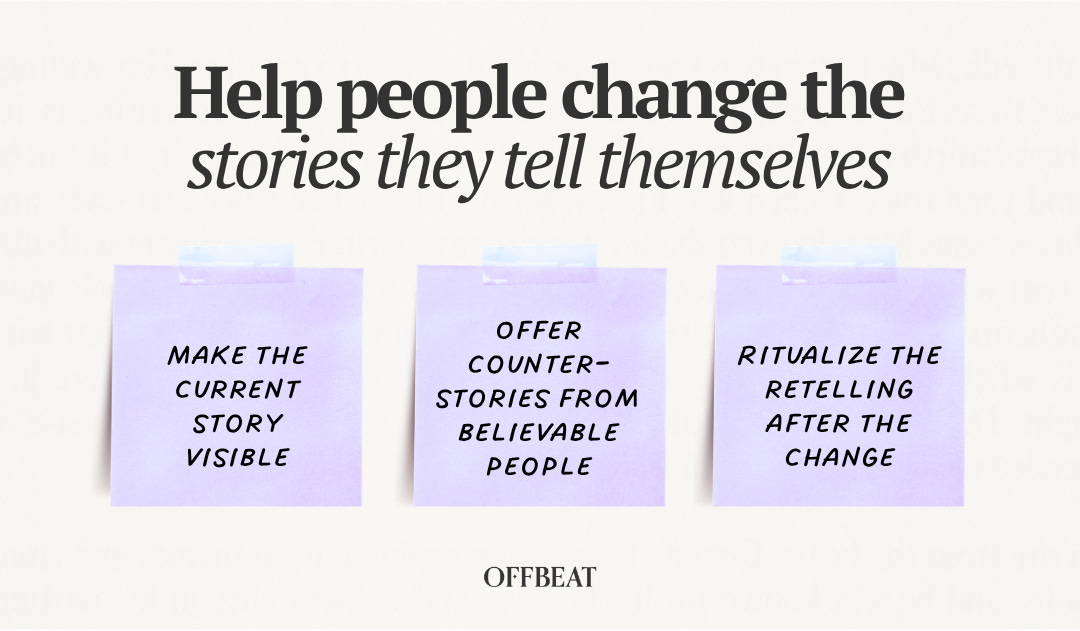
Real learning supports people in changing the stories they tell themselves. Funnily enough, we can use storytelling to support people in changing their narratives. I did a bit of research after our session to see how this can be done, and I found a few simple techniques:
– Make the current story visible. People can’t change what they’re not aware of, so we need to design experiences that leave enough space for people to grow their self-awareness.
– Offer counter-stories from believable people. This is one of the uses of storytelling I mentioned earlier. We can find people who’ve walked similar paths to share their own stories.
– Ritualize the retelling after the change. Offering people space at the end of a journey to reflect and repeat what’s changed for them. “I used to think… but now I think…”
Another framework we explored in our session was one people usually go through when rewriting their narratives: the hero’s journey.
Layer 2: the hero’s journey is a tool for designing that rewriting.
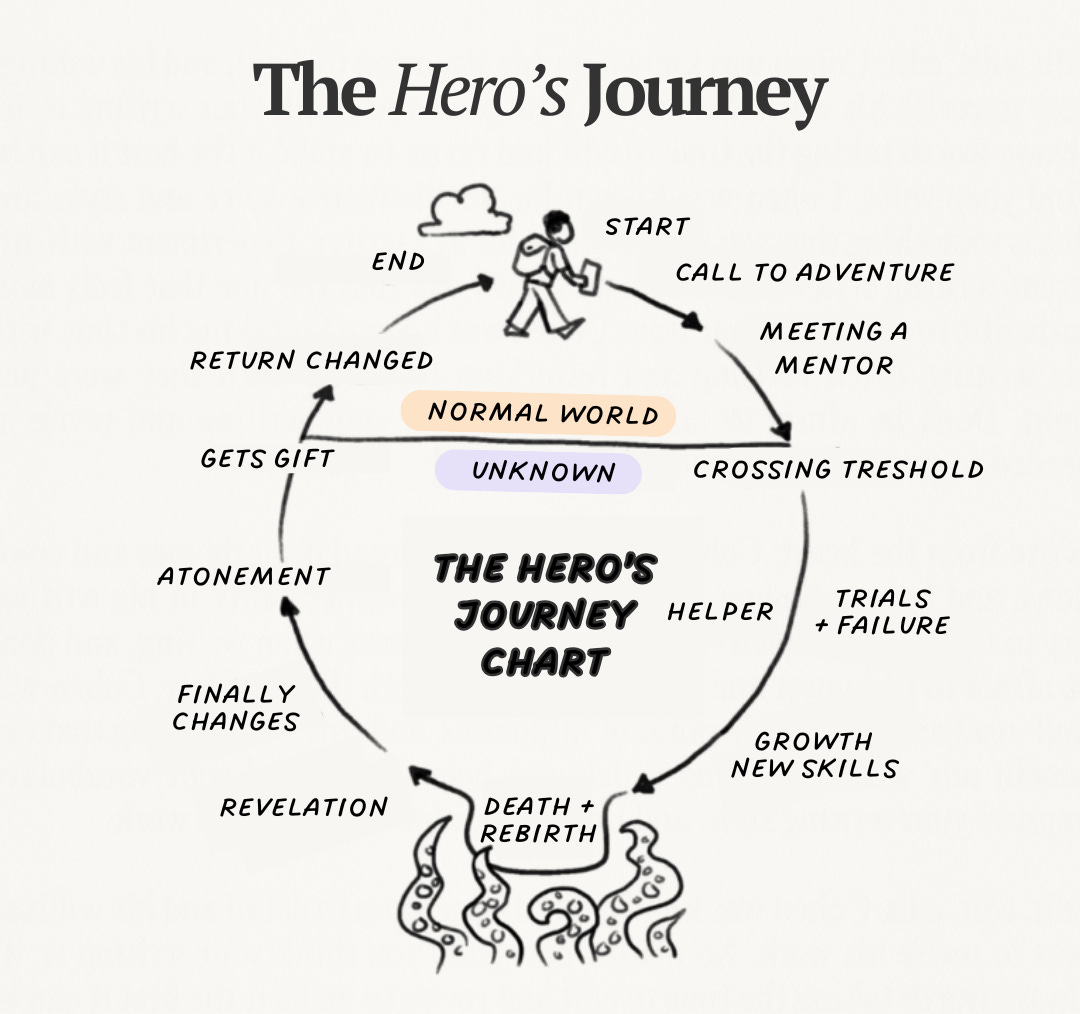
Ajay mentioned the hero’s journey is actually a learning journey, and once you look at its stages through an L&D lens, it becomes a design map. There are three key moments in the journey: the known, the adventure or the unknown, and the return.
Act 1: the known
– The call to adventure sits before the beginning of an experience. It’s when we should make sure we tell people something that truly resonates with them (their problems, their experiences, why the world as they know it will change), while also being honest about the difficulty of the journey ahead.
– Something we didn’t explore in the session, but that I think is really important for L&D, is the refusal of the call. There are so many blockers that prevent people from accepting our call to adventure. We need to make sure we talk about them in our call to adventure or be prepared to address them when they come up.
– I’d like to think of L&D as the mentor, the supernatural assistance that comes up in the story to help people move between the known and the unknown. The Gandalf, the Hagrid of the corporate world. We’re there to support people in the known and the unknown.
– Then, we should intentionally design the crossing of the threshold, that moment when things stop being easy, because the hero encounters challenges they haven’t faced thus far. In the last issue, which you can find here, I spoke about disorienting dilemmas and why we shouldn’t shy away from pushing people out of their comfort zone.
Act 2: the unknown
In the unknown, the hero encounters trials, surprises, and even crises. I wonder, once again, how much we design for the uncomfortable and for surprises intentionally. At the end of the day, it’s what makes people remember a learning journey the most.
Also, Harry Potter had Hermione and Ron. He was rarely alone facing He Who Must Not Be Named and his army. Community is powerful, and this is a good moment to activate it.
Act 3: the return
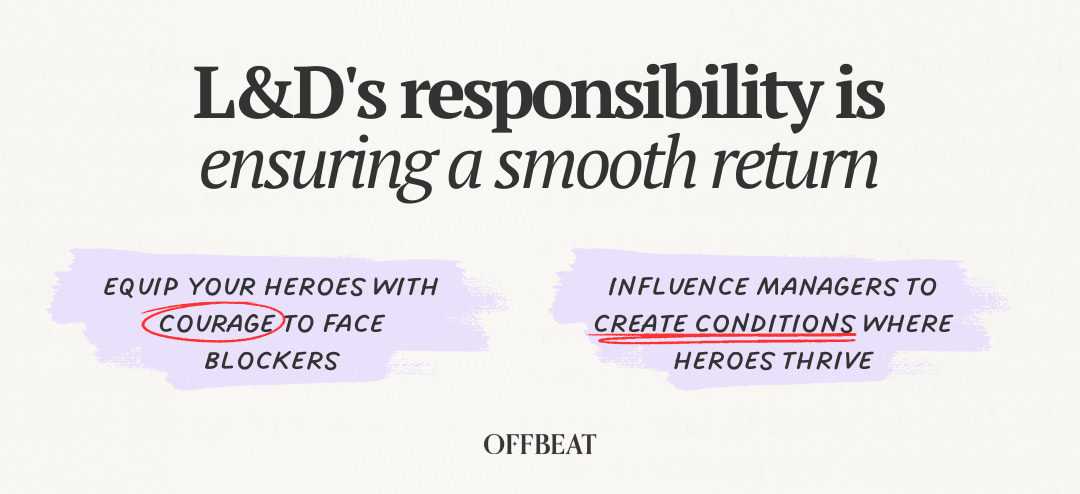
This is the part we have the least control over. Our heroes usually come back having changed their minds about different things and equipped with new tools to do work differently or even different work. More often than we like to admit, what they find is no support to implement their ideas. I think our responsibility is to equip them with the courage to face other people’s refusals of their call to adventure, while also influencing managers to create the conditions where our heroes thrive.
So, I ask you, what’s the story you’re telling yourself about L&D? Consider Offbeat a call to adventure to change your narrative. Our journey has lots of ups and downs, but we’re in this together!
I’m looking forward to exploring these ideas in more depth, and I hope that now, so are you.
Quick Sponsor Break
This issue of Offbeat is sponsored by my friends at Sana. Most learning stacks are patchwork, not design. Sana Learn replaces the mess with one intelligent platform that connects your HRIS, comms tools, and content sources, then lets AI handle enrollments, recommendations, and analytics. Learners get a seamless experience. Leaders get real-time insight.
3 L&D Resources Worth Exploring
Has Psychological Safety lived up to the hype? Can you train people to adopt psychological safety? We’ve been trying to do that in L&D, and more often than not, I hear people being disappointed by the results. This piece argues that while psychological safety is real and worth valuing, it’s not a lever or install-able practice, but rather something that emerges as a consequence of a variety of conditions.
The Art of Leadership. A 12-part series where Dr. Ian Hallett covers twelve principles of leadership that his research found underpin superior company performance. Available so far are the art of storytelling, listening, simplicity, foresight, and disagreement.
The Facilitation Inspiration Library. If facilitation is your passion, you’ll love this. Rebecca Courtney brought together books, podcasts, tools recommendations from 200+ of the best facilitators around the world. These resources are enough for you to create a mini-master in facilitation, without any other help. Love it!
The AI Find: Anthropic launched Claude for Teachers
On July 14th, Anthropic launched Claude for Teachers. Well, Claude for some Teachers, because it’s only aimed at K-12 teachers in the US. I think this is interesting to understand, because it might also point to a potential future we can see in L&D.
Okay, so here’s how it works.
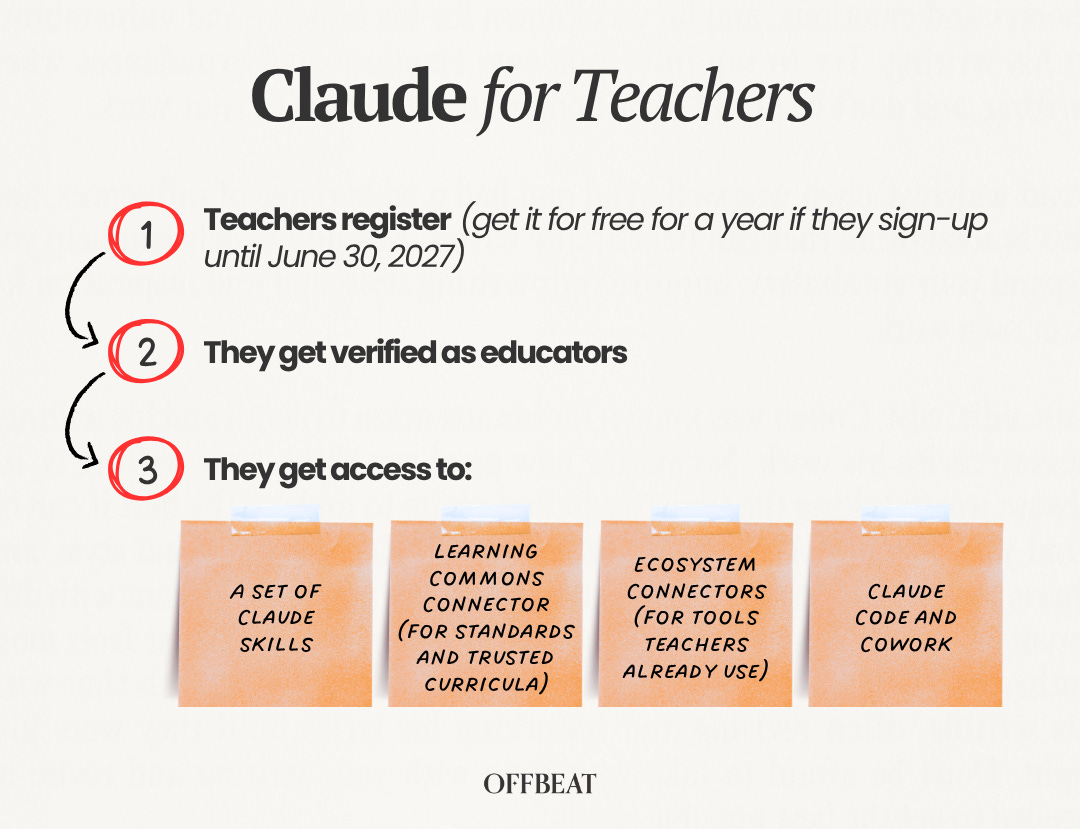
1/ Any K-12 teacher in the US can register and, once verified as an educator, gets access to Claude for Teachers free for one year (the offer runs for sign-ups until June 30, 2027).
2/ The teacher then gets access to a set of Claude skills (pre-written instructions that tell Claude how to do a task well) useful for different tasks (e.g. lesson planning). The skills were built by Anthropic in partnership with Learning Commons, with feedback from teachers, and are, according to Anthropic, grounded in learning science.
3/ The teacher also gets access to different connectors (live links that let Claude pull information from outside sources). The Learning Commons connector gives Claude access to the academic standards across all 50 states and trusted curricula (OpenSciEd for science, IM v.360 from Illustrative Mathematics for math). The ecosystem connectors plug Claude into tools teachers already use for generating assessments, analyzing recordings from classrooms, among others.
Claude for Teachers also includes Claude Code and Cowork, so teachers can hand off recurring work and focus on forming closer relationships with students and designing learning experiences that fit each of them.
Now, let me tell you why I said this is interesting for the future of L&D. Because the same set-up could be rebuilt with our own tech stack and materials. If you look at the architecture of this set-up, it has an LLM in the center that’s plugged into a bunch of things. This is what it would look like in our case:
– A content layer (competency framework, skill taxonomies, and corporate documents as curricula)
– An expertise layer (skills built the same way the teaching skills are, but focused on adult learning science)
– An agentic layer (Claude Code + Cowork: delegated and scheduled work)
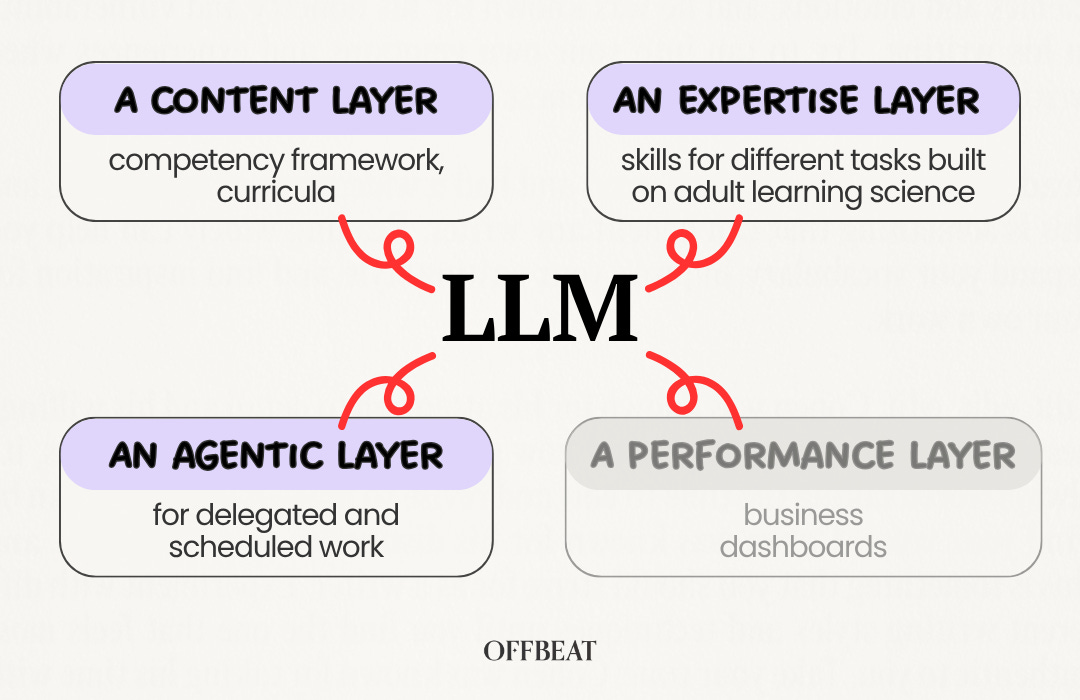
The one element where the translation gets harder is performance signals. Teachers can give tests, get data about their students’ performance, and adjust accordingly. A true signal in L&D means actual performance improvement, which would require connecting the LLM to business dashboards. And we all know how hard that is to do.
Some of the questions I’m left with looking at this picture:
– While teachers have a vetted curriculum, we don’t. We rarely even measure the performance of our programs. So we don’t have much to feed into the system, other than our current materials, maybe vetted by SMEs, right?
– If the learning design craft can be codified into skills, what’s left as our distinctive contribution? The K-12 answer was “time with students.” What’s ours?
– If we truly get all these connectors and the feedback loop runs daily (assess, analyze, adapt), what happens to the annual needs analysis and the course as the unit of delivery?
If you already have such a set-up or even parts of it, I’d love to learn more about it!
Surprise of the week
Each week, Offbeat brings you a new random surprise. Sometimes it might be big - a challenge you can join to win something nice. And sometimes it might be small, like a video or a nice Instagram account. Curious? Hit open!

