


Hey there 👋 I’m Lavinia, and each Sunday I write about modern ways of running L&D. If you want to learn more: Offbeat Fellowship | Offbeat Sparks | Offbeat Fest. Here are my favorite L&D people to follow, a list of L&D books you might want to check out, and a list of L&D conferences all around the world.
Before jumping into the newsletter, quick announcement! Thanks to D’Jeanne, Armina, and Victoria, our community is gathering in Seattle for an Offbeat Sparks on August 20th! If you’re in Seattle or know someone who is, check the registration page right here. If you’re in another city and want to host an Offbeat Sparks, let us know here. Now enjoy Offbeat!
Almost none of my growth has come from staying in my lane.
I remember going to Estonia when I was 19 for a one-week Erasmus exchange. It was my first time leaving Romania and my first time flying. I was 2000 km away from home, surrounded by strangers, speaking mostly English, a language I had never used conversationally. We were also discussing leadership, a topic I was virtually unfamiliar with. Nothing about what happened there was in my comfort zone. Yet, to this day, I think of my week in Estonia as the first moment in my life when I thought life can be more than what I knew, and what led me down the path I’m on today.
This experience, and some others I’ve had that were similar in length, made me believe that for big change to happen, learning experiences need to be long and very immersive.
In a recent conversation we had, Andy Sontag challenged my notion that we need a long time to challenge people’s worldviews. Of course, more time gives us more opportunities to do so, but even short sessions can provoke mental models if designed properly. Now, looking back at my own experiences, I concluded he’s right.
Not all experiences that made me grow were as long as a week. Spending 3 days in Copenhagen for the Kaospilot’s Experience Design Program made me rethink how and why we design learning. And many 1-hour therapy sessions have shaken me to my core.
What made different experiences powerful for me wasn’t the time I spent in them, but the degree to which they made me uncomfortable and disrupted my thinking.
In his article, Designing experiences that enable behavior change, Andy talks about The Transformational Learning Theory and references Mezirow to define transformational learning as “the process of fundamental change within our current worldviews, mental models, beliefs and values”.
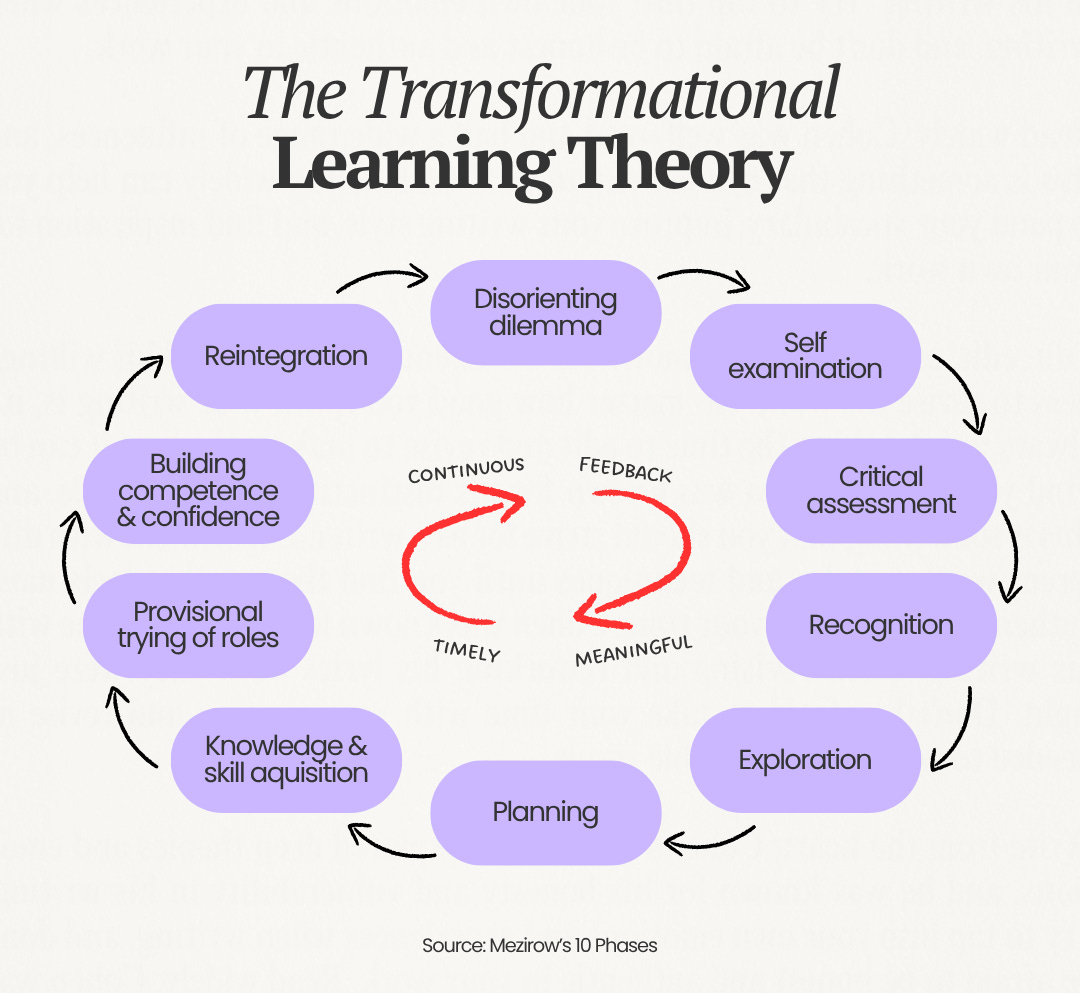
The model has 10 phases:
(1) Encountering a disorienting dilemma
(2) Examining your emotional reaction
(3) Assessing presently held assumptions
(4) Recognizing others also encounter disorienting dilemmas
(5) Finding a sense of agency and exploring how one can think differently
(6) Creating an action plan
(7) Gaining knowledge for the plan
(8) Trying things out
(9) Developing confidence
(10) Integrating the new perspective in one’s life
Today, I only want to unpack the first one. A disorienting dilemma is “a situation or an experience that does not fit individual preconceptions and can be perceived as confusing or jarring.” It might take people by surprise and usually elicits an emotional response that needs to be unpacked.
Others have studied similar phenomena.
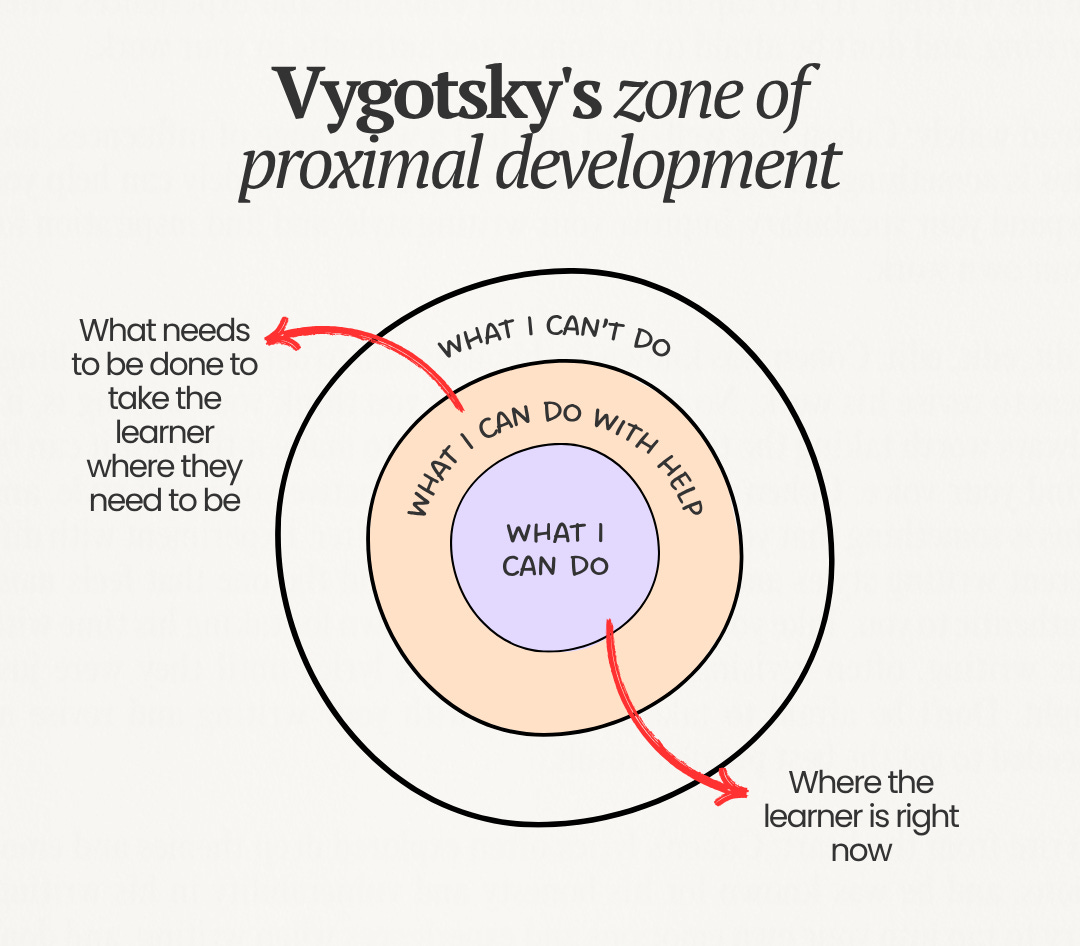
– Vygotsky’s zone of proximal development suggests learning happens just beyond what you can currently do.
– Robert Bjork’s work on “desirable difficulties” showed that things that make learning feel harder in the moment (spacing, interleaving, retrieval practice) often produce better long-term retention.
Now, I wonder how much time we spend purposefully creating moments where people encounter disorienting dilemmas in the learning spaces we design in L&D? My experience says “not much”. We’re often too focused on the next framework we need to present, or the next fun exercise we have to facilitate. I know I often am.
But what my own experience says, and what theories make clear is that to change minds, we need to change how we design learning. Carefully, but surely, we need to take people out of their comfort zone.
To do so, we can take inspiration from familiar AND unusual places.
(1) Ronald Heifetz at Harvard Kennedy School teaches leadership by refusing to lead. He opens class with silence, declines to answer questions directly, and lets the group flounder. Then, he uses the group’s own frustration, in real time, as the case study about authority and leadership.
(2) Dialogue in the Dark (a museum experience run entirely in pitch black, guided by blind guides) and Dialogue in Silence deliberately strip participants of a dominant sense. Visitors report genuine disorientation and even mild fear. The discomfort produces empathy and perspective-shift that a lecture about disability never could.
(3) IDEO-style workshops often force participants to build a physical prototype in 10 minutes with pipe cleaners and cardboard, then show it to strangers for feedback to break perfectionism and attachment to ideas.
(4) We decided to switch the traditional conference space for a brewery to intentionally give Offbeat Fest a feeling of informality and humanity. Tom Goulooze recently told me a story of how he brought a design team to a museum to reconnect with their craft.
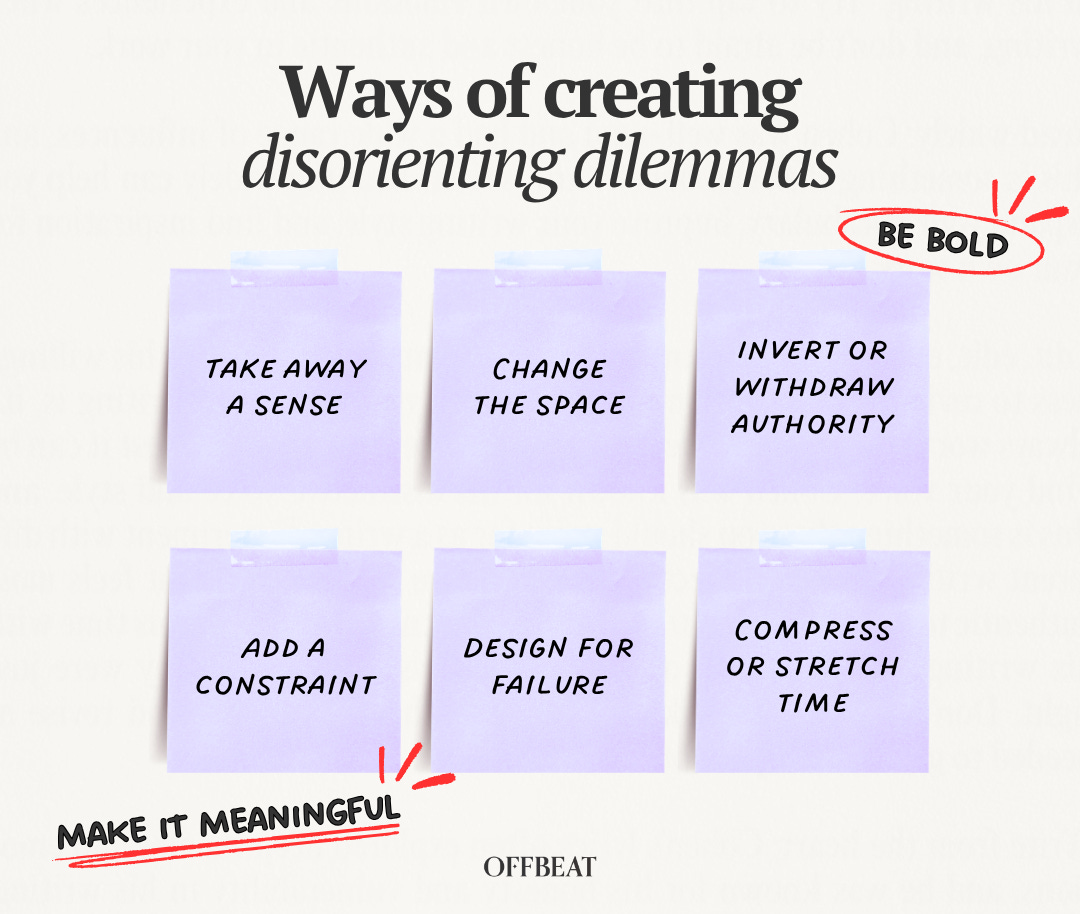
Depending on your goal, a disorienting dilemma can be created through senses, by changing spaces, by challenging hierarchy and authority notions, by adding constraints, by designing for failure, or by compressing or stretching time. The point is for it to be meaningful to the change you’re trying to create and bold enough for people to perceive it as disorientation.
So here’s my challenge to you. The next time you design a session, ask yourself:
(1) What’s a belief this group wouldn’t think to question?
(2) How might we design an experience that draws out this belief and its consequences?
Have fun with it!
3 L&D Resources Worth Exploring
The Skills Construct Problem. If you’ve ever sat through a skills platform demo, inherited a competency framework, or been asked to map learning content to a “skills cloud,” this article names the problem you’ve probably felt but struggled to articulate: leadership, resilience, SQL, and customer focus are not the same kind of thing, yet our systems treat them as if they were. Teresa Rose unpacks why tidy skills lists hide messy constructs, why more data scales the confusion rather than fixing it, and what it takes to build taxonomies that can actually support decisions about learning, mobility, and development. Essential reading before your organization bets its workforce strategy on a list of labels.
Five principles for designing brain-powered organizations. McKinsey found that 79 percent of organizations have adopted gen AI, but only 39 percent see any profit impact. What they argue is that we’re offloading so much thinking to AI that our reasoning muscles are atrophying, and automation has stripped out the easy tasks that used to give our brains a breather. An even more important conclusion for us, in L&D, is that our upskilling efforts can fail just because people are tired.
An Applied Behavioral Science Field Guide. Matt Furness shared this guide earlier this week in a LinkedIn post, and I found it very interesting. It comes from UNICEF, and it lays out what behavioral science is as well as their DEPTHS framework, a systematic process to help practitioners apply behavioral science in practice.
The AI Find: SumUp’s No-Code AI Hackathon
One of the lessons our L&D community quickly learned when supporting AI adoption is that traditional formats fall short. To start working with ChatGPT, Claude, Gemini (insert any other tool here), people need to get their hands dirty!
At SumUp, the learning and development team was quick to act on this insight. They brought in the AI Hackathon, a format that was generally used for engineers, to people outside of product and tech. The event is a two-day, no-code hackathon where colleagues from Legal, Risk, Finance, Ops, and People get together to redesign workflows and present their ideas.
The event was run once in São Paulo and later in Berlin.
Entering the experience
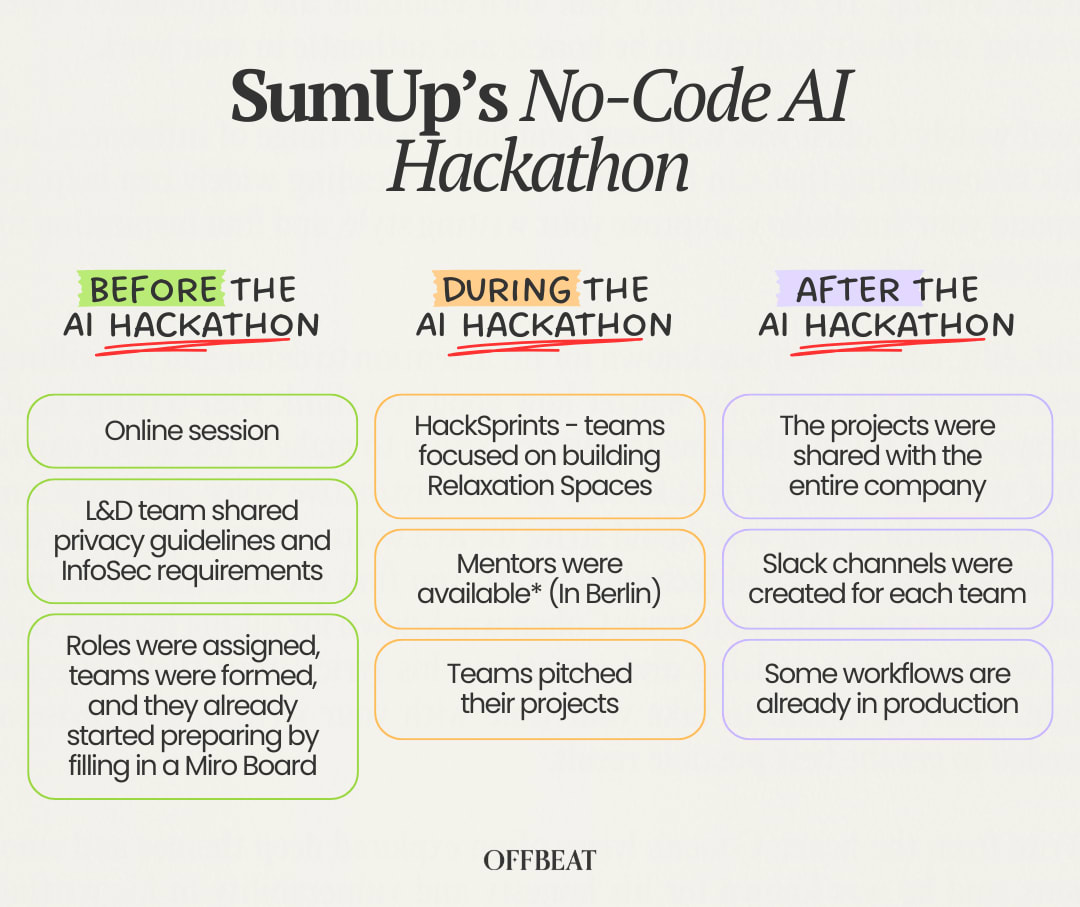
The experience starts online, with a session where the L&D team shared privacy guidelines and InfoSec requirements. The same session was used to form the teams, assign roles, and get people familiar with their chosen tool, while also helping them do the pre-work needed before the building actually started. For this, the L&D team shared a Miro board that was structured as a team workspace to help each group organize their project idea in a clear and consistent way during the hackathon.
Each team had its own dedicated section, including fields to define the team name and team members, followed by key project-building blocks:
Roles & Responsibilities: to clarify who would be responsible for each part of the project.
Problem Statement: to define the problem the team was trying to solve.
Main Goal: to align on what success would look like.
Stakeholders: to identify who had an interest in the project or would be impacted by the solution.
Tools: to list which tools, platforms, or AI resources the team planned to use.
Constraints & Risks: to capture possible limitations, dependencies, or risks.
Workflow: to map how the solution would work from start to finish, including the main steps and tools involved.
Milestones & Actions: to define the key next steps and activities needed to move the project forward.
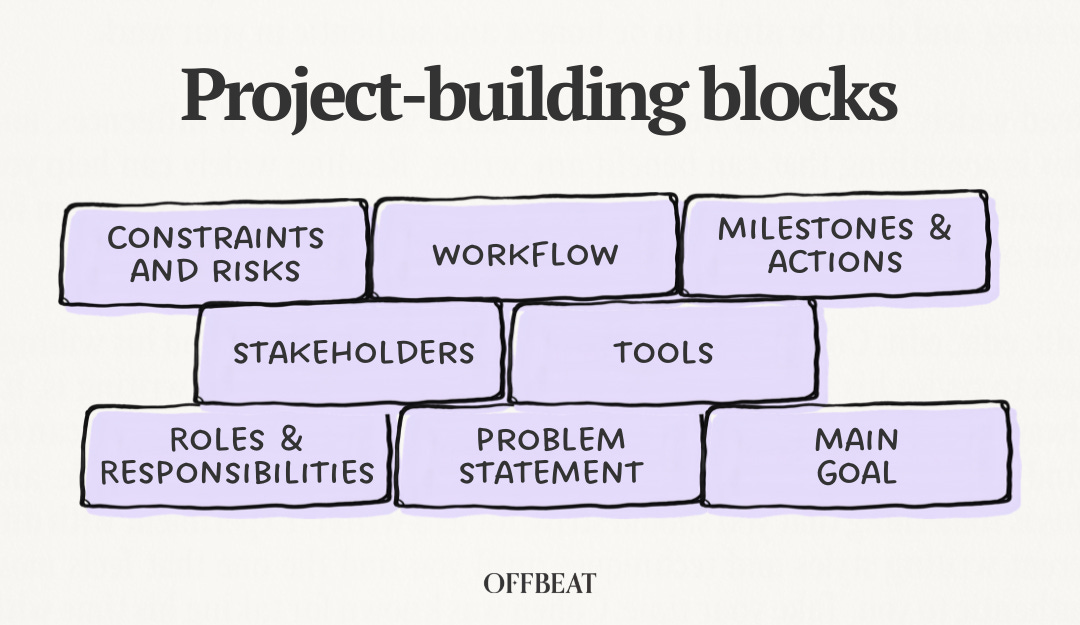
Overall, the board was designed to guide teams from problem definition to solution planning, helping them structure their thinking, align responsibilities, and prepare a clear project presentation.
The two days
During the two days, the teams spent their time building. Since the event was so intense, the space included sofas, comfortable chairs, and massage stations. But people were so excited they ended up using those relaxation areas to keep on discussing their projects.
In Berlin, participants also had access to mentors. AI Experts sat together at a table among the participants. Everyone could walk to them to ask for advice whenever they felt stuck.
Exiting the experience
In São Paulo, at the end of Day 2, the entire company was invited to watch the presentations, and each of the seven teams pitched for seven minutes. In Berlin, because the number of teams was much higher, mentors acted as judges. Three winners were selected in each city for the following prize categories: Best Overall Solution, Best Use of AI, and the Audience Award.
As a follow-up, the projects were shared in the company’s Slack channel, where even senior leaders congratulated and encouraged the teams. Some workflows built during those two days are now allowed in production.
Maria, the People Development Partner who led the AI Hackathon, also created a Slack channel for each project, open to anyone in the company who wanted to follow along, so teams could keep collaborating and pushing their solutions after the event.
Formats such as training and e-learning don’t tend to drive practice and application as quickly as a technology such as AI needs. Things also move so quickly that social learning seems to be the best way to keep up, compared to formats that are more static and become outdated quickly.
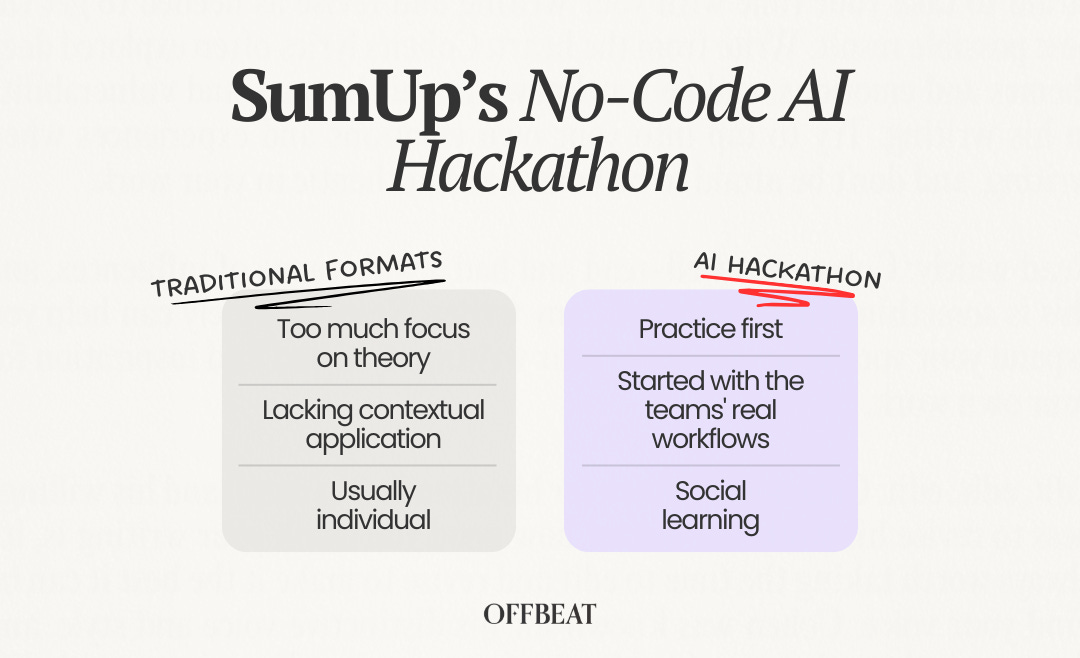
What Maria and her team did at SumUp seems to be the new standard for how AI learning sessions should look. Hope you’ve enjoyed the short story, and if you want to learn more details, the full case study is available here for Offbeat Fellows.
Surprise of the week
Each week, Offbeat brings you a new random surprise. Sometimes it might be big - a challenge you can join to win something nice. And sometimes it might be small, like a video or a nice Instagram account. Curious? Hit open!


Thank you for sharing that. I agree that discomfort is helpful for learning, especially when we need to work on changing beliefs and attitude. I also think that when we design interventions meant to create a discomfort it is very much important to properly communicate to participants before and after the intervention. I've seen cases where discomfort was so big, that people were in too much of a distress to learn and they also lost their trust towards the facilitator. It's worth to keep it in mind.