


Hey there 👋 I’m Lavinia, and each Sunday I write about modern ways of running L&D. Here’s what you can find in this newsletter: how Kristen Yealy would rewire L&D, 5 L&D resources worth exploring, our surprise of the week, and my thoughts on using foresight in an L&D strategy session. Enjoy! 💜
How would you rewire L&D?
Every week, we ask a community member the same question, “How would they rewire L&D?”
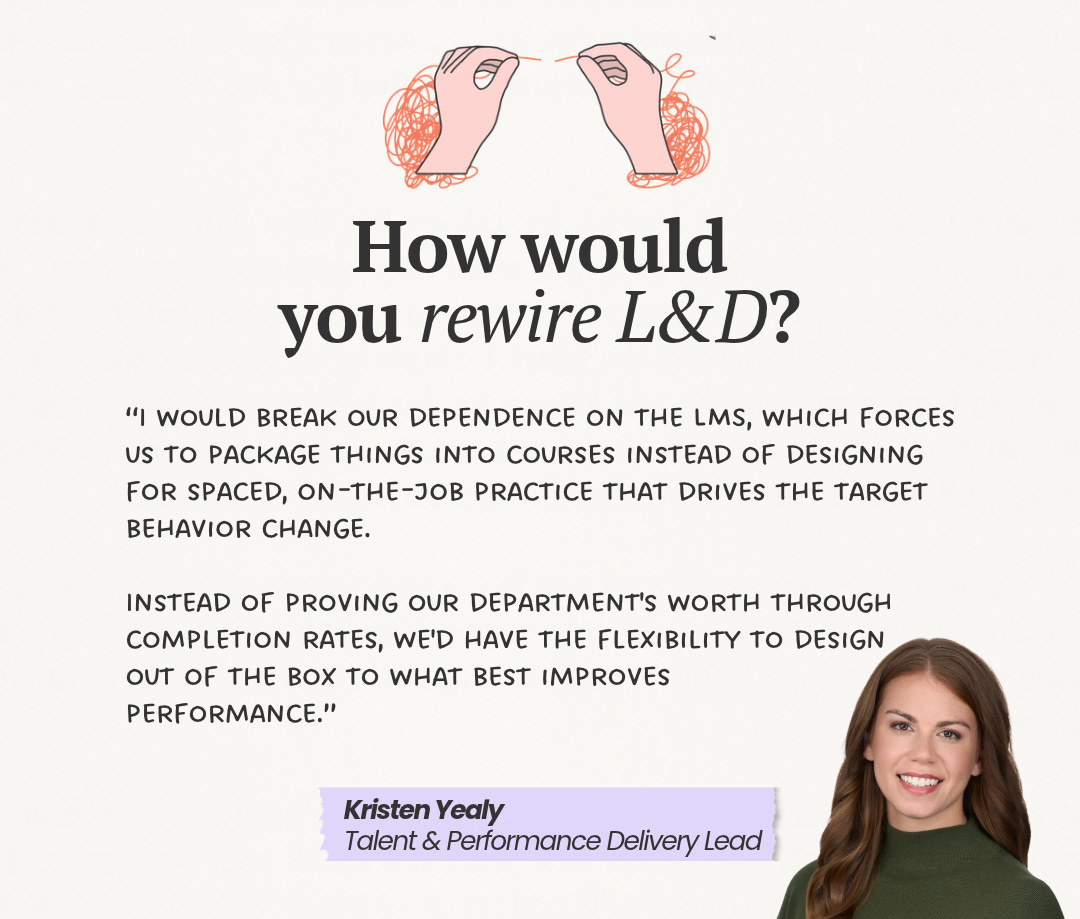
This week, Kristen Yealy says, “I would break our dependence on the LMS, which forces us to package things into courses instead of designing for spaced, on-the-job practice that drives the target behavior change. Instead of proving our department's worth through completion rates, we'd have the flexibility to design out of the box to what best improves performance.”
Wanna contribute? Share your answer here. Interested in how I would rewire L&D? Get your copy of L&D rewired.
5 L&D Resources Worth Exploring
Dear L&D: Your Facilitation Skills Might Be Your Biggest Advantage in the Age of AI. AI is getting increasingly good at personalising individual learning. But what about helping people work better together? This article makes the case that facilitation could be one of L&D’s biggest advantages in the AI era. Rather than focusing exclusively on individual skills development, L&D has an opportunity to use its facilitation expertise to help teams navigate friction, build trust and make decisions, while supporting greater alignment across organisations.
How to Use Stories to Transform the Way We Lead, Design and Relate. We use stories every day to explain ideas, make sense of complexity and shape how people see the world. But how often do we stop to question the stories we’re telling, and the assumptions they carry? Elena Vasileva explores how storytelling can become a tool for deeper change: helping us examine inherited narratives, challenge dominant ideas about progress and success, and imagine more caring and regenerative futures. A thoughtful look at how the stories we tell influence not only how we communicate, but how we lead, work and organise our lives.
How to build the career you actually want. Want a different career? You don’t necessarily need to quit your current job to start building one. Darius Foroux explores how to work towards the career you actually want while dealing with the realities of everyday life. His advice: get clear on where your skills and interests overlap, prioritise mastery over chasing what looks lucrative, and build momentum through consistent action. He also makes a case for financial discipline, not just as a way to build wealth, but as a way to give yourself more freedom to make better career decisions.
How to keep critical thinking alive when AI makes answers cheap and execution fast. This guide from LeaderFactor argues that the critical thinking challenge is fundamentally a culture problem. It explores how leaders can create the conditions for people to question recommendations, challenge assumptions, disagree constructively, and speak up before decisions are made. Packed with practical tools, including a thinking-and-safety matrix, a framing brief, and a five-day practice, it turns the argument into concrete leadership behaviours.
The Biscuit Story: A Lesson in Leadership From the Antarctic. What makes people truly trust a leader? Not their title, their words, or even their promises. It’s whether they’re willing to shoulder the same burdens as the people they lead. This short story from Ernest Shackleton’s Antarctic expedition illustrates the point. When one of his men was struggling to survive, Shackleton gave up his only breakfast biscuit, a sacrifice that meant something because he was starving too. A simple but powerful reminder that leadership credibility is earned through actions that carry a genuine personal cost.
Surprise of the week
Each week, Offbeat brings you a new random surprise. Sometimes it might be big - a challenge you can join to win something nice. And sometimes it might be small, like a video or a nice Instagram account. Curious? Hit open!
How to use foresight in your next L&D strategy session
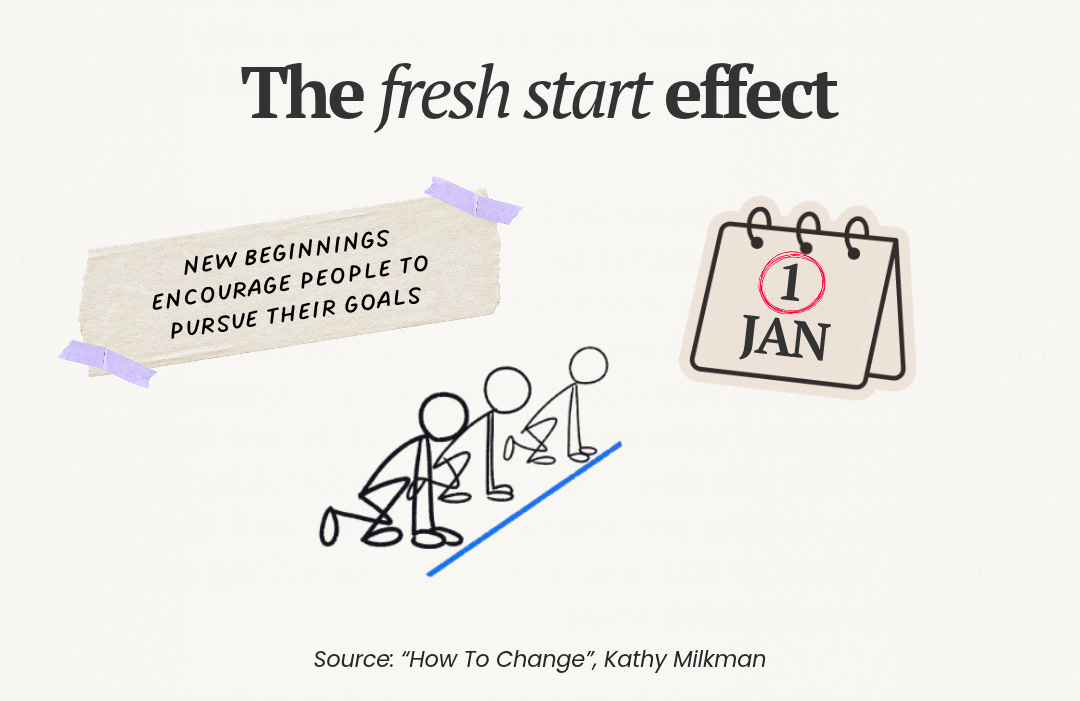
Every time the end of the year comes, we’re drawn to reflection and creating plans for what comes next. In How To Change, Kathy Milkman calls this the “fresh start effect”1. She describes how temporal landmarks like a new year, month, week, birthday, or job make people more likely to start pursuing goals, because the landmark creates a mental break from their past selves and past failures.
In the corporate world, that usually translates to “let’s run a strategy session”. Those might be planned company-wide (especially for start-ups, who can afford bringing everyone together because they have fewer employees) or at a department or team-level. L&D professionals might either attend a People offsite or organize one as a team, usually if the team is larger than 3-4 people.
Most of the sessions I’ve been a part of start with a review of the previous year. What went well? What could have gone better? What do we need to stop, start, or continue doing? While this type of exercise isn’t wrong in any way and should have its place during the time you spend together, I would argue there’s a different starting point one can take.
Jennifer Lo lists “refreshing last year’s plan” as one of the mistakes she often sees in strategy workshops2. Starting by looking at the past might already narrow down people’s creativity and imagination. Instead, she points out that many such exercises are in need of some foresight.
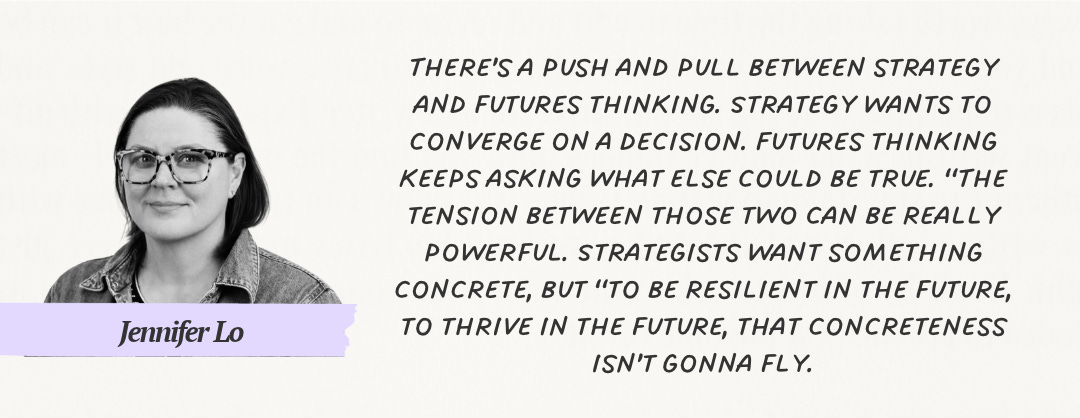
There’s a push and pull between strategy and futures thinking. Strategy wants to converge on a decision. Futures thinking keeps asking what else could be true. “The tension between those two can be really powerful,” Jennifer says. Strategists want something concrete, but “to be resilient in the future, to thrive in the future, that concreteness isn’t gonna fly.” Jennifer Lo
In summary, the future is so uncertain, narrowing down too quickly on an option is dangerous. So part of the time you spend together with your team should be dedicated to the exploration of the future by scanning signals and designing potential futures.
Part 1: Scanning Signals
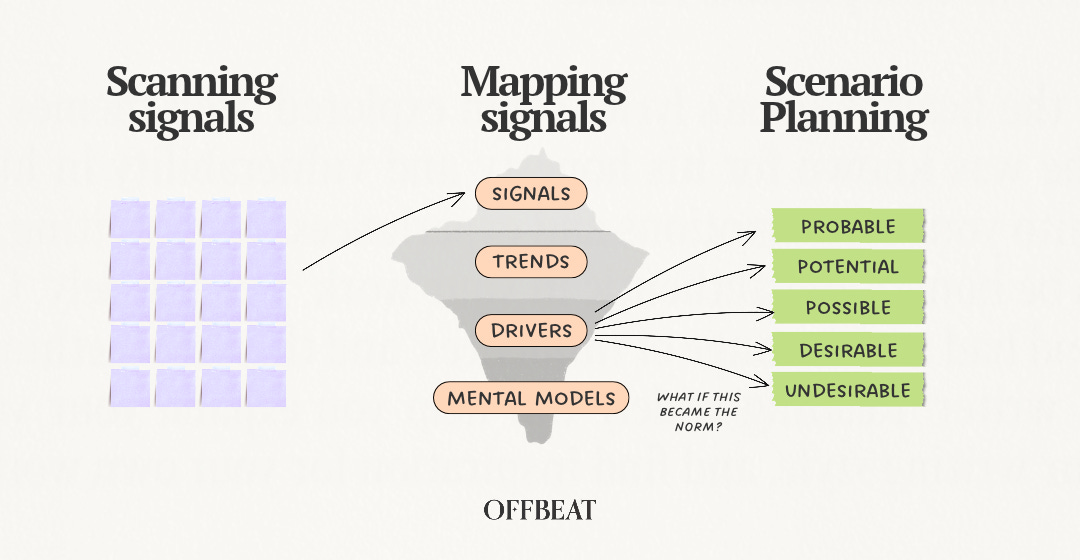
Exploring the future can start before the offsite or can happen at the beginning of the first day. If you have the time, I advise L&D Managers to start dropping short resources into their team’s inboxes early on so they can get exposed to potential futures quickly. But I acknowledge that might take too long, so you can simply use the first 2 hours of the day scanning for signals on 3 layers:
The world: “What are people outside our organization starting to do differently when they learn, work, or grow?”
The organization: “What are people in our organization starting to do differently, with or without us?”
Ourselves: “What are we starting to do differently when we need to learn something?”
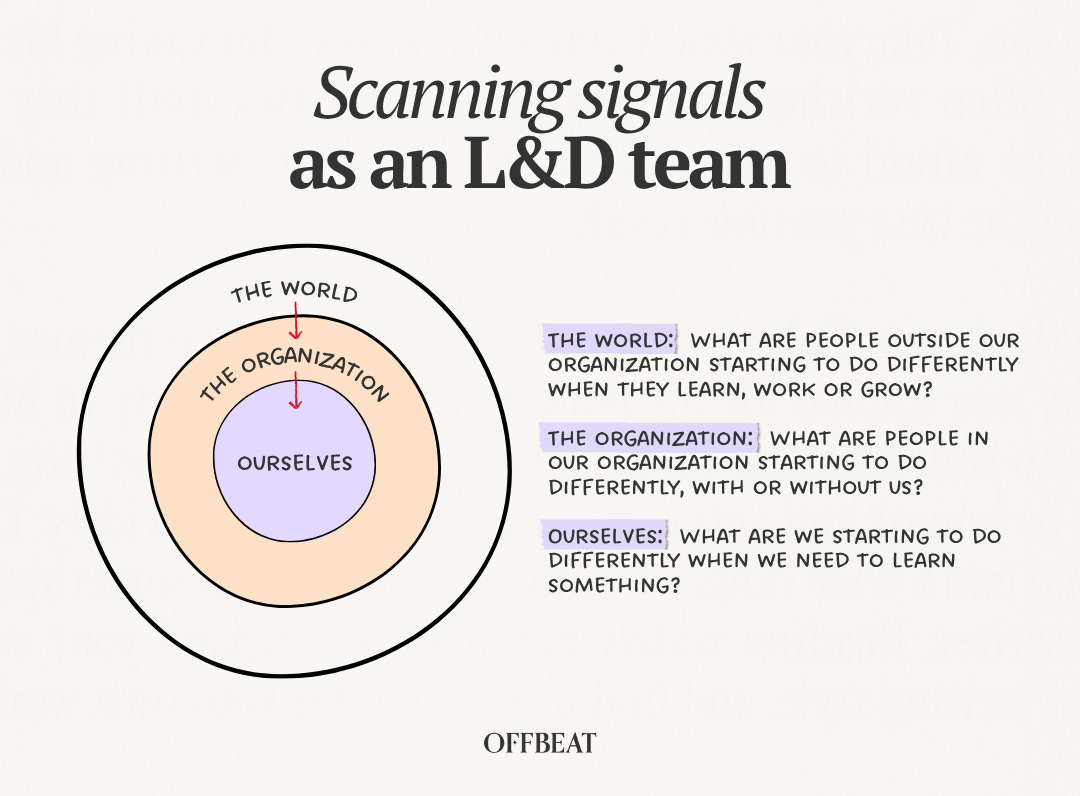
The first two layers might not be a surprise to anyone, while the last one is often overlooked. We work in L&D, sure, but we’re also learners. Our learning habits are pretty much the same as everyone else’s, give-and-take some extra activities. Stepping into the shoes of our roles as learners and employees can be incredibly useful for gaining insights into how everyone else acts.
For scanning the world, I’d advise you to prepare one or two activities and a few resources. You don’t need many. Anamaria described how her team did an after-lunch inspiration walk and watched a series of carefully curated TED Talks3. If you’re in need of a library of resources, you can always scan our newsletter for inspiration.
For scanning the organization, I’d borrow the first questions of a Liberating Structure called Discovery & Action Dialogue4. It’s built to find positive deviants, the people who manage to learn and grow despite facing the same constraints as everyone else. They’re the best answer to what people are starting to do differently. Ask your team who in the organization seems to be learning or working in new ways and what makes that possible for them. Leave out the structure’s later questions, which focus on actions, because this part isn’t for deciding. Keep the names you come up with. They’ll make great guests if you decide to bring in stakeholders to stress-test your strategy.
Finally, to scan our own learning habits, a good option would be the Liberating Structure 1-2-4-All5. Start with a minute of silent reflection on the question “What are we starting to do differently when we need to learn something?” Then let the conversation grow step by step, from pairs to the whole room. It takes about 30-40 minutes and works best when people bring concrete examples from the past few weeks. It can be revealing to notice how differently we learn compared to what we design for others.
By the end of Part 1, you’ll be left with a bunch of signals which can feed into Part 2.
Part 2: Map your signals
The signals you’ll be finding in Part 1 might seem subtle, but as Jennifer Lo puts it, they often point to something bigger on the horizon6. Part 2 is about creating a common picture of what “something bigger” means. For this, I adapted the Iceberg Model7, a systems thinking tool. As with an iceberg, most of what shapes the future sits below the surface, so you’ll work your way down:
Signals: What’s happening? Eg. A sales team built its own AI bot to practice handling objections.
Trends: What keeps happening? Eg. Employees are building their own learning tools with AI.
Drivers: What’s causing this? Eg. Generative AI is making content creation nearly free for everyone.
Mental models: What beliefs keep this in place? Eg. “I can create my own learning when I need it.”
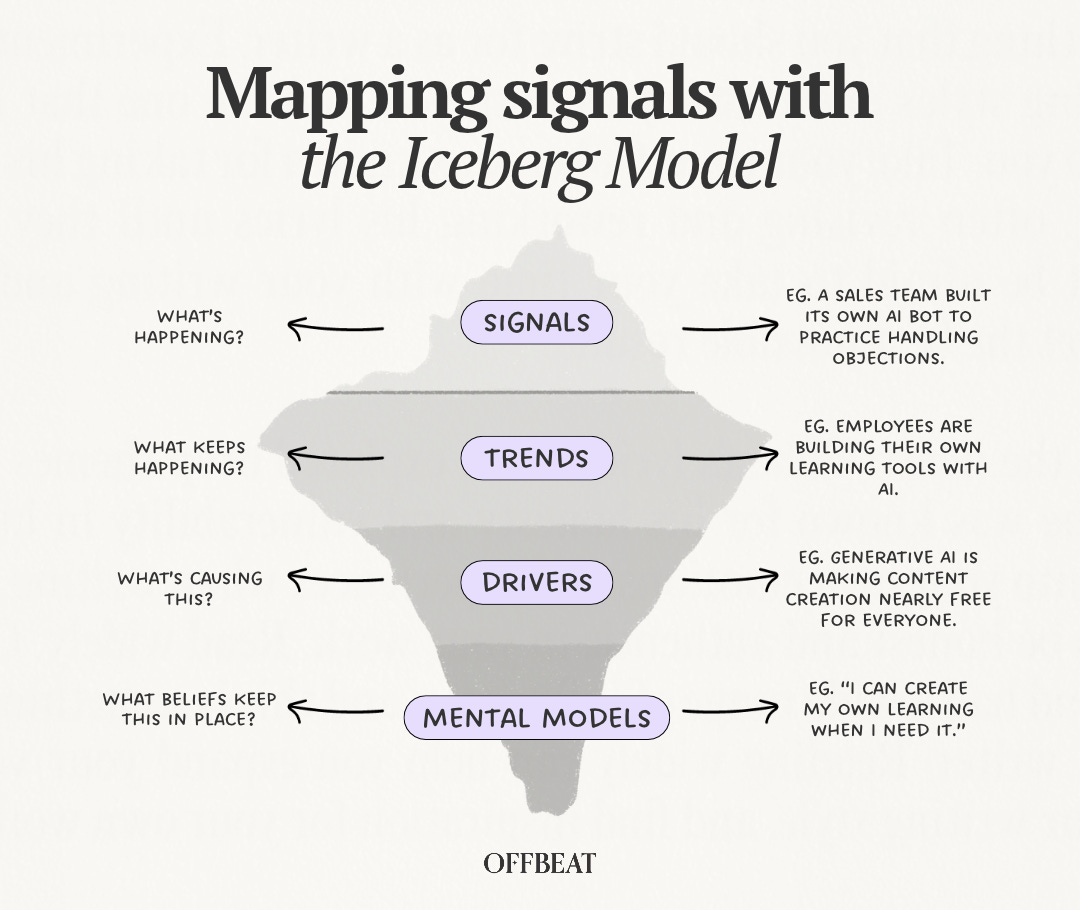
In pairs or small groups, place your signals at the top of the iceberg, then cluster the ones that point in the same direction into trends. For each trend, ask what’s behind it and write the drivers below. Finish by naming the beliefs that would need to hold for this to keep happening. If you do this in pairs, when everyone is done, use Shift & Share8 to visit each other’s icebergs and openly discuss similarities and differences. The drivers you collect here are what you’ll build your scenarios from in Part 3.
Part 3: Scenario Planning
The beauty of foresight is that it forces us to hold onto uncertainty a little bit longer than we’re used to. None of what happens during this part should be about predicting the future. We don’t know what the future holds. But what foresight gives us is a way to explore different futures and not be caught by surprise when any of them happens.
Jennifer Lo says that “the futures cone is a helpful tool for understanding the range of futures available.9” As a final activity for your foresight undertaking, I’d propose a simplified version of the futures cone exercise. First off, looking at the drivers in the Iceberg Model, answer the following question: “What if this became the norm?” The answer to this question will create a range of different scenarios for the future of learning.
To make the exercise simple, before creating scenarios, you can vote on the most important drivers by answering the question “What’s most likely to have a large impact on our team?” This way, you can create scenarios for 4-5 of the most important drivers and not get lost in the sea of drivers the previous exercise will reveal.
But let’s take a look at our example.
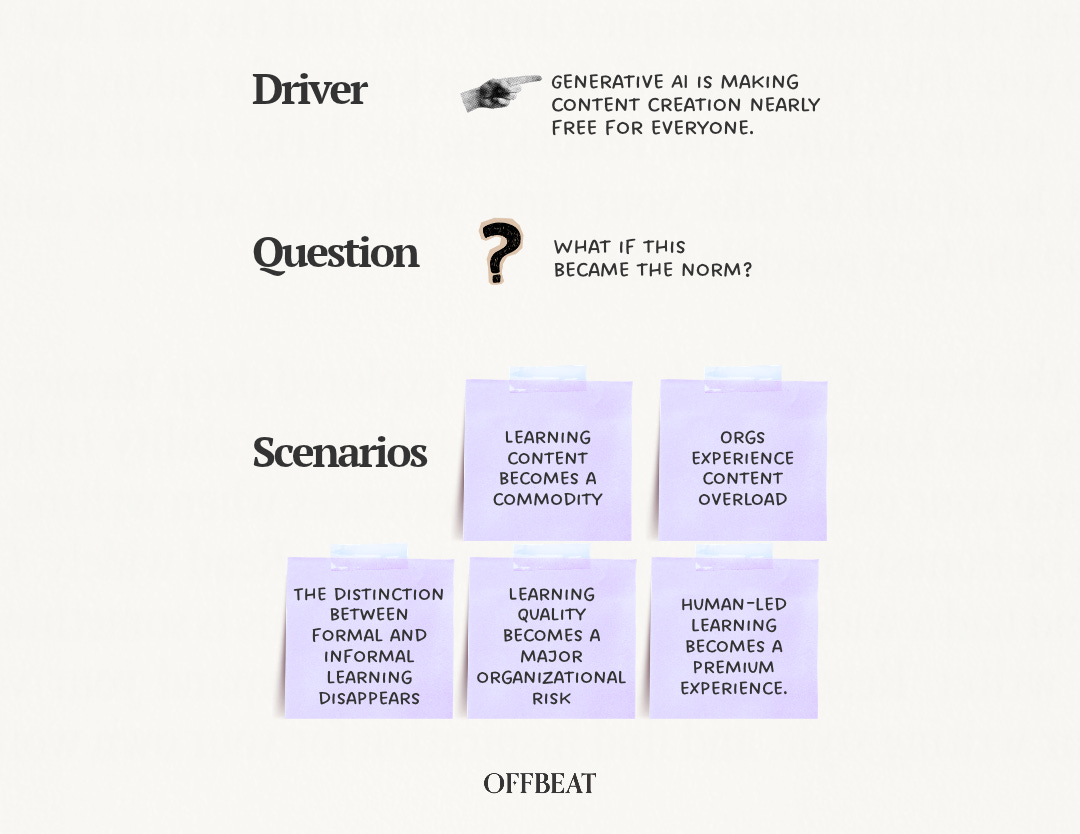
A driver we could identify is “Generative AI is making content creation nearly free for everyone.” If we ask “What if this became the norm?” potential scenarios could be:
– Anyone in the organization can generate courses, presentations, videos, simulations, and learning materials. The competitive advantage of L&D is no longer its ability to produce content.
– The abundance of AI-generated learning materials creates duplication, inconsistent quality, information overload, and difficulty identifying what employees actually need to learn.
– Employees continuously generate and consume learning resources through everyday interactions with AI, colleagues, and workplace systems. Learning becomes less dependent on formal training programs.
– Employees create and share inaccurate, outdated, or biased learning materials. Organizations struggle to maintain consistency, compliance, and institutional knowledge.
– As digital content becomes abundant and inexpensive, organizations place greater value on coaching, mentoring, peer learning, collaboration, and facilitated experiences.
This is just an example. The same question, “What if this became the norm?” can be asked for all the drivers you vote for, and at the end you’ll have a variety of potential scenarios for the future.
Once your scenarios are clear, your next step is to map them on three potential futures:
Probable. What is likely to happen? Eg. AI becomes a standard tool for content development.
Plausible. What could reasonably happen? Eg. L&D becomes a strategic learning architecture function.
Possible. What could happen? L&D departments disappear entirely.
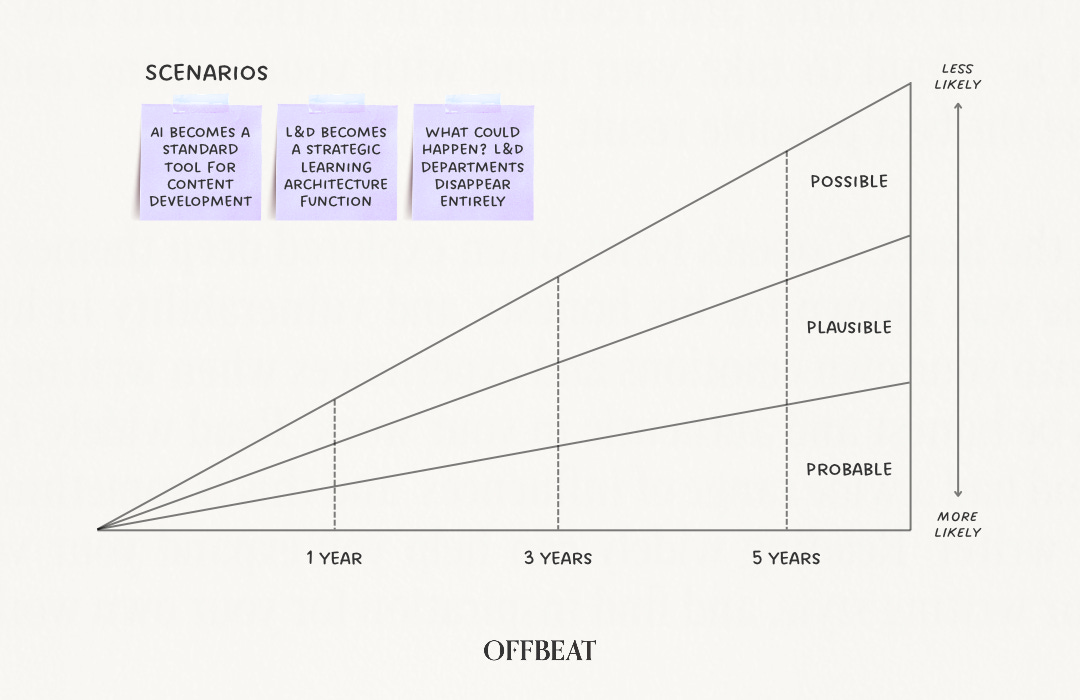
Ideally, you would also use a timeline to map your scenarios across these 3 futures. Something like a year, 3 years, and 5 years. It gives the exercise more nuance, but it can be made optional, especially for teams doing this the first time.
Finally, you’d look at these futures and vote for the top 5 most preferred scenarios and the top 5 least preferred scenarios. When you start creating your strategy, you’ll explore how you can move towards your preferred scenarios and avoid what you do not desire. If you have the time and want to get creative, you can even create an L&D job description for both desirable and undesirable futures to make things more palpable.

I’ve been saying this over and over again for the past couple of years, and I will not shy from repeating myself for as long as it’s necessary. Our organizations are changing, and L&D can’t wait for direction. If we want anything to change in our work, we need to muster the courage to explore new potential directions ourselves, and stress-test them as quickly as possible.
These exercises are concrete ways to do so, while also exposing L&D teams to things they’re not exposed to daily, and giving them the chance to align on what the future could mean for them as a team. Over the years, I’ve been brought in for shorter versions, usually to present the L&D Trends Map10, and offer people some inspiration. Any version works, as long as you take the time to think, not just do.
Those who avoid creating a strategy because they feel the world is uncertain, are up for a big surprise. As Roger L. Martin says, “it’s always been that way, and it’s not likely to slow down. It’s a challenge to keep up with new technology and innovations, but don’t use that as an excuse to wait in the wings. Use strategy to empower yourself.11”
https://www.amazon.com/clp/059308375X?lv=shuf&channelId=500
https://www.ideou.com/blogs/inspiration/why-you-should-add-futures-thinking-to-your-strategy-process

https://www.liberatingstructures.com/discovery-and-action-dialogue
https://www.liberatingstructures.com/1-2-4-all
https://www.ideou.com/blogs/inspiration/how-to-think-like-a-futurist
https://untools.co/iceberg-model/
https://www.liberatingstructures.com/shift-and-share
https://www.ideou.com/blogs/inspiration/how-to-think-like-a-futurist
https://fellowship.offbeat.works/l-d-trends
https://www.ideou.com/blogs/inspiration/how-to-create-winning-strategies
