Hey there 👋 I’m Lavinia, and each Sunday I write about modern ways of running L&D. If you want to learn more: Offbeat Fellowship | Offbeat Sparks | Offbeat Fest. Here are my favorite L&D people to follow, a list of L&D books you might want to check out, and a list of L&D conferences all around the world.
It took me a long time to decide how to approach the AI topic in our book. On one hand, part of the reason we decided to write L&D Rewired was because of all the changes we’re foreseeing AI will bring to L&D. On the other hand, how do you write in a book about a technology that’s advancing every week?
My amazing friend, Milica Sapic, gave me the answer.
She spoke to me about how she sees AI through two different lenses.
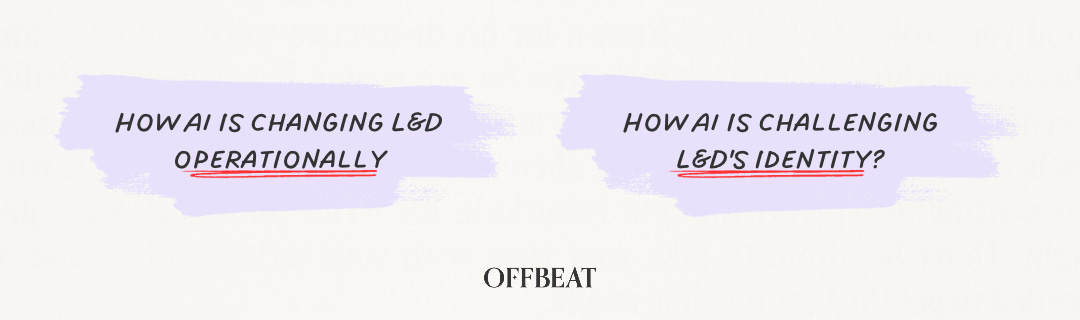
Operationally, adopting AI in L&D means mapping workflows, deciding which ones need a complete redesign, and which ones might need to be dropped entirely. It’s about the tools we’re buying or the chatbots and agents we’re creating. It’s about upskilling the L&D team in building and thinking with AI. It’s, in my view, the more transactional lens.
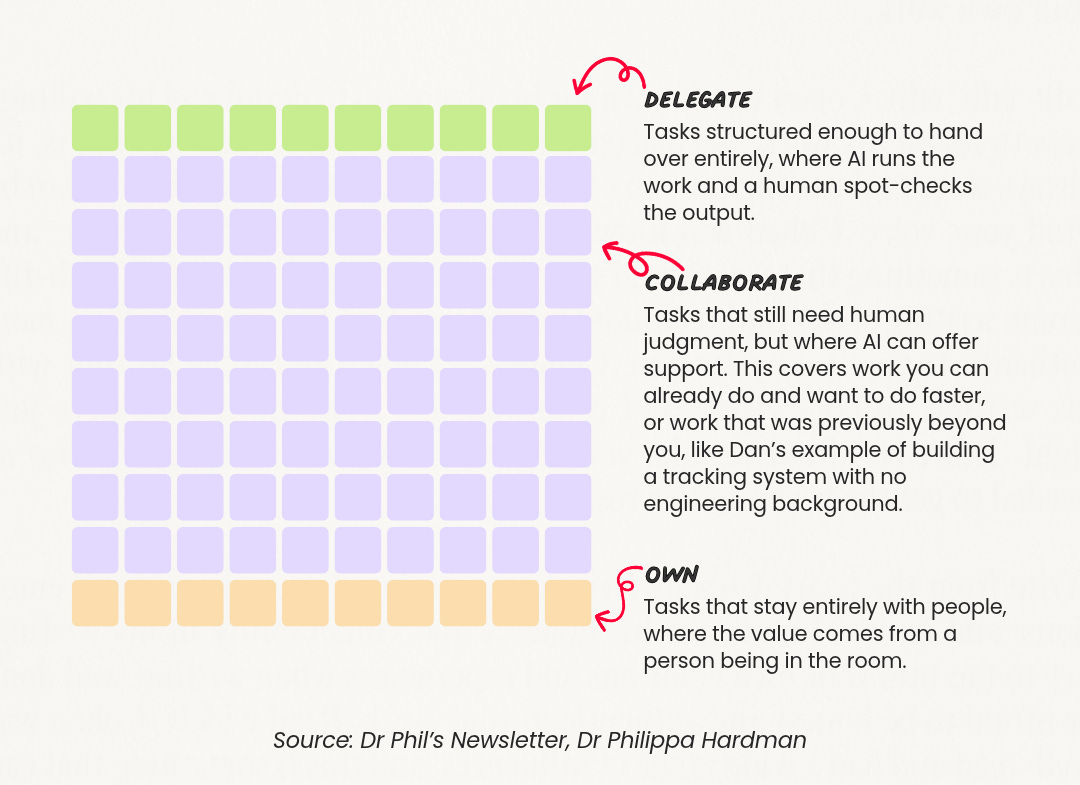
If you run such an exercise, I’d advise you to read the article Dr. Philippa Hardman wrote in May of 2026. It describes the questions an L&D team asked to decide where they would delegate, collaborate, or hand over work to AI.
The other lens, though, is more about identity. It’s about transformation. And it’s probably the most complicated part of AI adoption.
Psychologist Pauline Boss coined the term “ambiguous loss” to describe a grief without clear edges, like the families of soldiers missing in action, who couldn’t mourn and couldn’t move on. But since ChatGPT arrived in late 2022, I’ve seen a version of it every day at work. Nothing has been taken from us, and yet something has disappeared. In a world of human labor, expertise works like territory. Being the person who can do a particular thing marks out our territory, and professional identity depends on holding on to it. So when AI produces the same output we produce, it sometimes feels like it’s crossing an invisible line, chipping away at our professional identity.
If you’ve felt this in the past 3-4 years or you’ll feel it in the future, I just want you to know it’s normal. I’ve definitely felt it myself. The question is what your response will be. Compared to the operational process of adopting AI, the identity piece is a lot about rethinking why our function exists. It’s what we should be doing first, before even buying any tools or creating any agents.
A question you can ask yourself while rethinking your purpose is: Which L&D rules do you follow because they work, and which do you follow because everyone does?

Since we’re approaching the end of the year, I know many L&D teams will be going through some sort of identity exercise. Whether that’s rethinking your strategy, purpose, or values. I encourage you to keep a few hours in your process where you dream big and wide, and you incorporate such questions.
Once you do so, as Anamaria Dorgo explained in this article and in our book, go ahead and check whatever comes out of your exercise with your stakeholders. Don’t let them steer you too much in one direction or another, but make sure you make minor adjustments where you see fit. Remember you’re the expert, and if your exercise is grounded in what the organization will need from you and is backed by your due diligence, you should be confident that you’re on the right track.
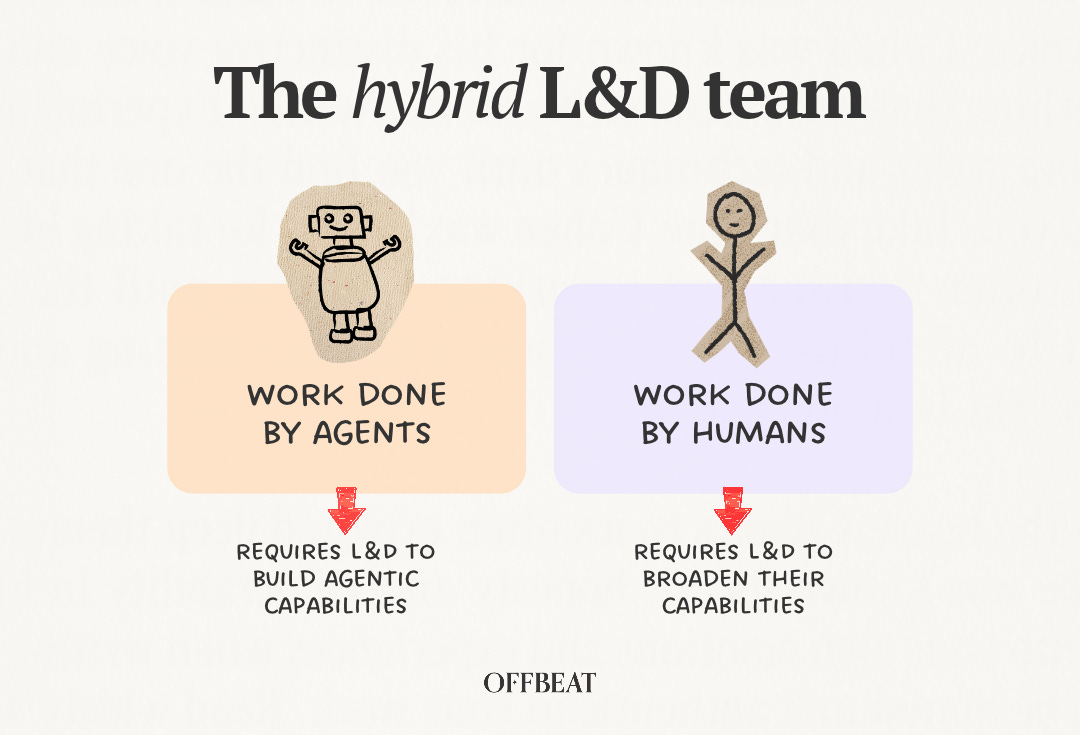
What might happen as a result of both exercises, the identity and the operational one, is the need to build what we call a hybrid team. A team where part of the work is done by agents, while the other part is done by us, humans. This means that your team needs both capabilities to build those agents, but also new capabilities to do new work AI unlocks.
There’s a story that’s been circulating on the internet about IKEA, the Swedish company. Whether it’s true or not, I’m not fully convinced, but it’s a good representation of what could happen in L&D, or other roles as well. When AI automated the work customer service agents were doing, IKEA thought of what other value they could bring to their customers, and realized interior design could be an opportunity. So they reskilled customer service agents to offer this service, a service that requires human touch to be delivered properly.
So what would be the equivalent of interior design in L&D? That’s part of what L&D Rewired explores. And starting this week, you can order it here.
We’re also hosting an online book launch on November 10. Join us here, and let’s discuss these questions together.

Until next time,
Lavinia
5 L&D Resources Worth Exploring
The Leadership Operating System Diagnostic. How you see your leadership and how others experience it might not be the same thing. This free diagnostic from Dr. Ian Hallett helps you explore that gap, alongside how you exercise judgement and respond under pressure. Built around five leadership domains and fifteen disciplines, it draws on three sources of evidence to give you a detailed picture of your strengths and development areas. If you’re looking for something more concrete than another leadership personality quiz, this could be worth exploring.
The Key to Creating Learning Projects You’ll Finish. Getting good enough at something is underrated. You don’t always need years of practice to make meaningful progress, but you do need a plan. Scott Young shares a three-step approach to designing short learning projects: map the skill and available resources, choose what to focus on (and what to leave out), and build a realistic plan around how you actually spend your time and energy. A useful reminder that successful learning projects start with good design, not just motivation.
Manager Cookbook. A curated selection of practical manager guidance from companies that publish how they lead. Explore expectations, hiring, everyday management, performance, feedback, self-care, and complete public handbooks.
Beyond Click-Next: When, How & Why to Build Learning Games with AI. AI can build a playable learning game in minutes, but getting something that looks like a game isn’t the same as creating an experience that develops skills. Philippa Hardman explores how L&D can use game design principles to create more active, experiential learning, with five practical examples ranging from cybersecurity simulations to decision-making challenges. The key takeaway? AI can do more of the building, but knowing how to design for learning is what makes the difference.
Why You Should Add Futures Thinking to Your Strategy Process. You don’t need a futurist on your team to get better at thinking about the future. Start by spending an hour a week looking for signals of change, not just in your own industry, but in adjacent fields and places you wouldn’t normally look. In this episode of Creative Confidence, IDEO’s Jennifer Lo explains how signal scanning, storytelling, and plausible future scenarios can help leaders challenge long-held assumptions and build more adaptable strategies. The goal isn’t to predict what’s coming. It’s to be better prepared for what might.
Meet L&D peers in your city
Live events all around the world, made to facilitate networking and exchange ideas that inform, inspire, and innovate the future of learning. Wanna bring Offbeat Sparks to your city? Click here.

Surprise of the week
Each week, Offbeat brings you a new random surprise. Sometimes it might be big - a challenge you can join to win something nice. And sometimes it might be small, like a video or a nice Instagram account. Curious? Hit open!