Hey there 👋 I’m Lavinia, and each Sunday I write about modern ways of running L&D. If you want to learn more: Offbeat Fellowship | Offbeat Sparks | Offbeat Fest. Here are my favorite L&D people to follow, a list of L&D books you might want to check out, and a list of L&D conferences all around the world.
As this year comes to a close, I’m getting excited about having some free time. And what does a bookworm do right before? Piling up books, of course. Whether the weeks I have off before 2027 will allow me to read all of them, that’s a whole different story. 😅
In any case, I wanted to share with you 4 books I added to my “to-read” list and 1 I didn’t, but you could.
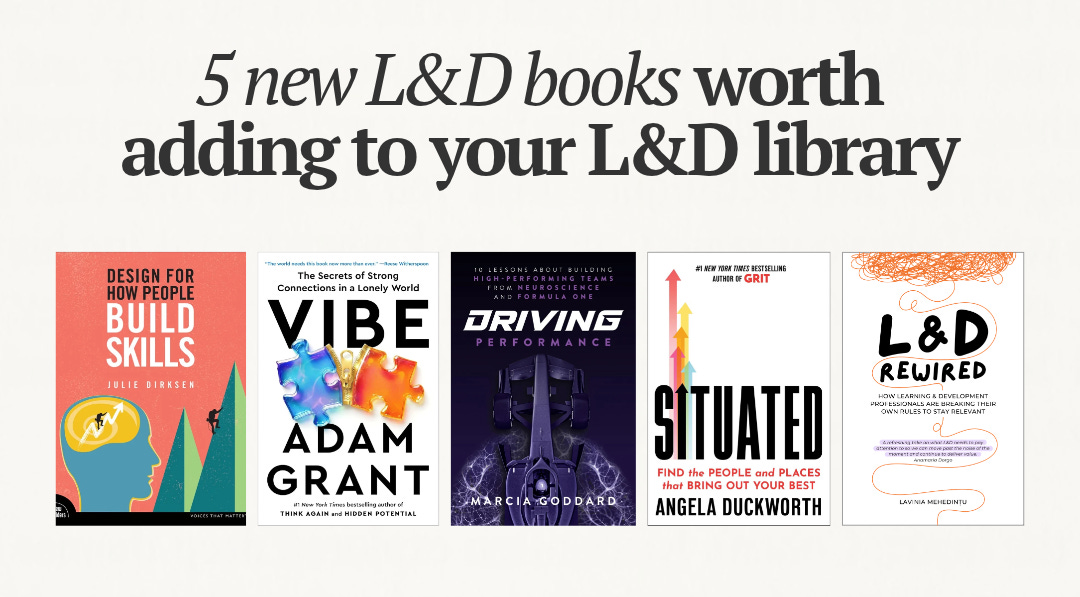
1/ Design for how people build skills by Julie Dirksen. Julie’s first book, Design for How People Learn, was my introduction to proper L&D, and I’ve been a fan ever since. If you haven’t read that one, I totally recommend it. In my opinion, it’s still a foundational read for every L&D. So is Julie’s second book, Talk to the Elephant. If the first one asks how people take in and remember information, the second one is more about why people who know what to do still don’t do it.
Now, as the title says, this third one seems to be more focused on skills, rather than knowledge or behavior. Given how hot the skills conversation is at the moment, this comes at the perfect time. Can’t wait to put my hands on it!
2/ Vibe: The Secrets of Strong Connections in a Lonely World by Adam Grant. Another author I’m a groupie of is Adam. From what I’ve read, Vibe seems to also come at a time when the world needs it most. It’s about how we can forge faster, stronger, and longer bonds, and similarity is not necessary for solidarity, chemistry doesn’t always happen quickly, and closeness doesn’t always take time.
I heard something interesting at an event this week. “Humans’ need for connection will never die. But it will for sure not be sustained on its own.” I’m paraphrasing here, but it did sound so true. This book seems to be exactly about this.
3/ Driving Performance: 10 Lessons About Building High-Performing Teams from Neuroscience and Formula One by Marcia Goddard. Now look, this is a very personal choice of mine. I’m a big Formula One fan and a big learning fan. This book is about both. How can I not buy it?!
One of the many things that drew me to this sport is how they optimize for performance. How the human and the machine work together to be number one out of 22. If you like fast cars as well, I think you’ll also love it!
4/ Situated: Find the People and Places That Bring Out Your Best by Angela Duckworth. I feel like the launch of this book was quiet in my world. For someone who really enjoyed Grit, Angela Duckworth’s other book, I was really excited to know it exists. If in Grit she talks about the inner workings of humans that make them successful, Situated seems to be more about the exterior. Can’t wait to look into it!
5/ L&D Rewired. How learning & development professionals are breaking their own rules to stay relevant by, well, me. I mentioned there’s one book I don’t have on my to-read list. That’s ‘cause I’ve read it probably 100 times by now, in all its forms. At this point, I know some parts by heart. I’ve dreamed of it many times. I loved it, disliked it, felt proud and ashamed of it at different times. And it hasn’t even come out yet. 😅
Next week, though, it will see the light of day. And I hope it will inspire and start new conversations. I’ve already learned so much from writing it, and I can’t wait for what I’ll learn when you read it. If the title isn’t a dead giveaway, L&D Rewired is about the different experiments L&D professionals are running to become more impactful in this very messy world we live in.
These are my 5 recommendations.
BUT!
If books are also your gem, we have a list full of other books you can explore, recommended by others. It’s right here. We’re looking to update it, so if you have a recommendation, please do share it in the comments! 💜
Quick Sponsor Break
This week’s newsletter is sponsored by our friends at Sana. Your organisation is full of valuable knowledge, but too much of it gets stuck in documents, decks, and people’s heads. By the time it makes its way into training, it may already be out of date.
Sana Learn helps turn the knowledge you already have into learning people can actually use. Its AI can build interactive courses in minutes, answer questions in plain language using your own sources, and cite where those answers come from. And when your knowledge changes, your learning can keep up. Less time turning knowledge into training. More time putting it to work. That’s Sana Learn.

5 L&D Resources Worth Exploring
3 days, 1 L&D team, and lots of post-its. Planning an L&D team offsite for 2027? Anamaria Dorgo shares a detailed, three-day workshop design that goes well beyond the usual team-building activities. The structure is simple: reflect on the year, make room for bold ideas before narrowing down next year’s priorities, and then look at team strengths and dynamics. I particularly like the emphasis on getting stakeholder feedback before committing to a strategy, and the many practical activities you can borrow and adapt for your own team.
Here, have some of my AI transformation mistakes (I’ve got plenty). “Everyone is a builder” sounds like an exciting vision for AI transformation, until it becomes another expectation that leaves people overwhelmed and managers struggling to provide direction. Stephanie Hubner shares what GetYourGuide learned the hard way: people need clarity about what AI means for their roles, managers need to guide teams toward meaningful outcomes, and organizations need ways to share solutions instead of reinventing them in silos. For those of us in L&D, there’s an important implication here: building AI skills is only part of the job. We also need to help managers rethink work and create the conditions for those skills to translate into impact.
How to use social learning to make leadership development stick. e invest a lot in leadership development, but how often do we know what actually changes once people return to work? Sotos Poulimenos argues that great content and engaging sessions aren’t enough to change leadership behavior. People need opportunities to experiment with what they’ve learned, reflect on what happened, and work through real challenges with their peers. This playbook offers a practical four-step approach, from identifying the behavior you want to change to gathering evidence that it actually changed.
The AI Tools that L&D Teams Are Building (Rather than Buying). For years, L&D has mostly bought its technology rather than built it. Now, generative AI is changing that equation. Dr. Philippa Hardman explores what happens when practitioners can build their own tools around their organization’s methods, standards, and evidence, rather than relying entirely on off-the-shelf solutions.
Leading Yourself (the part of leadership nobody can do for you). What did I learn? Where was I wrong? Did I say so? Ian Hallett offers three simple questions leaders can use to reflect on how they handled the week, especially when things got difficult. Behind them are three learnable disciplines: regulating your emotions under pressure, adapting based on experience, and being open enough to admit when you’re wrong. It’s a practical alternative to vague self-reflection, with a clear next step: identify your weakest area and practise one behaviour to improve it.
Meet L&D peers in your city
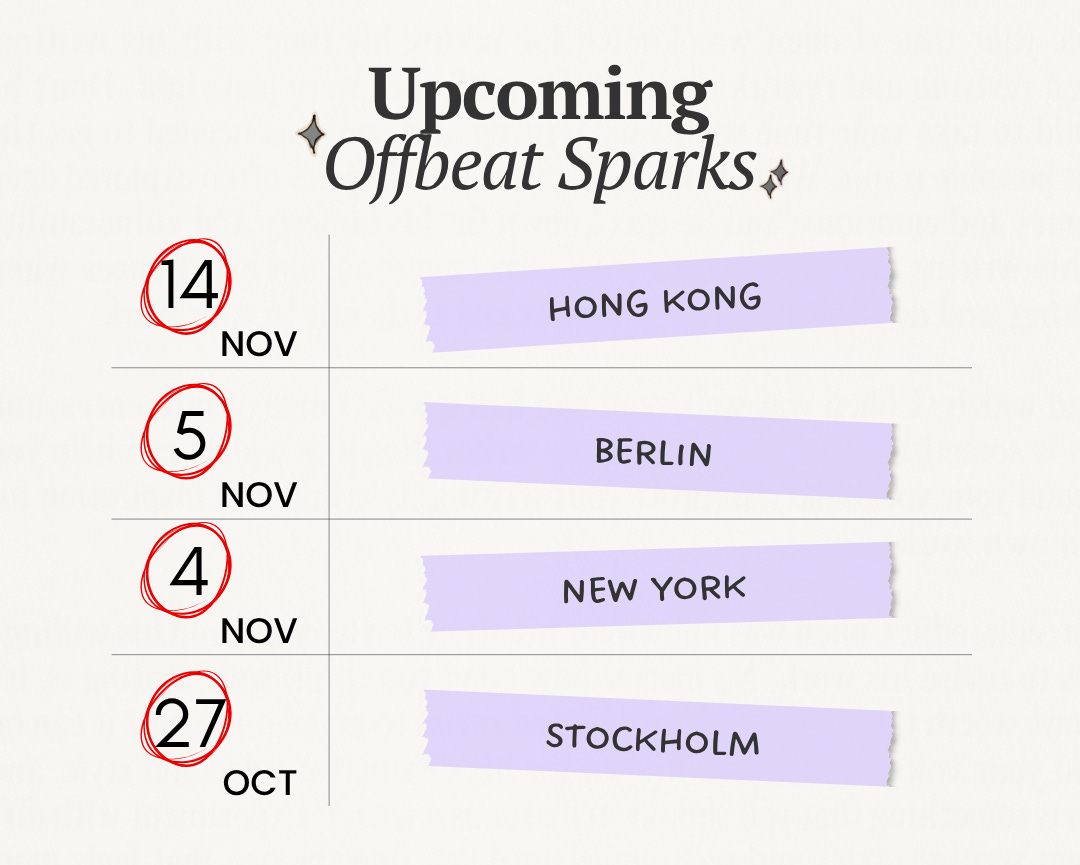
Live events all around the world, made to facilitate networking and exchange ideas that inform, inspire, and innovate the future of learning. Wanna bring Offbeat Sparks to your city? Click here.
The AI Find: What L&D roles ask for when they mention AI
Over the past few weeks, I’ve turned my LinkedIn profile into a job board. Every time I see an L&D role, I comment so it can reach anyone who follows me. This week, I had a question. How many of these jobs mention AI, and most importantly, how?
I selected 100 random jobs and used Claude to answer my questions.
I was pleasantly surprised to see that 47% of jobs mentioned AI in one way or another. I was expecting a lower number. Is 47% good or bad? Well, I couldn’t tell you. The only other way I could think of was to take jobs from other business functions and run the same analysis. To make the comparison as accurate as possible, I looked at the same industries and countries the L&D jobs were from.
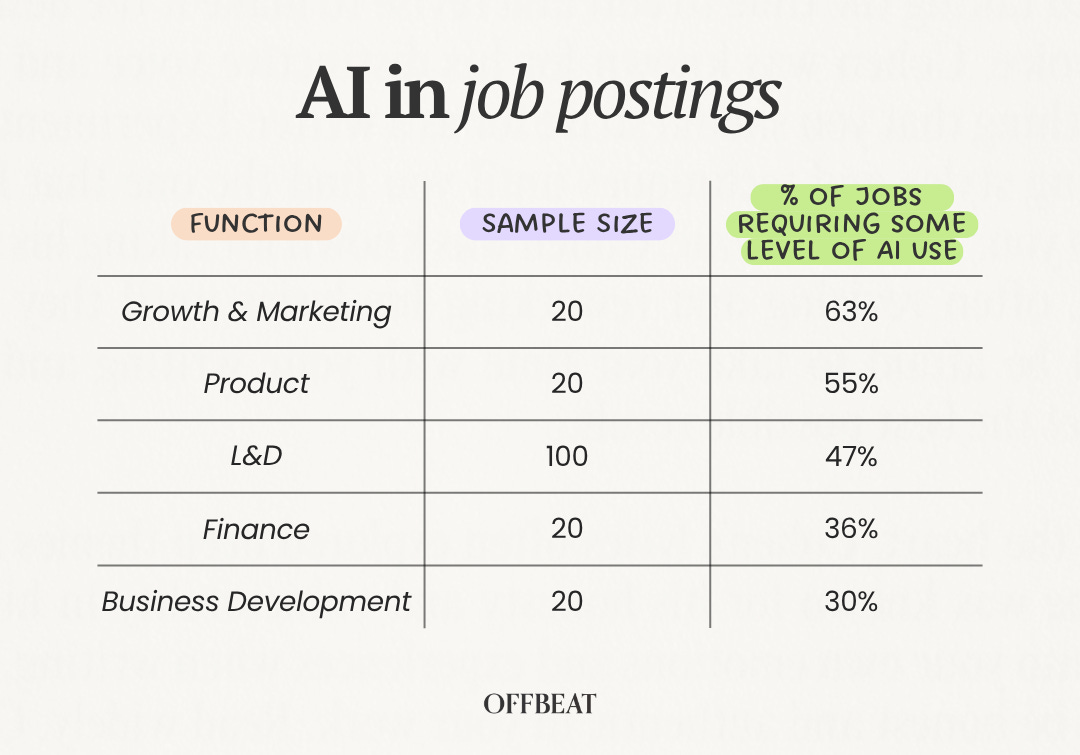
Interestingly enough, it looks like when it comes to requirements to use AI, we’re not necessarily behind other functions. What we’re asked to build, though, is relatively different. Product is required to build AI into whatever they ship. Growth & Finance are heavily asking for automation. And Business Development is asked mostly to stay in the loop with the AI conversation, but keep everything else human. The differences make sense, because they appeal to the nature of each role. So, how about what L&D is asked for when it comes to AI?
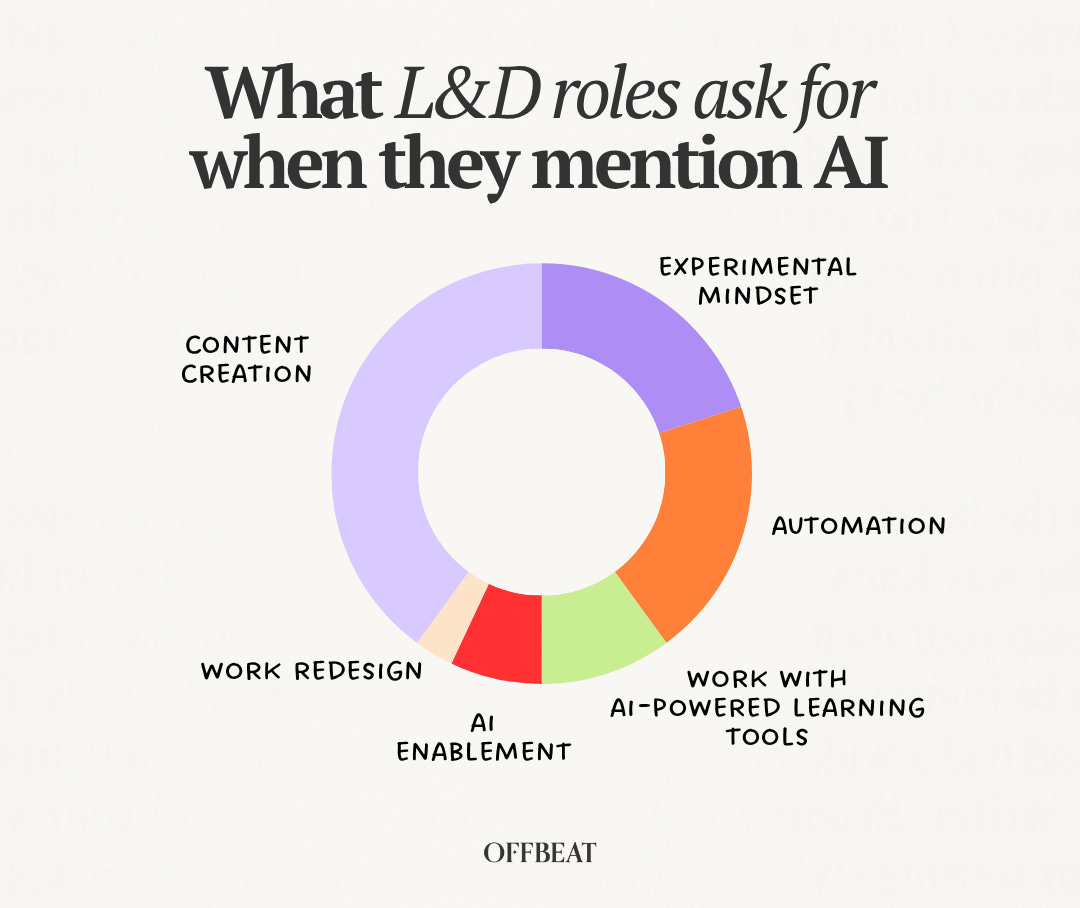
1/ Content creation. Most of the AI-mentioning postings ask L&D professionals to use AI to produce content faster: scripts, assessments, or videos. Many name the tools they expect you to know, most often Microsoft Copilot, ChatGPT, Claude and Gemini, followed by AI video and voice tools like Synthesia, HeyGen and ElevenLabs. Reading through them, the work seems to be mostly about speed. Only two postings mention being able to judge the quality of what AI produces, and a few more simply ask you to use the tools “responsibly.”
2/ Automation. A smaller group, about one in six of the AI-mentioning postings, goes further and asks L&D professionals to build things with AI, not just produce content. Most of these ask for prototyping learning experiences quickly. A couple go much further, wanting people who can build working tools and automate workflows with low-code platforms like Power Apps and Power Automate. Others apply it to the less visible parts of the job: automating admin and coordination, or keeping learning materials up to date.
3/ Experimental mindset. Quite a few of the job postings require generic fluency, but don’t mention specific tasks. This, paired with the fact that quite a few companies ask for an “experimental mindset,” tells me that we simply don’t know what L&D professionals will end up using AI for.
4/ AI-powered learning tools. Building learning where people interact with AI, like AI coaches, roleplay simulations, or custom chatbots, is also a fairly common task. But it’s thin. Most ask for “familiarity with” or a willingness to “experiment with” these tools, without saying what should be built or what it’s for. Only three employers spell it out. Employers seem to sense that AI-powered learning matters but haven’t decided what it should look like, so the job description asks for curiosity rather than skills.
5/ AI Enablement. Fewer than a third of the AI-mentioning postings ask L&D to support AI enablement for the rest of the organisation. Where they do, the asks range from running AI fluency programs and building prompt libraries to setting up AI champion networks and helping teams adopt new AI tools in their day-to-day work. Some go further, asking L&D to help people judge when to rely on AI and when human judgment still matters.
Several of these are dedicated AI-learning roles, like AI fluency consultants or AI upskilling designers, rather than general L&D jobs. Organisations seem to be hiring specialists for AI enablement instead of expecting it from their existing L&D teams.
6/ Work redesign. Fewer than one in ten of the AI-mentioning postings connect AI to how work itself is changing. Those that do ask for work redesign: figuring out which tasks AI should take over, how roles need to change, which new skills people will need, and how to build reskilling paths and career routes into those new roles. Almost all of these are organisation design or transformation roles, not core L&D jobs.
In the cases where AI does come up in a job listing, it’s rarely a wish-list item. Only two of the AI-mentioning postings list it purely as a preferred qualification. Everywhere else it’s a requirement, but often among twenty others.
AI has become a standard expectation, while at the same time, the rest of the job hasn’t changed much. This tells me that for now, we’re still piling AI on top of the current role, instead of rethinking the role itself.
Hope this helps in your job search or even generally, as you think about the future of L&D.
Surprise of the week
Each week, Offbeat brings you a new random surprise. Sometimes it might be big - a challenge you can join to win something nice. And sometimes it might be small, like a video or a nice Instagram account. Curious? Hit open!