Hey there 👋 I’m Lavinia, and each Sunday I write about modern ways of running L&D. If you want to learn more: Offbeat Fellowship | Offbeat Sparks | Offbeat Fest. Here are my favorite L&D people to follow, a list of L&D books you might want to check out, and a list of L&D conferences all around the world.
I don’t know why, but as soon as the end of the year comes, leadership development comes up more and more in conversations. L&D teams are thinking about next year’s strategies and are reflecting on what happened this year. This might be the most reasonable explanation. Now, if you’re in this “era” yourself, a few ideas came up in conversations I’ve had recently, and I’d like to share them with you.
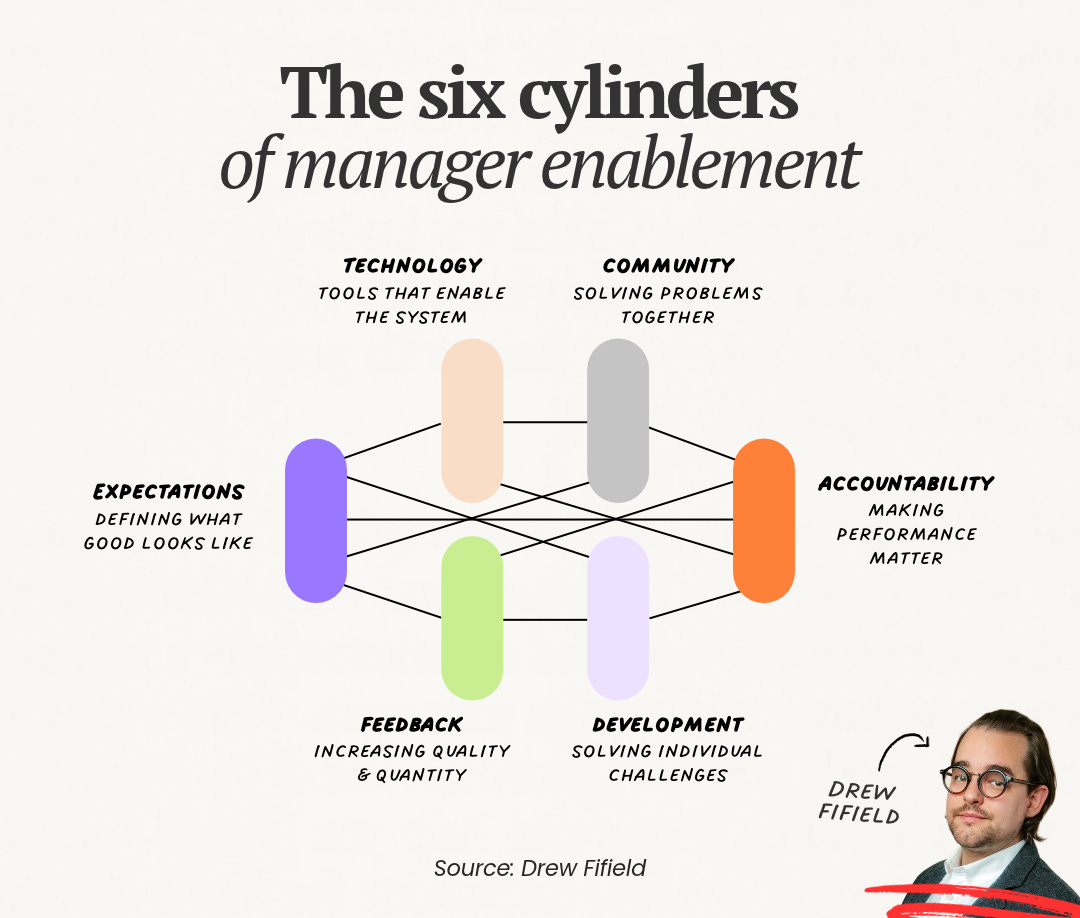
The first one is about the switch from development to enablement. I won’t go too deep into this, because it’s something we’ve covered extensively in the past. The point is that focusing simply on development for leaders doesn’t seem to be enough. There are other areas that you might need to focus on, such as creating clarity around the responsibilities of the role, making sure leaders get timely feedback, and supporting them in building their internal networks. If you’re curious to learn more, our research report from 2025 is right here and it’s filled with ideas, and Drew Fifield wrote a fantastic article about the topic here
.
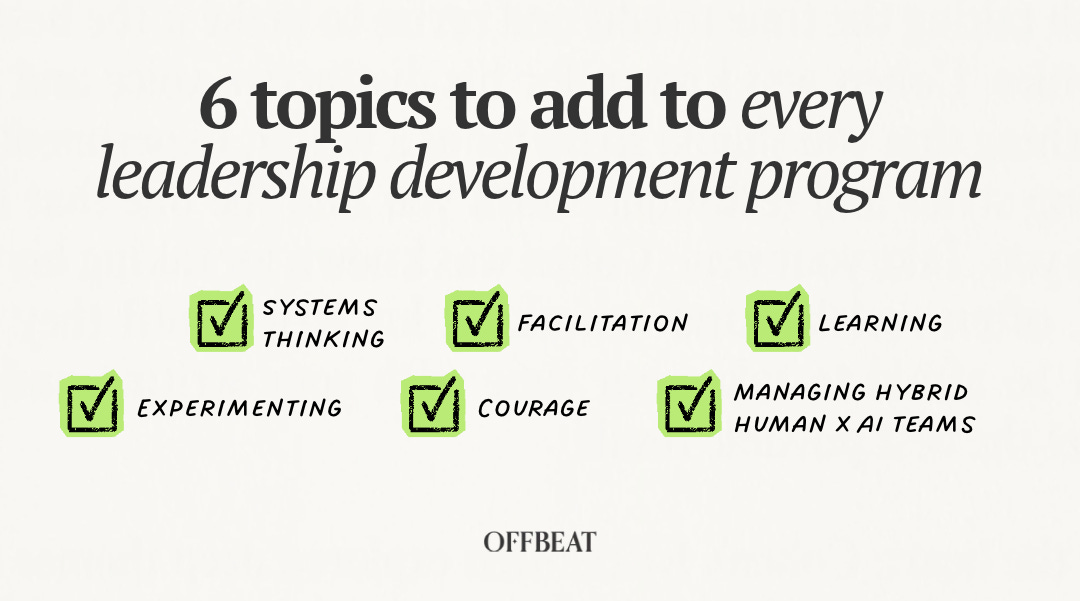
The other side of the development coin is what skills will the leaders of the future need. While leadership development programs are already quite fantastic in terms of what they’re covering, I’d like to propose 6 new topics worth considering.
1/ Systems thinking. I have to admit, this is probably my favorite topic. Maybe because I’ve seen what the lack of systemic thinking can do to an organization too many times. It’s also something that comes up more often in conversations. This matters more now because very little work stays inside one team. Over the past two decades, the time people spend collaborating has grown dramatically, which means every decision touches more people than it used to. Add AI to that mix and the ripple effects multiply. Leaders who only see their own part will keep being surprised by consequences they could have seen coming.
2/ Facilitation. It might sound odd to think of facilitation as something a leader would do, but I’d argue they’re already doing it. Whether they know that what they’re doing is facilitation, and how proficient they are is another story. IAF describes facilitation as helping a group think together, explore options, and make decisions. Leaders with or without teams find themselves in these situations all the time. Democratizing facilitation can help organizations have more meaty conversations, aligning faster, and having more clarity around the decisions that are being made.
3/ Learning. I have to admit, I didn’t know how else I could call this. But let me explain what I mean by learning, because I’m thinking about two things. One one end, you have individual learning. This is about how people acquire knowledge, build skills, and change their behaviors. If you ask me, this is something that we should’ve all been taught earlier in life, but if it didn’t happen, it’s never too late!
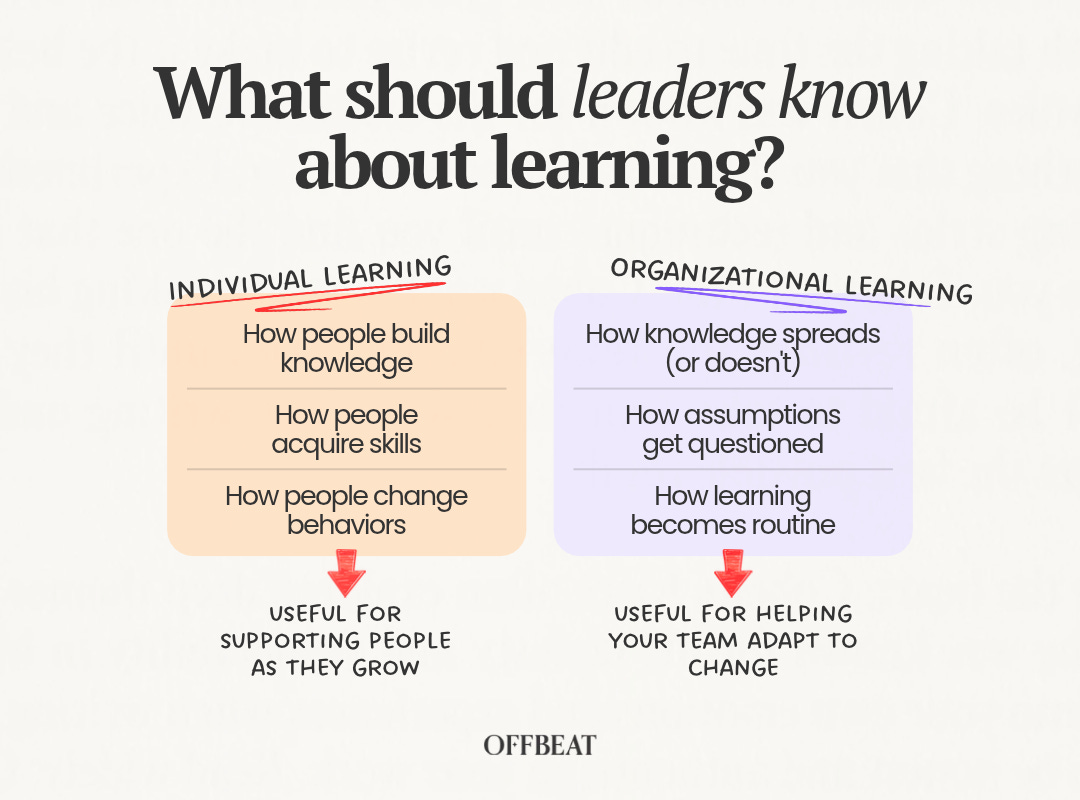
The other end is about how systems and organizations learn. This might overlap a bit with systemic thinking as well, because it requires leaders to understand how to think bigger than themselves, their team, and sometimes even their organization. If individual learning is something leaders should understand so they can develop people, organizational learning is more about how their team, regardless of size, can adapt. The reason we need this is to avoid something like what happened with AI adoption. Maybe if more leaders would’ve been more aware of the fact that it’s not enough to give people “time” and “tools” to adopt AI, adoption would’ve happened faster and more intentionally.
4/ Experimenting. This also goes hand in hand with learning. Experimentation has been locked into product, technology, and growth teams up until a few years ago. Today, that’s no longer the case. What I’ve come to learn is that there’s a big difference between good experimentation and chaotic experimentation. Chaotic experimentation shows up in organizations when leaders try ten new things at once, without a clear reason why, and kill tests without much evidence either way.
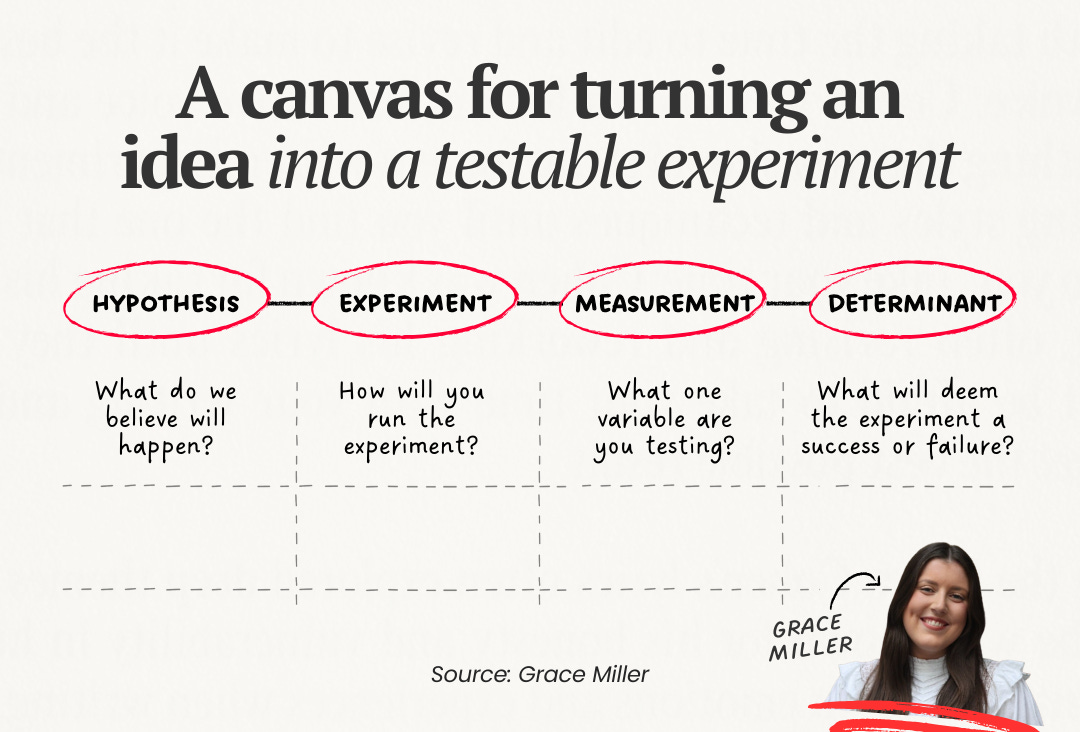
Good experimentation is more about thinking like a scientist. At an event I attended in November of 2025, Grace Miller, former Head of Failure and Experimentation for Steven Bartlett and the famous podcast The Diary of a CEO, spoke about her experimentation process. It involves a clear hypothesis, a focused test, meaningful signals, and a determinant. A hypothesis is what you believe will happen by doing something. The test is the actual experiment. Meaningful signals are the KPIs you’re measuring. A determinant is your definition of success or failure.
I think this is an example of what a good experimentation process looks like, and since the world is in continuous change, more leaders will need to learn how to do this properly.
5/ Courage. I can’t think of many examples in the day-to-day work of a leader where courage is NOT required. Speaking up, sharing feedback, stopping an experiment, making tough decisions all demand leaders to step out of their comfort zone. Roi-Ben Yehuda, CEO of NextArrow, talks about courage as the product of three things: a sense that you have the power to act, a reason you care deeply about, and an obstacle that feels manageable. I liked this definition because it makes courage something you can actively work on.
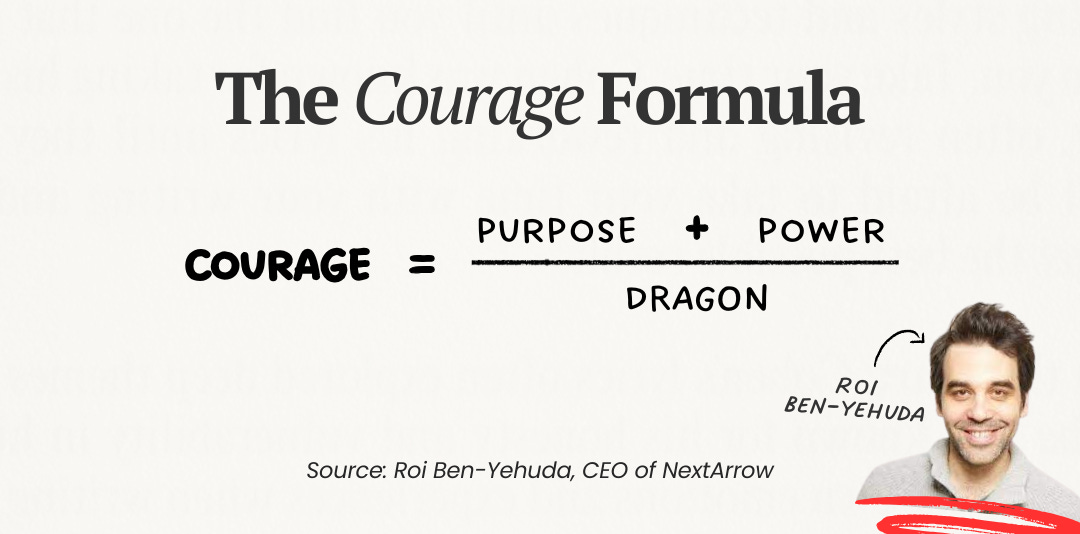
If we want leaders to pursue and support change, courage should be non-negotiable.
6/ Managing hybrid human x AI teams. Finally, one topic I feel it’s going to be prioritized massively in upcoming years is managing teams that are part machines, part humans. If this sounds easy, it’s maybe because we haven’t considered the complexity of the responsibility, the effect on people, and how intentionally such a team should be built in order for performance to follow.
Whether leadership development programs should just be available to leaders is another discussion. If you ask me, all the topics above should be transparently discussed with the entire organization. But if that’s not something you can do at the moment, it should be enough to at least bring them up more consistently with leaders.
Quick Sponsor Break
This issue is sponsored by our friends at Guideless. Guideless turns any software workflow into a narrated video guide and a step-by-step doc. You do the task once, and AI writes the steps and adds voiceover, captions, and your branding in 42+ languages. When the software changes, you update only that step. Share by link, embed it, or export to MP4 or PDF.

4 L&D Resources Worth Exploring
The Untold Story of Bloom’s Taxonomy and the Pyramid That Never Was. Most of us in L&D have learned about Bloom’s Taxonomy early in our careers. Yet, what fewer of us knew (myself included) is that Bloom never intended for it to be a hierarchy, and that the idea that knowledge as the “lowest” level, was added by others. This article traces where the pyramid came from and argues that Bloom’s real contribution was mastery learning: don’t move people on until they have the prerequisites.
The Three Dimensions of Leadership for the AI Era. It’s honestly mind boggling that it took us 4 years to get to the conclusions of this article. It describes how AI-ready leaders switch between three roles: the Visionary, the Codeveloper, and the Steward. Each role has its strengths that can be useful depending on the stage your organization is in when adopting AI. So the practical advice is to assess where you are, where your leaders are, and support them in adjusting their behaviors depending on what the organization needs.
How to Read an Organization. I really love this series. It has 4 articles (so far) all trying to make systemic thinking something we can practice within our organization. Each article focuses on one specific area: the work, the story, the system, and power is next in line. The idea behind the series is that reading an organization is a learnable skill. You’ll never see the whole system, but you can get better at making sense of your partial view. I totally recommend you read each piece.
How To Future-Proof Your Career In The Age Of AI. This article talks about the judgment economy, where decision quality matters more than output volume, and credentials shift toward track records of good decisions. When AI is pushing the cost of production to zero in some cases (something we’ve spoken about in this newsletter in the past), what becomes valuable is judgment in messy contexts, persuasion, negotiation, trust-building, and connecting ideas across domains. Definitely worth reading for ourselves and sharing with others!
Meet L&D peers in your city
Live events all around the world, made to facilitate networking and exchange ideas that inform, inspire, and innovate the future of learning. Wanna bring Offbeat Sparks to your city? Click here.

The AI Find: Building the human x agent L&D team
In the span of a month, I spoke to two L&D managers who are already building teams where humans x AI agents work side by side. I don’t think they’ll be the only ones for long. Over the next few years, I expect we’ll hear a lot more about human x agent L&D teams.
By a human x AI L&D team, I mean a team where AI agents take on whole parts of the work, like running a step in needs analysis or managing enrolments, rather than just helping people do it faster. What defines it isn’t the tools but how the work is divided. Some tasks are owned by agents, some are shared, and some stay human on purpose. And someone on the team decides which is which.
So the question I kept asking myself after those conversations was: how do you get from “I want to do this” to “I’m working on it”? Here’s what I think it takes.
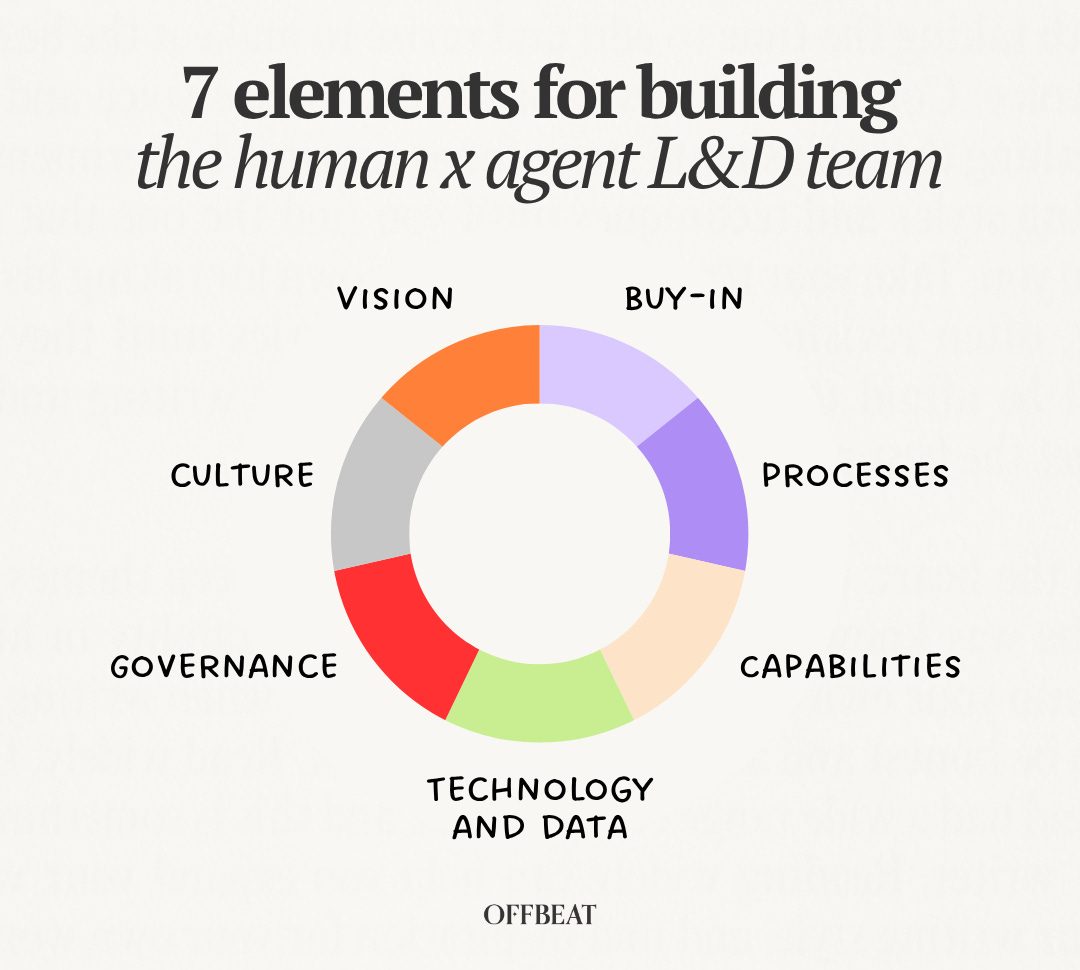
1/ Vision. McKinsey calls this the business model, and I think it translates well to L&D. Before we build anything, we need to rethink what L&D is for. Otherwise, we’ll end up doing the same things that aren’t working, just faster. The AI in L&D report shows this happening even years after we started playing around with AI. Content development keeps growing as the top use of AI, and “create content faster” is still the benefit people expect most. I think this bit is the hardest, mostly because there’s a lot of uncertainty about the future and deciding what L&D is for isn’t easy and takes a lot of courage.
2/ Buy-in. If a VP of People, HR Business Partners, or other stakeholders don’t buy into the new vision or into the idea of adopting AI and building agents, realizing the vision will be really hard. A new vision for L&D most likely requires crossing over lines that were drawn years or even decades ago, so the people around our function might feel anything from threatened, dismissive, scared, or will be downright ready to block any such initiative.
3/ Processes. McKinsey did a review of more than 50 agents, and what they discovered is that value comes from changing workflows, not just building agents for current processes. That’s why I think this should be done in parallel with creating the vision. I’ve spoken in the past about this, and this guide from LeaderFactor shows some of the questions you should be asking, such as “What are the tasks we’re doing?”, “Which of them require information processing, pattern recognition, and output generation?”, “Which of them require assigning value, exercising judgment, and bearing responsibility?”, “Which tasks can be truly agentic?”, “Which ones require humans?”
4/ Capabilities. I think there are two sides to this. On one hand, you need people who know how to build agents, and just as importantly, orchestrate them. On the other hand, there are the new capabilities people will need, because they’ll end up doing different things. Our book, L&D Rewired, coming out on October 27th, is very much focused on the second.
5/ Technology and data. In the past few years, somehow, technology stopped being the biggest problem. Access to tools is probably easier than ever, and integration between them is also becoming easier. The data part, though, is not as simple to solve in my experience. Outdated documents, inconsistent records, and tacit knowledge can be big blockers in the process of creating and improving an agent’s output.
6/ Governance. This is the part I think most L&D teams will underestimate. Every agent needs a named owner who keeps it working and answers for its output. Human involvement should be decided per task, ideally right on your process map, and so should a short list of things agents must never do, like sharing someone’s learning data with their manager or using documents that haven’t been approved. Someone also needs time to review what agents produce. McKinsey warns that agent adoption will be capped by how much oversight capacity humans have. L&D teams will need to work closer with legal to ensure security, and plan a regular keep-or-kill rhythm so they don’t end up maintaining agents nobody uses.
7/ Finally, culture. For all of this to work… For L&Ds to be courageous about their visions. For them to push using AI beyond already traditional use cases. For new capabilities to make their way into the team… L&D teams will need the right culture. A culture of learning and experimentation, where people are valued, and where adopting AI feels safe because your job is not at risk.
It will probably take 2-3 years for us to see more examples of learning managers pushing the boundaries, but I really think it will happen. It’s not a matter of if, but a matter of when and how. I don’t expect anyone who jumps in on this journey to have it easy. There’s no playbook for doing it, and everything keeps on changing. But I think if it’s done well, the work can become really exciting and meaningful.
If you’re interested in this, I’d love to hear from you!
Surprise of the week
Each week, Offbeat brings you a new random surprise. Sometimes it might be big - a challenge you can join to win something nice. And sometimes it might be small, like a video or a nice Instagram account. Curious? Hit open!