Hey there 👋 I’m Lavinia, and each Sunday I write about modern ways of running L&D. If you want to learn more: Offbeat Fellowship | Offbeat Sparks | Offbeat Fest. Here are my favorite L&D people to follow, a list of L&D books you might want to check out, and a list of L&D conferences all around the world.
I’ve been in L&D long enough to know that learning is a very loaded word.
We all want to learn, and because we’re in L&D, we also want others to learn. What that really means isn’t always as well defined as it should be. We often fall back on behaviors that are easy to measure, like “attending training” or “completing an e-learning”. But we also know that oftentimes people do both, they consume information, without ending up truly learning.
Peter Senge, best known for his book The Fifth Discipline: The Art and Practice of the Learning Organization, describes a learning organization as “an organization where people expand their capacity to create the results they truly desire, where new and expansive patterns of thinking are nurtured, where collective aspiration is set free, and where people are continually learning how to learn together.”
Nothing in this definition suggests that what matters is people attending training sessions or logging into your latest LXP every day. What Senge describes is an organization where people, their thinking, and their ways of working together continuously shape each other.
A lot has been written about the behaviors we should be seeing in a learning culture. Victoria Marsick and Karen Watkins, two of the most influential scholars in adult and workplace learning, have written a lot about informal and incidental learning. Amy Edmondson extensively explored psychological safety and team learning. And Jean Lave and Etienne Wenger preach on the importance of knowledge sharing through communities of practice.
Their work might help us have a clearer understanding of what learning behaviors truly matter in an organization. I’ve made a list, but I’d love for you to complete it, because I’m pretty sure I might be missing something. Here it goes:
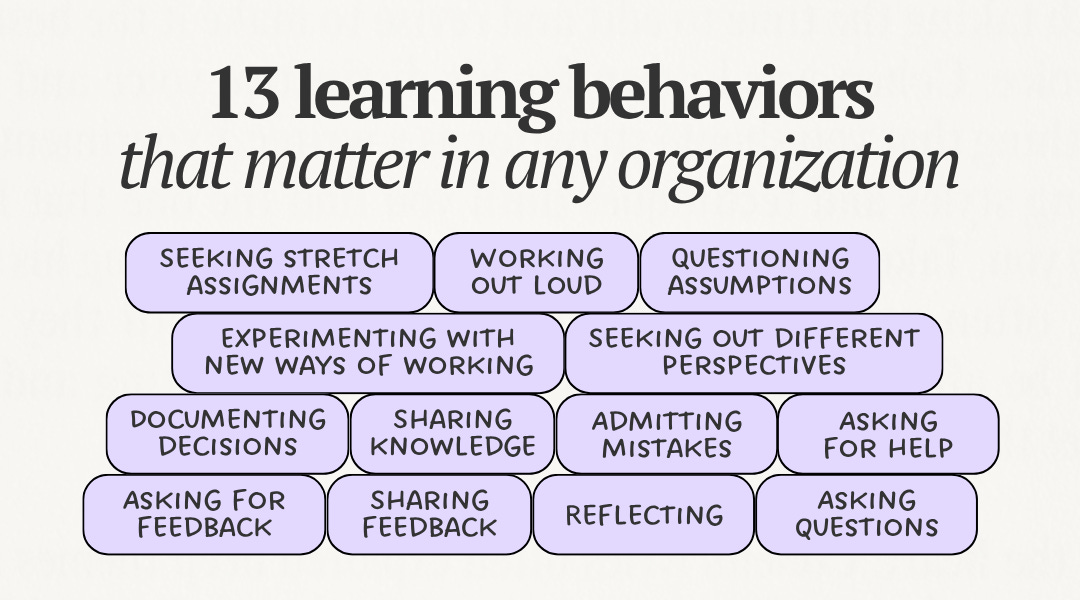
– Sharing feedback
– Asking for feedback
– Reflecting
– Asking questions
– Documenting decisions
– Sharing knowledge
– Admitting mistakes
– Experimenting with new ways of working
– Seeking out different perspectives
– Seeking stretch assignments
– Working out loud
– Questioning assumptions
– Asking for help
These are the ones I could come up with that cover some ground. Comment away with your own thoughts.
Now, there are a few reasons I think it’s important to be clear about what we mean by learning or learning culture. We talk a lot about the idea that L&D’s role in the future should be supporting the conditions for learning to happen. That’s quite a departure from creating content. Being clear about these behaviors can:
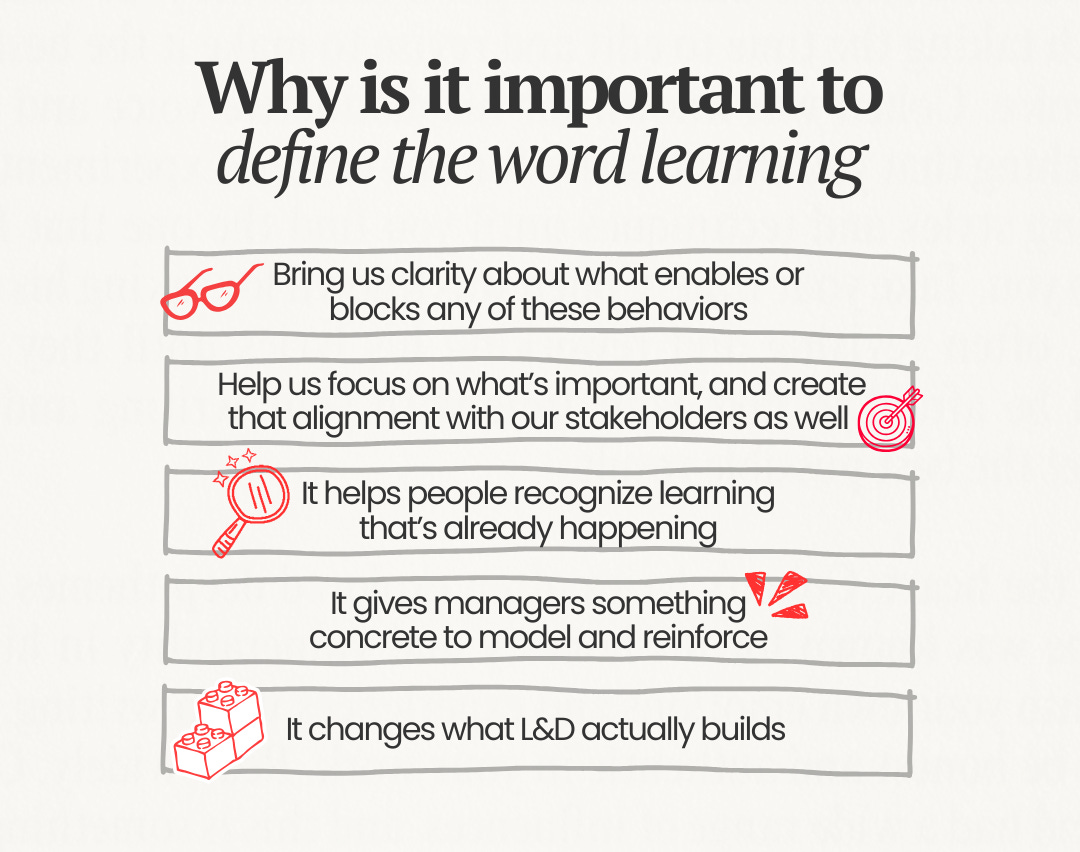
1/ Bring us clarity about what enables or blocks any of these behaviors.
2/ Help us focus on what’s important and create that alignment with our stakeholders as well.
3/ It helps people recognize learning that’s already happening.
4/ It gives managers something concrete to model and reinforce.
5/ It changes what L&D actually builds.
These seem to me pretty good reasons to build more clarity around the very broad word we use daily: learning.
Quick Sponsor Break
This issue is sponsored by our friends at Manageable. Managers need skills to drive team performance. But training ends, and what they learned fades. Manageable+ equips managers with the leadership skills that boost team performance. You have the option to pick from our pre-built topic catalogue, add custom topics, and implement unique journeys for your organizational context. Reach out to find out more.
4 L&D Resources Worth Exploring
Resilience, Mental Health, Growth Mindset, and Well-being: How They Differ—and How They Interconnect. We live in an age where the language of human flourishing is everywhere. Leaders speak of resilience, governments report on mental health, educators encourage a growth mindset, and public policy now tracks well-being. These concepts overlap but are not identical. Understanding their distinctions—and how they connect—matters, because clarity guides action.
AI is changing work. Now it has to change the organization. The companies that capture the most value from AI will not necessarily be those that deploy the most agents or automate the greatest number of tasks. They will be the ones that use AI to rethink how value is created, then make the organizational choices required to deliver it, from how work and talent are organized to how transformation is led and built. The larger opportunity is not simply to make today’s organization work better, but to build an organization capable of doing what was previously out of reach.
5 Ways to Lead When You Don’t Have the Answer. Oftentimes, being in a leadership position might come with the pressure of having all the answers. The reality today is much harder to navigate, because so many times that clarity isn’t there from the start. Instead of faking certainty, advise your leaders to follow these 5 ideas: Test reality. Admit the unknown. Clarify decision rights. Give people something to work toward. Make the call.
Designing Employee Onboarding in the AI Era. In this video, the Notion’s People team shares how they redesigned the entire employee journey, from a candidate’s first interaction with a recruiter through their first 90 days at Notion.
Meet L&D peers in your city
Live events all around the world, made to facilitate networking and exchange ideas that inform, inspire, and innovate the future of learning. Wanna bring Offbeat Sparks to your city? Click here.

The AI Find: AI in L&D report – the good and the bad news
This week, Eglė Vinauskaitė and Donald H Taylor dropped their yearly AI in L&D report. I’d like to share what I consider to be good and bad news and why.
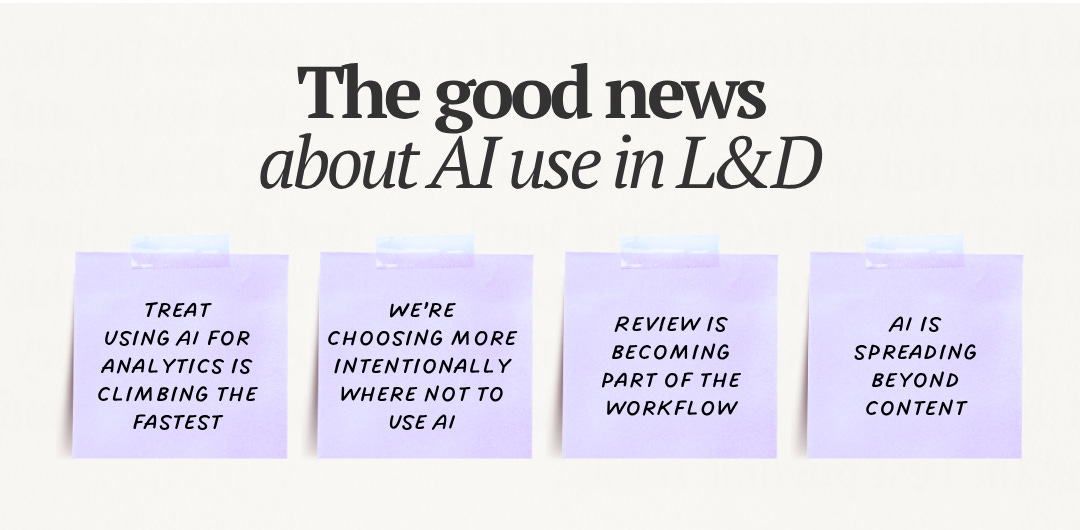
The good news about AI use in L&D
Using AI for analytics is climbing the fastest. In 2023, 7.8% of respondents used AI for evaluation and analytics. This year it’s 34.1%, up from eighth to third place. Making decisions with data is now the second most expected benefit of AI, after faster content.
I’m not sure what data we’re analysing yet. If it’s still attendance, completion, and NPS, we’re just getting faster at the usual numbers. But the habit matters. Once we’re used to questioning our data, connecting learning tools to the rest of the business is the next step, and that’s where the interesting data lives. It won’t be easy, because the same report says that tool integration is the barrier that has grown most.
We’re choosing more intentionally where not to use AI. While only 1.7% of respondents describe deliberately not using AI, or limiting it, on principle, I hope this is a trend that will only grow. It’s not that I’d like people to reject AI, I think it simply shows more critical thinking and more deliberate choices in our work.
The case studies in the report tell the stories of Suzanna Horsfall who’s team removed AI activities from a programme after realising the learning was in the struggle, and AI was taking it away, and Remco van den Hout’s team won’t use AI to make more courses, because “more content does not solve a transfer problem.”
Review is becoming part of the workflow. Using AI to review and quality-check content has grown sharply, according to the report. This is on one end good news because it shows, again, more critical thinking in our AI use. On the other hand, though, one person mentioned in the report that all the time they saved using AI is now going into reviewing AI’s output. It makes me wonder if this is what working smarter looks like, and how things will evolve.
AI is spreading beyond content. In 2023, the average respondent described AI use in 2.1 categories. This year it’s 2.7. The growth has come around the core of our work, like needs analysis, analytics, automation and building internal tools. While the growth happened most in 2025 and stayed steady in 2026, I want to see it as good news that we’re experimenting with AI beyond its most obvious use.
The bad news about AI use in L&D
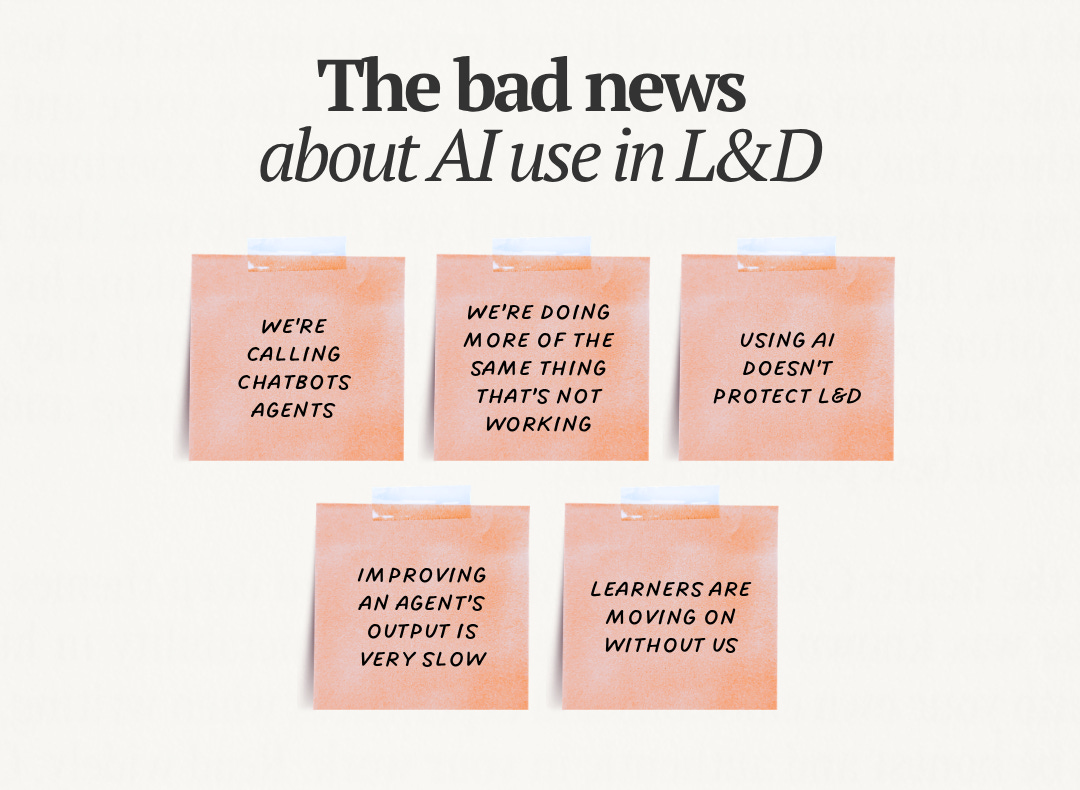
We’re calling chatbots agents. This year, 41 respondents mentioned AI agents. But many use “agent” and “chatbot” interchangeably, and most describe something closer to a custom GPT than software that plans and carries out tasks on its own. Only a handful describe agents linked into real multi-step workflows.
That suggests we don’t yet share a clear idea of what an agent is. Vendors calling everything an agent doesn’t help. But if we can’t name what we’re building, it’s hard to judge what it can do, or explain it to the business.
We’re doing more of the same thing that’s not working. Content development has been the top use of AI every year since 2023, and it’s grown: from 69.5% of respondents to 77.6%. “Create learning content faster” is still the benefit people expect most.
We’re doing what we’ve always done, just faster. Meanwhile, the uses that would change L&D’s role – AI drawing on data, systems and relationships beyond our own team – are barely more common than four years ago. More AI hasn’t changed us. It’s mostly sped up the old job.
Using AI doesn’t protect L&D. Two respondents describe losing their roles to AI. One lost their job after running an AI training programme. Another’s whole Training Specialist role was eliminated: “We trained the field how to use them, then they discarded us.” Across the survey, 3% say L&D no longer exists as a central function in their organisation, and 10% of commenters fear for L&D’s future. While this isn’t a strong trend, I don’t see this as good news, especially since it’s really hard to reinvent L&D in organizations that simply refuse to see our work differently.
Improving an agents’ output is very slow. Jinani Muhammad built an AI agent at the International Aviation Technical College in Riyadh. Getting its output from 60% to 90% quality was “excruciating,” he says, and it still makes regular mistakes. A UK team reports its agents are easy to build but hard to get adopted. Building agents takes patience, and in my experience, stakeholders rarely give L&D much of it. If the first version disappoints, we may not get a second.
Learners are moving on without us. A few respondents say learners now learn directly through AI chatbots. Zoe Qiu admits she has less patience for webinars herself, and says “our learners are no longer interested in our content.” Meanwhile, L&D’s own learner-facing AI is shrinking: it peaked at 27.6% of respondents in 2025 and fell to 16.6% this year, the lowest in four years.
Learners are turning to AI while we turn our AI inward. If we keep offering more of what’s losing their interest, we risk becoming the option people skip.
I hope you find this interesting enough to explore the whole report yourself. It’s definitely interesting and poses some important questions for the future of L&D!
Surprise of the week
Each week, Offbeat brings you a new random surprise. Sometimes it might be big - a challenge you can join to win something nice. And sometimes it might be small, like a video or a nice Instagram account. Curious? Hit open!