


Hey there 👋 I’m Lavinia, and each Sunday I write about modern ways of running L&D. If you want to learn more: Offbeat Fellowship | Offbeat Sparks | Offbeat Fest. Here are my favorite L&D people to follow, a list of L&D books you might want to check out, and a list of L&D conferences all around the world.
This week, we had Ashley Hinchcliffe, Founder of MAAS Marketing, as a guest for an Offbeat Fellowship session. We thought her insights were definitely worth spreading wider, so I’ll leave you with Ashley in the next few paragraphs. Enjoy!
Over seven years of running MAAS Marketing, I’ve spent over 250 hours on video calls and in rooms with employees, asking them one question: “When you want to learn something new, what do you actually do?”
Not once, across dozens of global organisations, has an internal learning platform come out on top. Not once. Unsurprisingly, Google wins the race, closely followed by their colleagues, then YouTube, and more lately, ChatGPT et al. With one client, I coded every single answer: Google took 21%, asking a mate took 16%, and the flagship learning platform, the one with the six-figure budget and the big internal launch, limped in third at 7%.
I’d love to tell you that 7% was an outlier. It isn’t.
There’s a thread running through all of this research, and it’s taken me a few hundred hours to see it properly. L&D has spent two decades getting very good at creating learning supply. Platforms, libraries, pathways, curricula, the lot. And we have spent almost no time at all on generating demand, because somewhere along the line we decided that if the learning was good enough, people would come and find it.

They don’t.
Demand isn’t a thing that happens to you once the build is finished. Demand is created by you, on purpose, or it doesn’t exist.
Three common threads in my research tell me it doesn’t currently exist. And now I am telling you.
They can’t find what’s for them.
Three separate organisations, on three different continents, have described their own learning offer to me as an ocean. Nobody prompted that word, and it’s never once been meant as a compliment. One woman put it best:
“It feels like an ocean of information and training, but you still gotta learn to swim.”
Another told me how grateful she was for her company’s library, then admitted in the same breath that she doesn’t open it. A third said she’d never check more than two platforms before giving up.
Two. That’s the entire search budget you get, and most of us are busy building a third. Meanwhile, the thing they do find is frequently built for somebody else, or is so universal and generic that it doesn’t have any relevance to their role anyway.
So they stopped looking.
Searching has a price, and two dead ends is all it takes before somebody writes the whole thing off for good. My favourite answer in 250 hours came from when I asked a guy where he’d go to learn something new: he gave the name of his own company’s learning platform, with the words “definitely not” in front of it. I imagined a puking emoji 🤮, and I’m sure he did too.
Others take it even further and spend their own money on it.
“I spend my personal money because I need something they don’t offer.”
That’s a person buying a course out of their own pocket while a perfectly decent ocean-library sits there, paid for and untouched.
And so, they stopped caring.
I once ran an NPS calculation on a client’s training offer, and it came out at +3. Not a typo. Nobody was angry, nobody was mounting a campaign against the L&D team, and 53% sat squarely in the middle, going “meh, it’s fine I suppose”. Inert, the lot of them. At least you can do something with anger, because anger means somebody cares enough to have formed an opinion, whereas indifference means you’ve quietly become office furniture.
Which brings us back to that assumption of ours, that if it’s good enough, people will find it. You know, á la Kevin Costner and the field, and the promise that if you build it, they will come. They don’t. They never did. The whole industry has been standing in a cornfield for twenty years waiting for those baseball phantoms to appear.
The silence is deafening. And I’m sure we’re all getting tired of the tumbleweeds and the dust.

So what do you actually do about it?
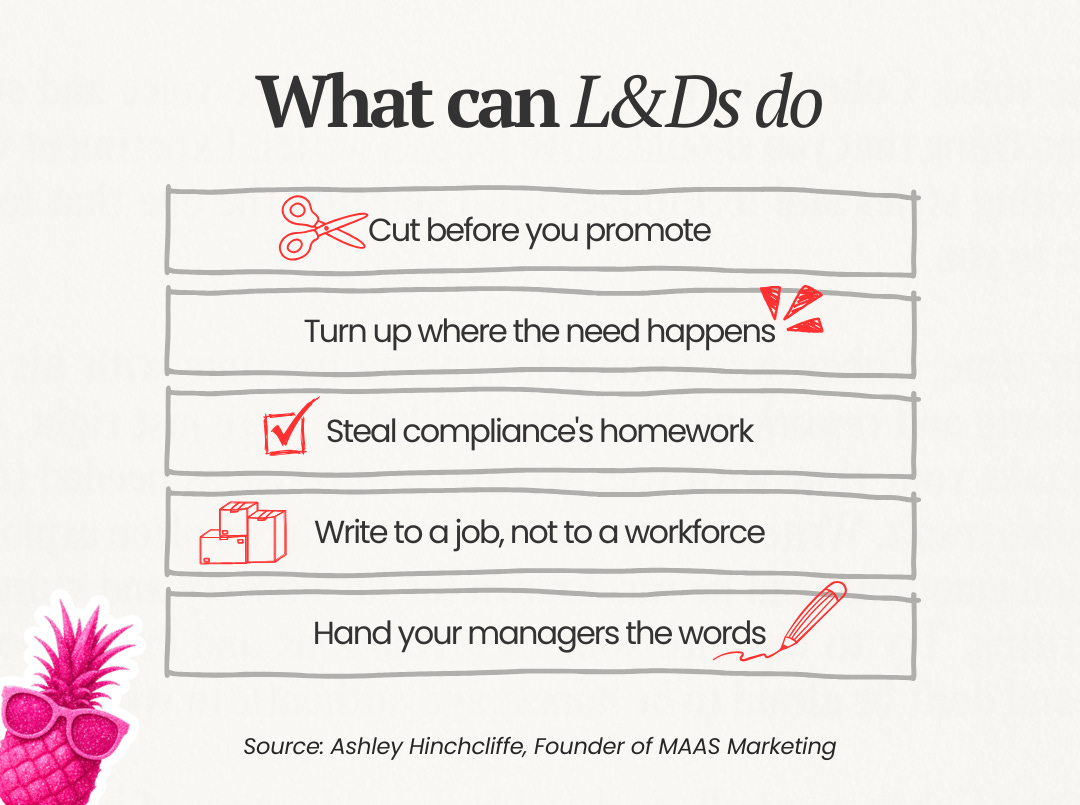
Based on my research, there are five things you can do to start to mend this, and none of them require investment in more tech or purchasing a new ocean.
Cut before you promote. You’ve got about ninety seconds of anyone’s patience (if that). Pick the twenty things that genuinely matter to the roles you’re targeting this quarter and bury everything else behind them. I’m well aware nobody has ever been promoted for deleting e-learning. Do it anyway.
Turn up where the need happens. People reach for Google and the person at the next desk, so go and stand in both places. Make internal search work, put topic-specific channels where your teams already talk, and get one line into the manager’s weekly agenda. The moment of need lasts about ten seconds, and you are currently nowhere near it.
Steal compliance’s homework. Compliance gets done because it has a deadline, a named owner, and a consequence for missing it. Your voluntary programme has none of the three, which is precisely why it loses to the eleven things that do. Give it a window, a cohort and a reason to move now rather than in March. N.B. This does not mean make it mandatory, by the way.
Write to a job, not to a workforce. If it’s for everyone, it’s for nobody. Segment by role, market, and seniority, and say the actual job out loud in the actual subject line. One person told me flatly, “It doesn’t consider what I already know; I have an MBA,” and she’s right to be irritated.
Hand your managers the words. They come up constantly as intrinsic to their team’s learning, and they’re every bit as lost as their teams about what to recommend. They’re not blocking you. They’re guessing, and a one-page script would fix most of it by Friday.
That’s what Marketing for Learning® actually is, underneath the trademark. Audience first, demand deliberately built, and the campaign treated as the job rather than the bit you do at the end if there’s budget and time left.
Oh, and one last thing, because it reframed how I think about all of this. In one set of focus groups, we asked 114 people what their primary motivation in life was. 73% said, family. Vocation came in at three percent. “Learner” is our word, not theirs, and not one of them has ever used it to describe themselves.
You don’t need 250 hours to find out what yours think. Ten will do it. Book the calls, get your own team out of the room, promise anonymity, and genuinely mean it. Then shut up and let somebody finally tell you why nobody’s coming. 🍍
Quick Sponsor Break
This week’s newsletter is sponsored by our friends at LearnUpon. Caught between executive AI demands and team anxiety? The Learning Signal Podcast by LearnUpon, hosted by Frances Kleven, exposes what’s actually working on the ground. Tune in for unfiltered strategies with industry pioneers (from Zoom leaders to top global analysts) to help you cut through the hype, protect human creativity, and elevate your strategic L&D impact.

4 L&D Resources Worth Exploring
L&D Cannot Own Learning Anymore and That May Be the Best Thing That Ever Happened to Us. What happens when every subject-matter expert can build their own training kit in an afternoon? Using Articulate’s new Frontline as a starting point, this piece argues L&D should stop owning production and start owning the system around it: templates with learning science built in, sign-off rules, and risk tiers where higher stakes mean less freedom for the creator. Worth it for the risk-tier idea alone.
Your Org’s Critical Thinking Problem Is a Culture Problem. AI has made answers abundant and execution nearly free. It has not made judgment any cheaper, and judgment on a team is a social process. This companion guide to the podcast episode with Dr. Timothy R. Clark and Junior follows the episode’s argument from diagnosis to practice: critical thinking is being outsourced faster than it is being replaced, fluent answers nobody can defend are flying through the decision process, and a bad call that once died in committee can now go live overnight. The premise underneath it is that a team’s critical thinking depends less on its members’ intellect than on Challenger Safety, the permission to disagree, question, and critique without paying a social price. The guide turns that into things a leader can run this week.
Three Lessons for Applying Deliberate Practice to Your Career. Scott Young revisits Ericsson’s deliberate practice and admits where it falls short. Practice probably doesn’t explain away talent, and the method works best in chess or music, where “better” is easy to define. His fix for messier, real-world skills is the part for L&D: instead of separating practice from work, make the work itself function more like practice, with stretch projects and deliberate constraints.
L&D Is Making More AI Video Than Ever. But Is Any of It Actually Helping People Learn? A finished minute of training video now costs a few dollars. But what is video actually good for? Philippa Hardman’s answer, drawn from a lot of research: showing a performance learners have to reproduce, and only when they do something with it afterwards. The tools’ default (upload a document, get a narrated summary) does the opposite. The six strategies at the end are worth keeping as a checklist.
Meet L&D peers in your city
Live events all around the world, made to facilitate networking and exchange ideas that inform, inspire, and innovate the future of learning. Wanna bring Offbeat Sparks to your city? Click here.

The AI Find: 65 AI tools for L&D professionals
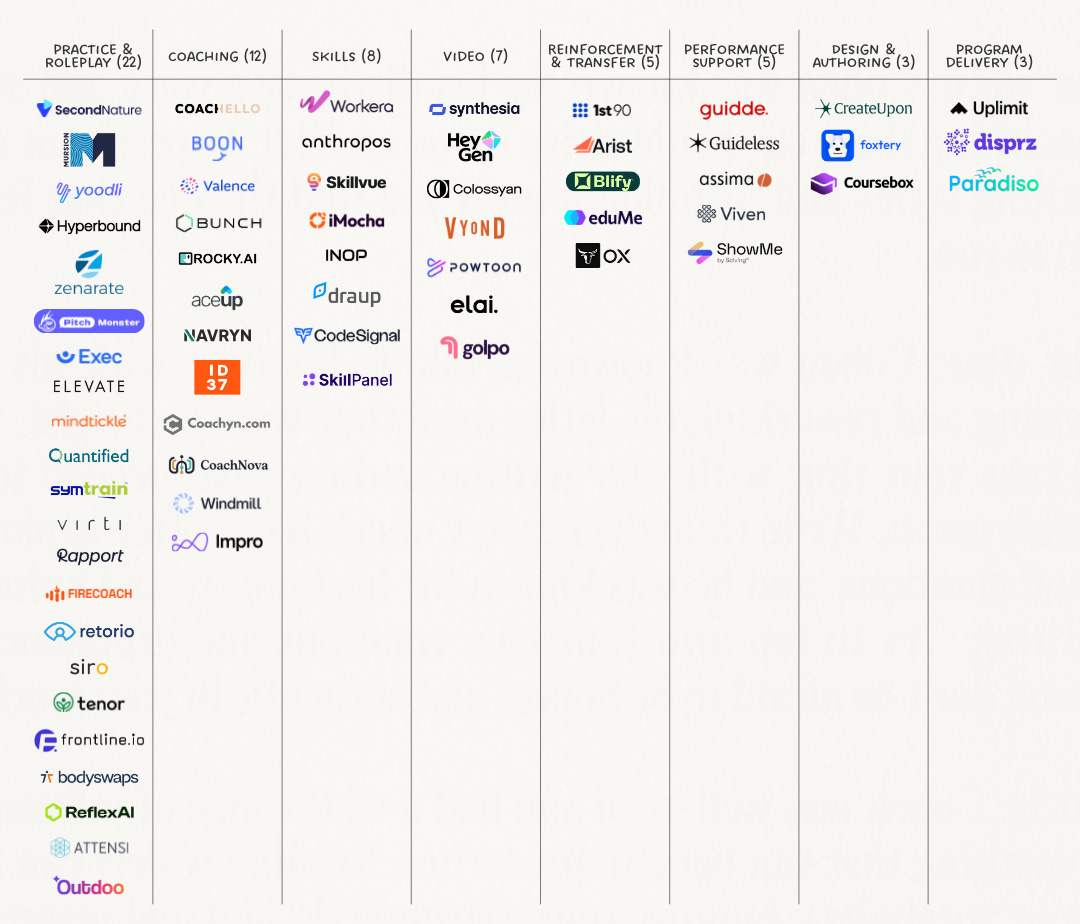
A few days ago, an Offbeat Fellow asked on our Slack channel about emerging learning tech, and I realized I’m a bit behind. It’s been a while since I spent time researching the market… and oh, boy, I felt it. I spent a few hours looking at different tools, and I found many companies I had never heard of before.
I know that in L&D we’re always on the lookout for tools, so I decided to share with you a list of AI tools I built for myself.
– The list excludes LMS/ LXP or any tool that’s more on the L&D Ops side.
– What I noticed is that the practice & roleplay market got REALLY busy, as well as the coaching one.
– I’m pretty sure I might have missed some, so if you want to share another name, feel free to drop a comment.
– This list is in no way a recommendation. It’s just an overview, and you’ll have to check for yourself if their products are any good and a fit for what you’re looking for.
Hope it helps!
Surprise of the week
Each week, Offbeat brings you a new random surprise. Sometimes it might be big - a challenge you can join to win something nice. And sometimes it might be small, like a video or a nice Instagram account. Curious? Hit open!

