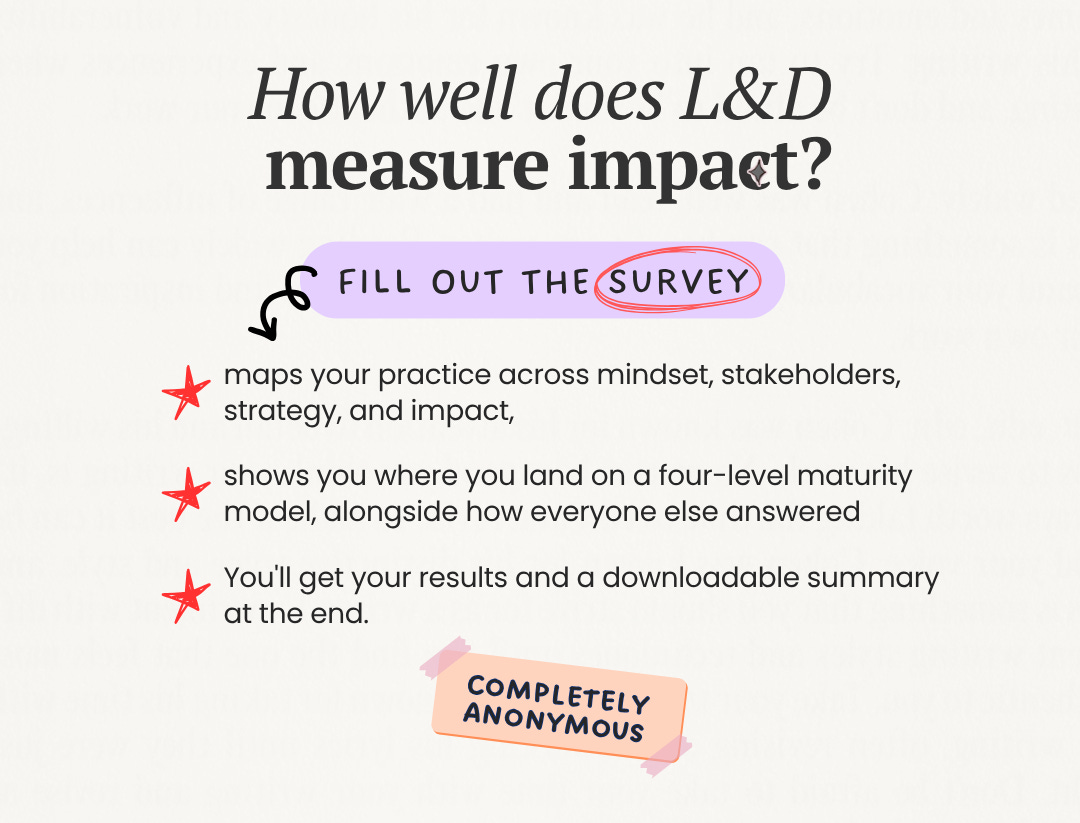
L&D Measurement is still the bane of everyone's existence. 😶🌫️ The good thing about communities is that you don't have to figure it out all by yourself. Together with Bo Dury, we spent weeks building a survey and a model to help you benchmark your own practice and also get advice on next steps. Fill out the survey by November 10th! 💜
One of the questions I’ve been often getting since running Offbeat has nothing to do with L&D. It’s more along the lines of “how did you get to building your own thing?” I’ve been wanting to address this for a while, but I wasn’t ready to do it. I also wasn’t sure how to frame it. Because I didn’t want to talk about general entrepreneurship advice, but rather about the journey of a former internal L&D jumping to build my own business. Some general advice might be worth pursuing, operating in the learning and development industry isn’t the same as building something in product, marketing, or sales.
While I have plenty of thoughts to share from my last 4 and a half years of running Offbeat full-time, I’m well aware that I’m one person, based in Romania, serving L&D professionals. I knew other people from other countries, serving other audiences, doing coaching or training, might have different experiences. So I wanted to spend some time getting to know how others see their entrepreneurship and freelancing journeys before putting pen to paper, or better said, fingers to keyboard.
This piece is for anyone who’s actively thinking about going freelance, those who are doing it but have never spoken to others, and those who have no plans to do so, but are wondering what the grass looks like on the other side of the fence. It’s about my experience, but also about the journeys of eight more people I interviewed, and some others I’ve watched closely. It speaks about the technicalities, but also about the emotional journey of running your own show.
Some of the best advice you’ll find in the article:
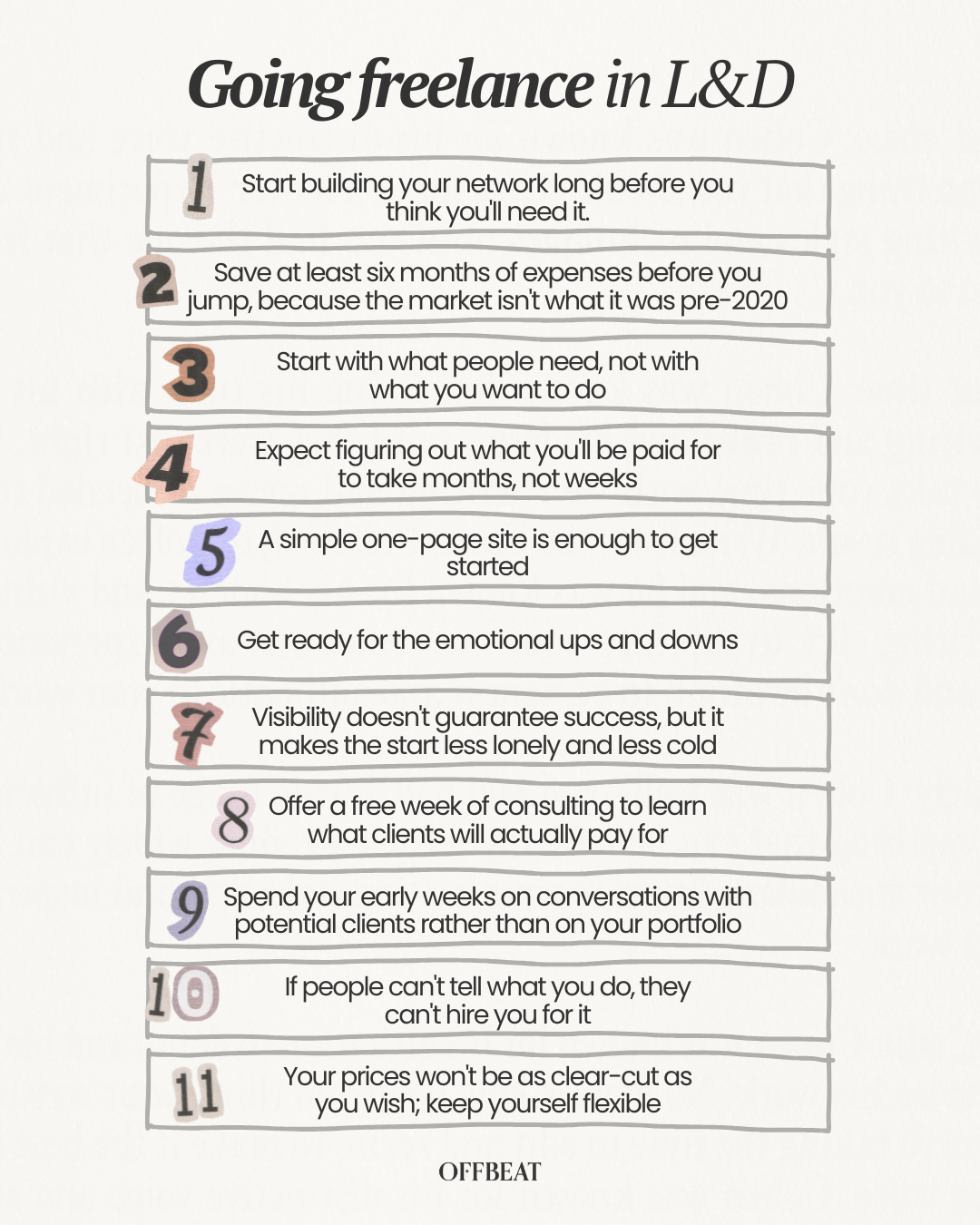
1/ Start building your network long before you think you’ll need it.
2/ Save at least six months of expenses before you jump, because the market isn’t what it was pre-2020.
3/ Start with what people need, not with what you want to do.
4/ Expect figuring out what you’ll be paid for to take months, not weeks.
5/ A simple one-page site is enough to get started.
6/ Get ready for the emotional ups and downs.
7/ Visibility doesn’t guarantee success, but it makes the start less lonely and less cold.
8/ Offer a free week of consulting to learn what clients will actually pay for.
9/ Spend your early weeks on conversations with potential clients rather than on your portfolio.
10/ If people can’t tell what you do, they can’t hire you for it.
11/ Your prices won’t be as clear-cut as you wish; keep yourself flexible.
Hope you’ll enjoy it, regardless of where you’re standing! Big thanks to Jess Almlie, Tom McDowall, Klara Hermesz, Dwayne Britton, Laura Massetti, Chris Wong, LMHC, ACC, Rafize Santos, and Liam Moore for joining me in preparing this! You’re awesome!
Quick Sponsor Break
This week’s newsletter is sponsored by our friends at Sana. Most L&D teams spend their time chasing tasks: enrollments, reminders, exports, and updates. Sana Learn flips that model. You define the rules and outcomes; the AI-powered system runs in the background. It automates workflows, adapts content to each learner, and surfaces real‑time insights leaders can trust. Instead of managing courses, you design the system, and the system makes sure learning keeps pace with the business.

4 L&D Resources Worth Exploring
The Psychological Safety Playbook. Ten practices from Corporate Rebels, and the one that caught my eye isn’t really about psychological safety at all. Viisi, a Dutch financial services firm, has no fixed training budget. People choose whatever learning benefits them and their team, without having to justify every expense. It’s listed here because trust runs both ways, and it’s a good provocation for anyone who controls a learning budget. The rest of the list is more familiar but well chosen: equal speaking time at P4Q, blameless postmortems at Google, and failure parties at Supercell. Each one comes with a few prompts you can adapt.
Learning Landmarks. What if a course were designed less like a sequence and more like a map? This piece uses two examples to explore the idea: The Wonderful Adventures of Nils, a Swedish geography textbook disguised as an adventure, and the Atlante Calvino, which turns a writer’s work into a territory. It ends with a set of design questions I’d happily steal for any programme review.
Organization Development is Not “Just Training”: The Science Behind Real Change. Where does L&D end and OD begin? This piece draws the line firmly. OD is an applied behavioural science focused on planned, systemic change, and training is just one possible move within it. The author sums it up well: all OD is about change, some change requires training, but not all change is training. What makes the piece worth reading is the list of what goes wrong when the two get confused: jumping to solutions, treating symptoms, and measuring attendance instead of impact. If your team is trying to move from order-taker to performance partner, this is the mindset behind that shift, even if you never call it OD.
Frontline can generate a course, but does it really have “instructional design expertise”? Ohhh, boy! I’ve been watching this play out like a telenovela. Articulate launched Frontline, a tool for people outside L&D to build training with “learning science built in,” and our corner of the internet exploded. Alongside all the drama, as always, Dr. Phillippa’s approach is very thoughtful. She gave Frontline the same policy document with three different goals: recall the rules, follow the procedure, and handle the grey areas. She got the same course back three times. She also gave it a problem that no course could fix, and it built a course anyway. The conclusion? Frontline can author a course, yes. But it doesn’t mean it can design a good one or tell you whether a course is the best option. At least not yet.
Meet L&D peers in your city
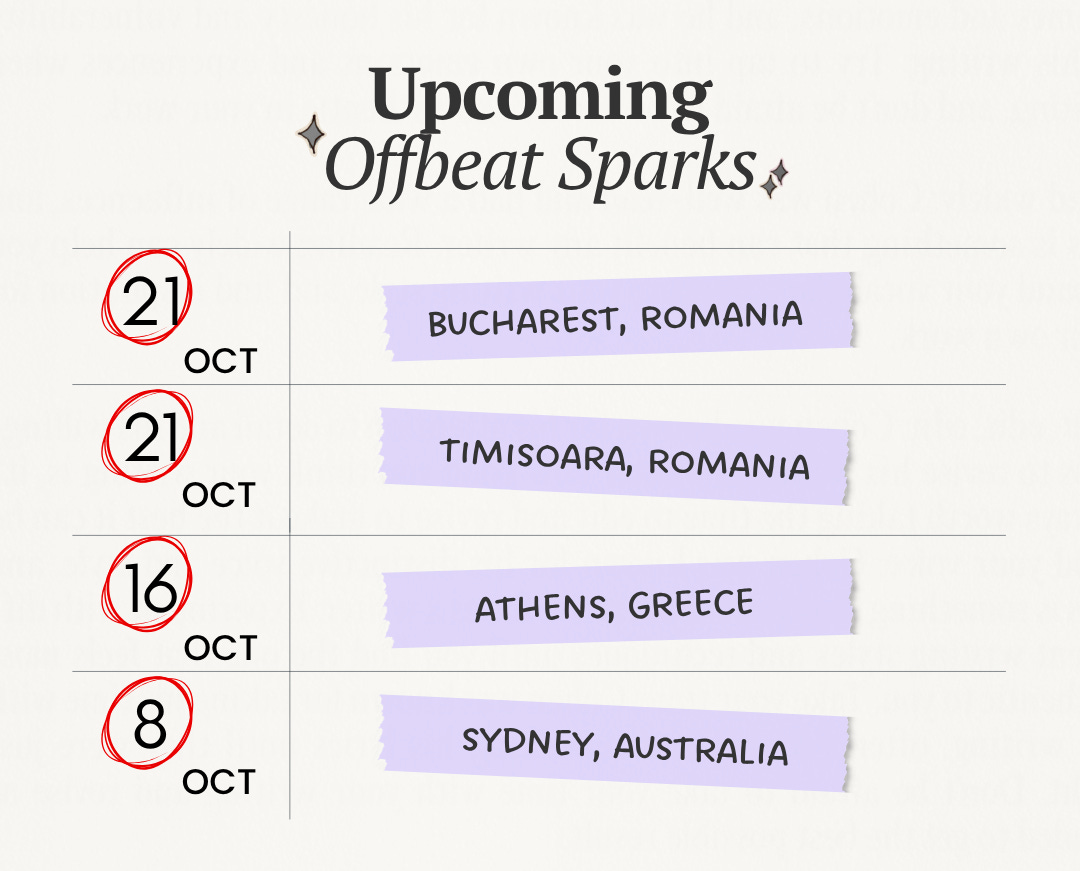
Live events all around the world, made to facilitate networking and exchange ideas that inform, inspire, and innovate the future of learning. Wanna bring Offbeat Sparks to your city? Click here.
The AI Find: What leaders need to know about AI and psychological safety
When I think about how AI influences psychological safety in an organization, I can only think of the negative scenarios. One of my main worries is that as AI adoption grows, human connection weakens, and with it, trust and psychological safety as well.
Apparently, though, there’s another scenario worth discussing. In an article published in HBR last week, Amy Edmondson and Jayshree Seth explore, among others, the concept of safety by proxy.
Here’s a scenario. A CEO insists on launching another market in the upcoming months. The Go-To-Market leader has many concerns, but their relationship with the CEO has a lot of history, things have been up and down forever. So instead of sharing the risks as his own, the GTM leader gets help from AI to draft and send them over.
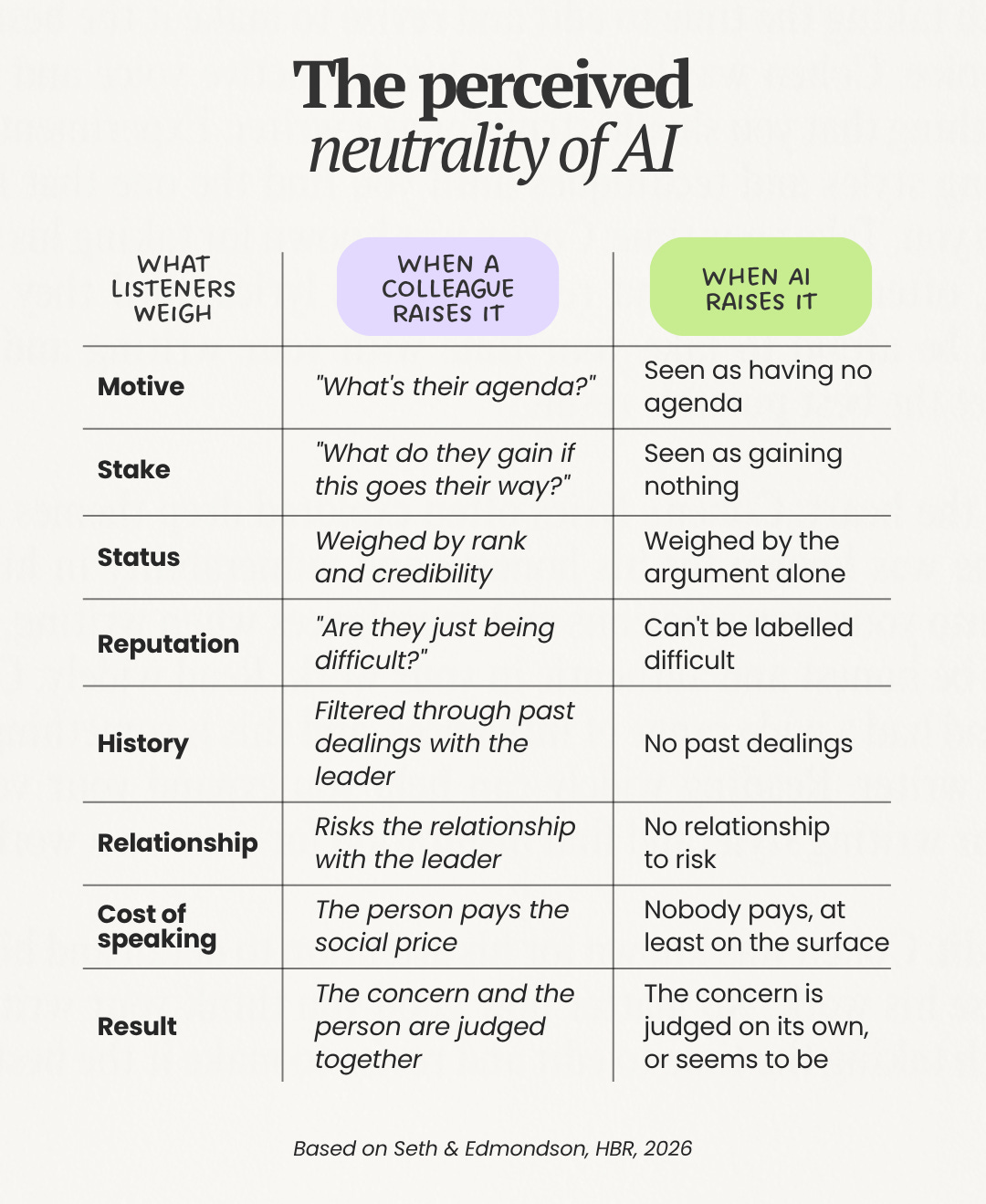
I think what the authors say or imply in the article is that there’s a perceived neutrality of AI. When a colleague raises a concern, listeners judge the person as well as the point: their motives, their status, whether they’re being difficult, what they stand to gain. AI output mostly skips that step. There’s no ego, no career interest, no history with the leader, so the critique gets read on its merits, or at least seems to be. That’s what makes it useful as a proxy: the concern gets a hearing without anyone paying the social cost of raising it. Hence, safety by proxy.
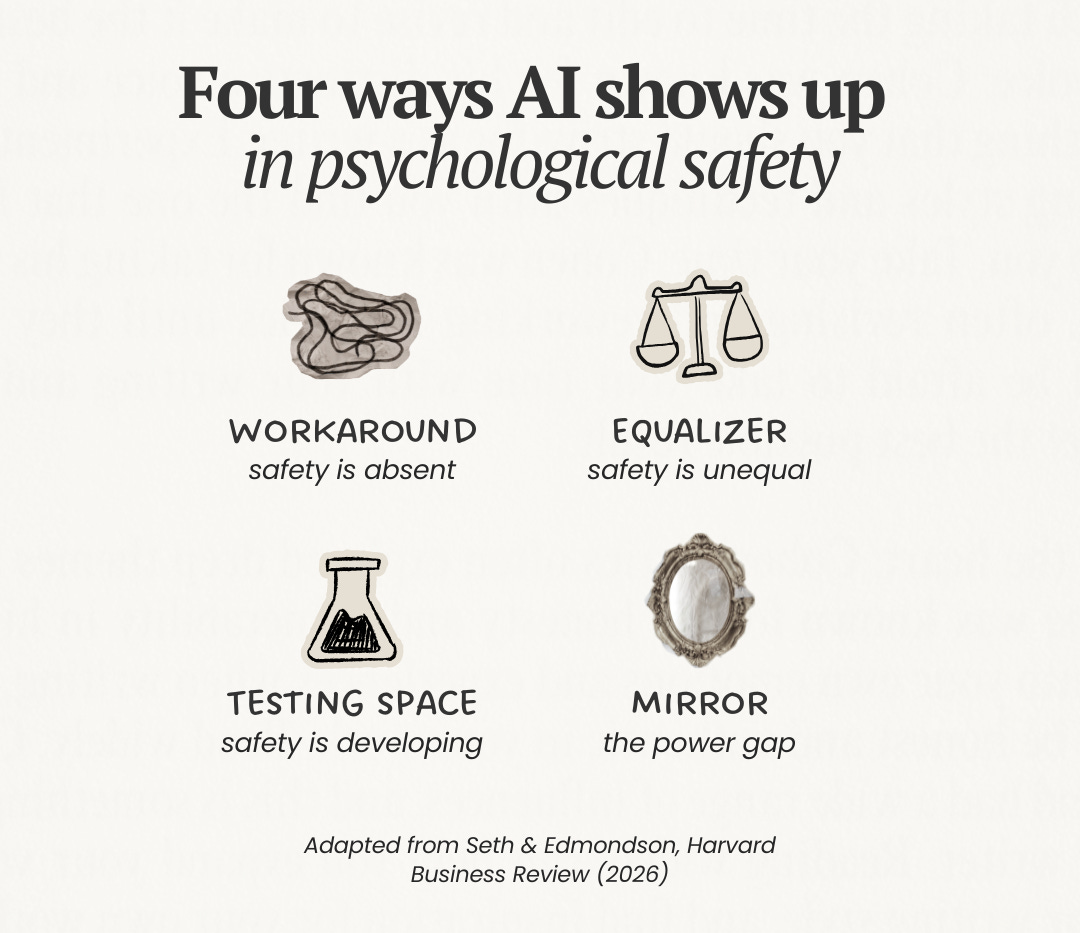
The article describes four patterns. Each pairs a state of psychological safety with a role AI plays.
1/ Workaround (safety is absent). People who think speaking up is personally costly use AI to raise concerns without attaching their name. What it signals: something important is going unsaid.
2/ Equalizer (safety is unequal). Safety varies by position, status, and identity. AI helps people with less standing get a concern heard, either anonymously or by helping them phrase it clearly. What it signals: whose voices the culture has been underweighting.
3/ Testing space (safety is developing). People use AI to rehearse an argument before raising it in person. What it signals: people want to speak up and are working their way toward it. It’s still unclear whether this builds safety or replaces it.
4/ Mirror (the power gap). Authority filters what people tell a leader. Asking AI for the strongest objections gives the leader input their position would otherwise suppress. What it signals: how much information power is costing the leader.
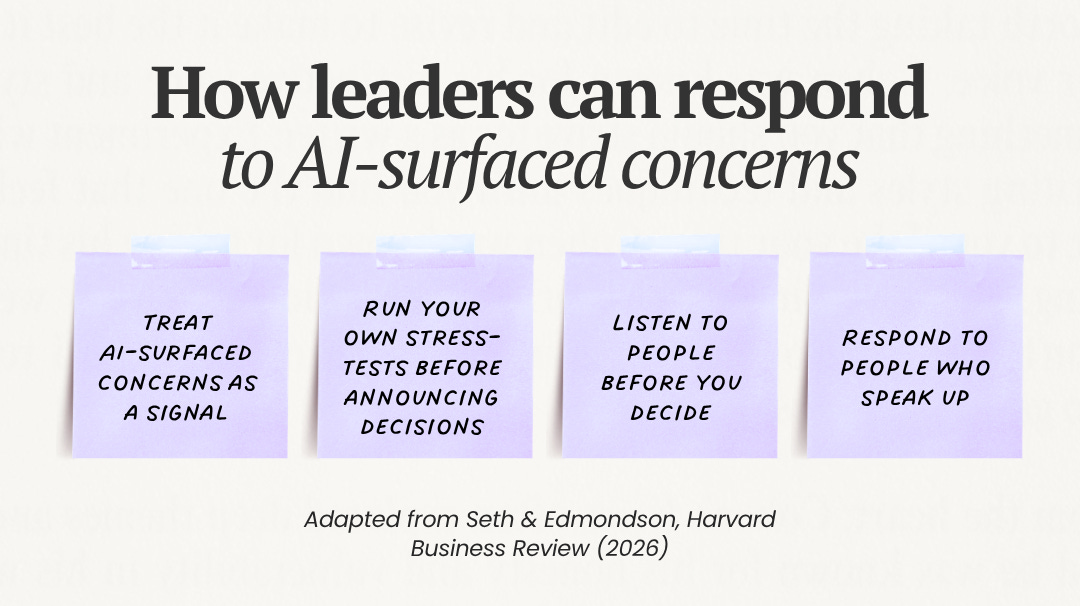
Now, what the authors advise leaders to do:
Treat AI-surfaced concerns as a signal. When an AI critique of your decision shows up, don’t only assess the content. Ask what it says about your culture: someone held a view they didn’t feel able to raise directly. Respond with curiosity, because defensiveness confirms the problem.
Run your own stress-tests before announcing decisions. Ask AI what your team would ask it: the strongest arguments against, unaddressed risks, untested assumptions. This shows you value challenge.
Listen to people before you decide. After the AI stress-test, talk to your team to hear them out, not to win them over. AI gives broad categories of concern, but only people can tell you which ones matter most in your context and why.
Respond to people who speak up. However a concern arrives, engage with it: acknowledge it, explain your reasoning, or change course. This shows that speaking up actually changes something. You don’t have to agree, and a respectful “no” still builds safety, as long as the person isn’t made to feel foolish.
The final point the article makes is that as AI becomes routine at work, people will start asking “who prompted this, and why?” At that point AI output gets judged like any other argument from a person with an agenda, and the proxy stops working. So right now, the question of how AI is impacting psychological safety stays open. But it’s an important conversation you and your leaders need to have.
Surprise of the week
Each week, Offbeat brings you a new random surprise. Sometimes it might be big - a challenge you can join to win something nice. And sometimes it might be small, like a video or a nice Instagram account. Curious? Hit open!