


Hey there 👋 I’m Lavinia, and each Sunday I write about modern ways of running L&D. If you want to learn more: Offbeat Fellowship | Offbeat Sparks | Offbeat Fest. Here are my favorite L&D people to follow, a list of L&D books you might want to check out, and a list of L&D conferences all around the world.
I remember how, in my previous roles, I always had a task that said “book vendors for English courses”. If you work in a global organization and are in charge of countries where English is not the first language, you might be familiar with this. And if you are in a native English-speaking country, your company might have a need to upskill in another language, depending on where you do business.
Our support looked fairly similar regardless of where I worked. Look for vendors. Run an assessment to see where people are. Split them into groups based on their levels. Run classes for ±6 months for each level.
I never, ever thought there might be another option, or an additional way to support language learning.
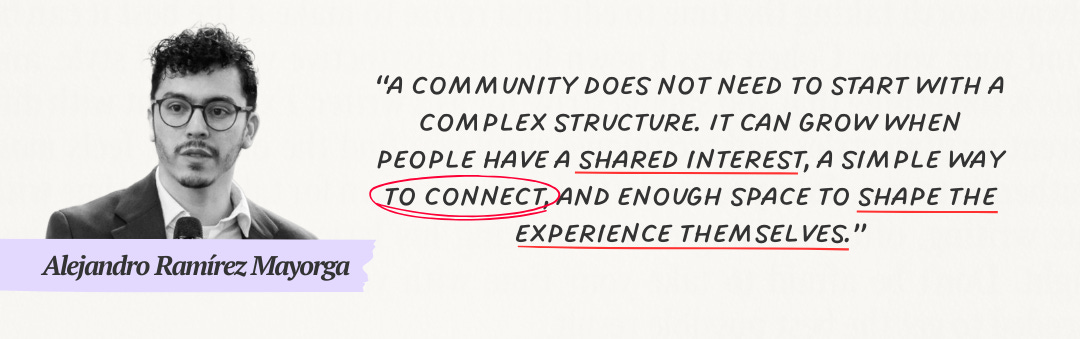
I first met Alejandro years ago. We kept in touch over time, and he always came across as someone who’s open to experimenting. Alejandro Ramírez Mayorga is the Talent Development and Learning Manager for Latin America at KPMG and together with his team decided to support language learning in his company through community.
Colleagues in LATAM needed to upskill in English because they often work with colleagues at clients from the US, while colleagues in the US and Brazil wanted to upskill in Spanish. While looking for a vendor was also their first thought, they decided to give the idea of community a try, after learning that colleagues in Japan took a similar approach and were very happy with how things were going.
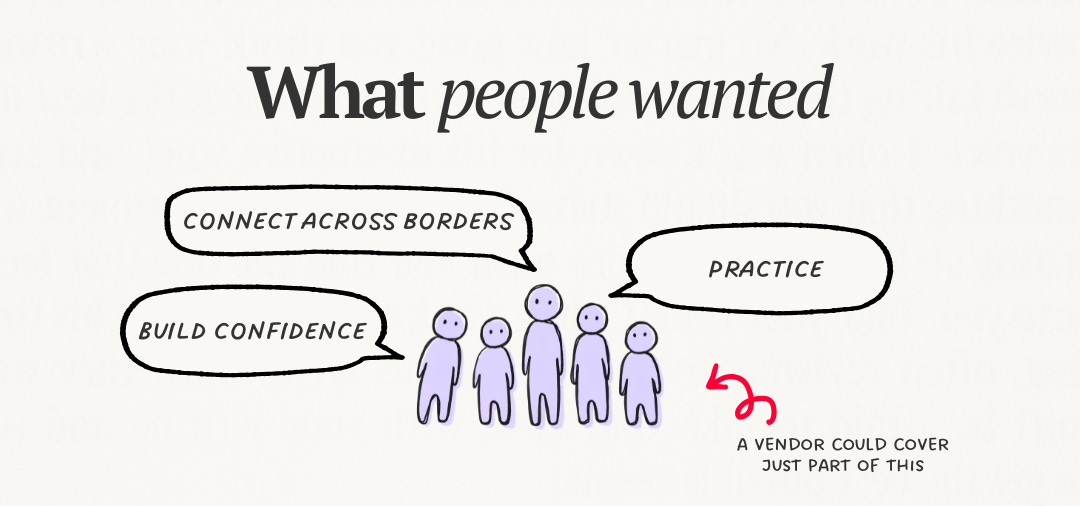
What the community offers members is mostly a set of ways to find each other.
Community formats
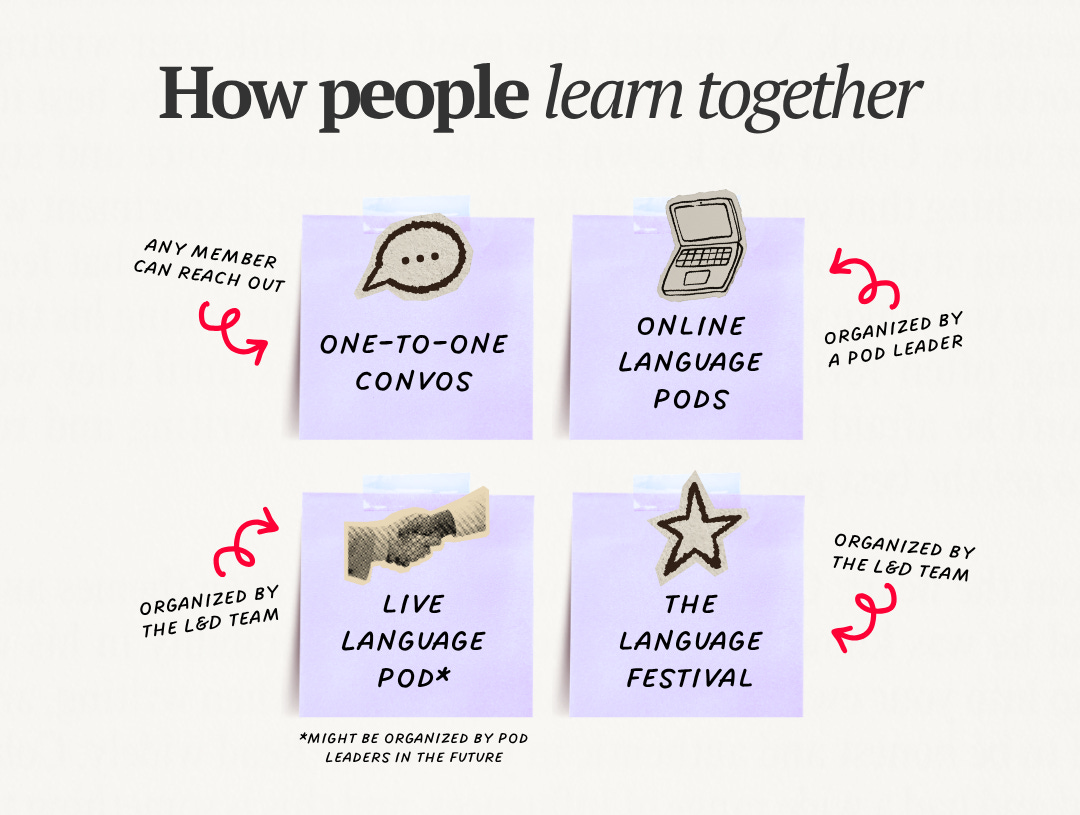
The most flexible format is the one-to-one conversation. Anyone who joins the community is added to a database that includes a little about each person along with the languages they currently speak and the languages they want to learn. Any member can open it and reach out to someone learning the same language or someone who speaks a language they want to practice. What happens from there is left entirely to the two people involved, whether that means meeting periodically on Teams, texting, exchanging emails, or becoming pen pals.
Language Pods are the group format, led by volunteers and kept intentionally simple. Pod Leaders usually organize monthly sessions, choose a topic, and invite anyone in the community to join, with topics ranging from business subjects to travel, movies, culture, or everyday conversation. Most sessions run virtually and often use small breakout rooms, and attendance has ranged anywhere between five people and around 100. The numbers matter less to Alejandro than what participants do with the time, which is to practice, help others learn, and meet peers from around the world.
The timing of the sessions is left to the community as well. One-to-one conversations can be arranged whenever the two people can manage it, while Language Pods follow the Pod Leaders’ own agendas, which puts some sessions early in the morning and others late at night.
The in-person version of a pod started without much of a plan behind it. David was coming to São Paulo, and testing the format face to face seemed like a fun opportunity. Everyone in the database based in São Paulo was invited to meet on a Friday afternoon in a cafeteria, where a quick introduction was followed by short conversation rounds of roughly 10 minutes per topic, with participants changing partners or groups after each one. Sixteen people came.
“It just kind of happened,” Alejandro says of the decision to run it at all. The format proved easy to run, and the energy was strong enough that in-person sessions are now something the community wants more of, though the constraint has shifted to finding people in other cities who can organize them locally.
The community’s biggest event so far was a language festival in May, which ran more than 15 sessions in one week and brought in more than 400 people from around the world. “You could see people from Hong Kong, Melbourne, Lagos, Milan, Stockholm, Rio de Janeiro, Bogota, Denver and much more in one session learning French, for example,” Alejandro says. The energy and the sense of scale it created were strong enough that the plan is now to run something similar at least once a year.
Lessons Learned
Months of running this initiative came with many lessons learned:
(1) Measurement is the clearest thing the community gives up by not going through a vendor. What the team does is run periodic surveys asking members to state their current level in a given language, which at least shows whether people believe they have gone up a level. “Obviously, this is not as formal as vendor assessments; it’s more of a self-evaluation, but it’s better than nothing,” Alejandro says.
(2) The work of communicating, engaging members, finding Pod Leaders, and keeping the momentum going is constant. But the growth itself came from a clear interest that was already there; it just needed to be nurtured.
(3) What the community adds to more classical ways of supporting language learning comes down to how little pressure it puts on people. It is informal, which takes out some of the stress that tends to come with learning a new language, and participation carries none of the weight of a class, an assessment, or a fixed curriculum.
(4) The practice itself is closer to the work than a beginner course would be, since members rehearse the words, expressions, and situations they are likely to meet with colleagues rather than generic vocabulary.
I never thought we’d explore language learning at Offbeat because it seemed an area where not much can be done. That’s until you pair it with the idea of community, and things start becoming more interesting.
Having heard Ale’s story, I realize that community can be tested as a replacement for the traditional vendor course, but also in parallel with it. Ale had more to say about business impact, challenges, and other lessons learned in the process, and you can read his full account right here.
Have you done something similar in your company? I’d love to hear your story as well! Don’t hesitate to share it in the comments section or DM me.
Quick Sponsor Break
This issue is sponsored by our friends at Manageable. Managers need skills to drive team performance. But training ends, and what they learned fades. Manageable+ equips managers with the leadership skills that boost team performance. You have the option to pick from our pre-built topic catalogue, add custom topics, and implement unique journeys for your organizational context. Reach out to find out more.
3 L&D Resources Worth Exploring
5 Learning Program Design Truths You Need to Know. We’ve all been there, pouring our hearts and souls into a meticulously designed program only to see it fall flat. It stings, but sometimes the hardest lessons are the ones that propel us forward. After designing quite a few programs, Srishti Sehgal distilled her reflections into five hard-earned truths for fellow LxDs.
The Great Managers Playbook. Oldie but goldie. In The Great Managers Playbook, LifeLabs Learning shared the most essential lessons we’ve learned about the systems, tools, and skills your company can use to unlock the power of your managers fast.
9 Frameworks for Leading and Managing People. Loooved this one! Extremely good content to share with your people managers or to keep in mind when designing your leadership development programs. My favorite framework: Think, Pair, Share.
Meet L&D peers in your city
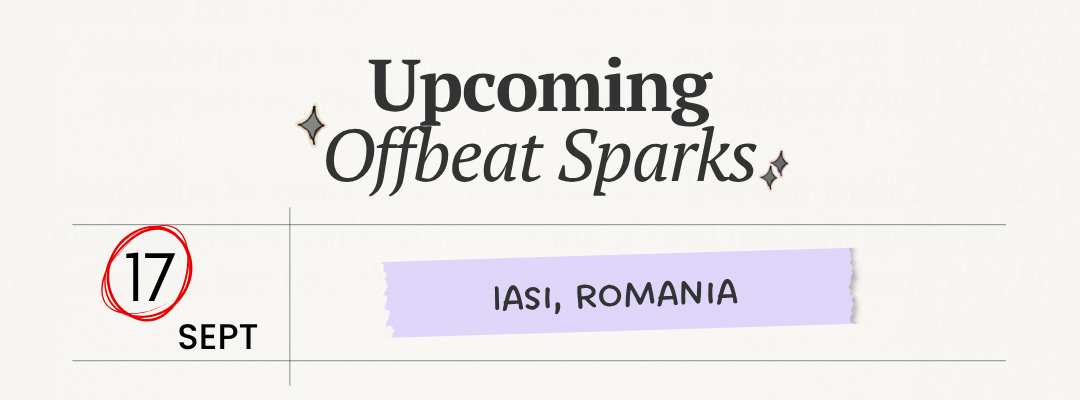
Live events all around the world, made to facilitate networking and exchange ideas that inform, inspire, and innovate the future of learning. Wanna bring Offbeat Sparks to your city? Click here.
The AI Find: From experimentation to actually changing how work gets done
One of the largest frustrations companies have at the moment is that while people are experimenting with AI, those experiments don’t turn into everyday workflows. Between the moment people experiment and when they should make real changes, something breaks. This leads to frustration on all sides. Because while AI has a lot of potential, all that potential is being spilled, and what’s left is tokens being consumed with no real benefit for the company.
I “enlisted” once again my friends from 100School to lay down what helps companies bridge that gap. They spend their time inside companies like Ocado and BCG running AI capability programmes, which means they get a front-row seat to where adoption actually stalls. In their view, the gap is no longer between “can’t use AI” and “can use AI”, but between experimenting and building a demo, and making that demo a default in how someone works.
Here’s what they learned about closing that gap:
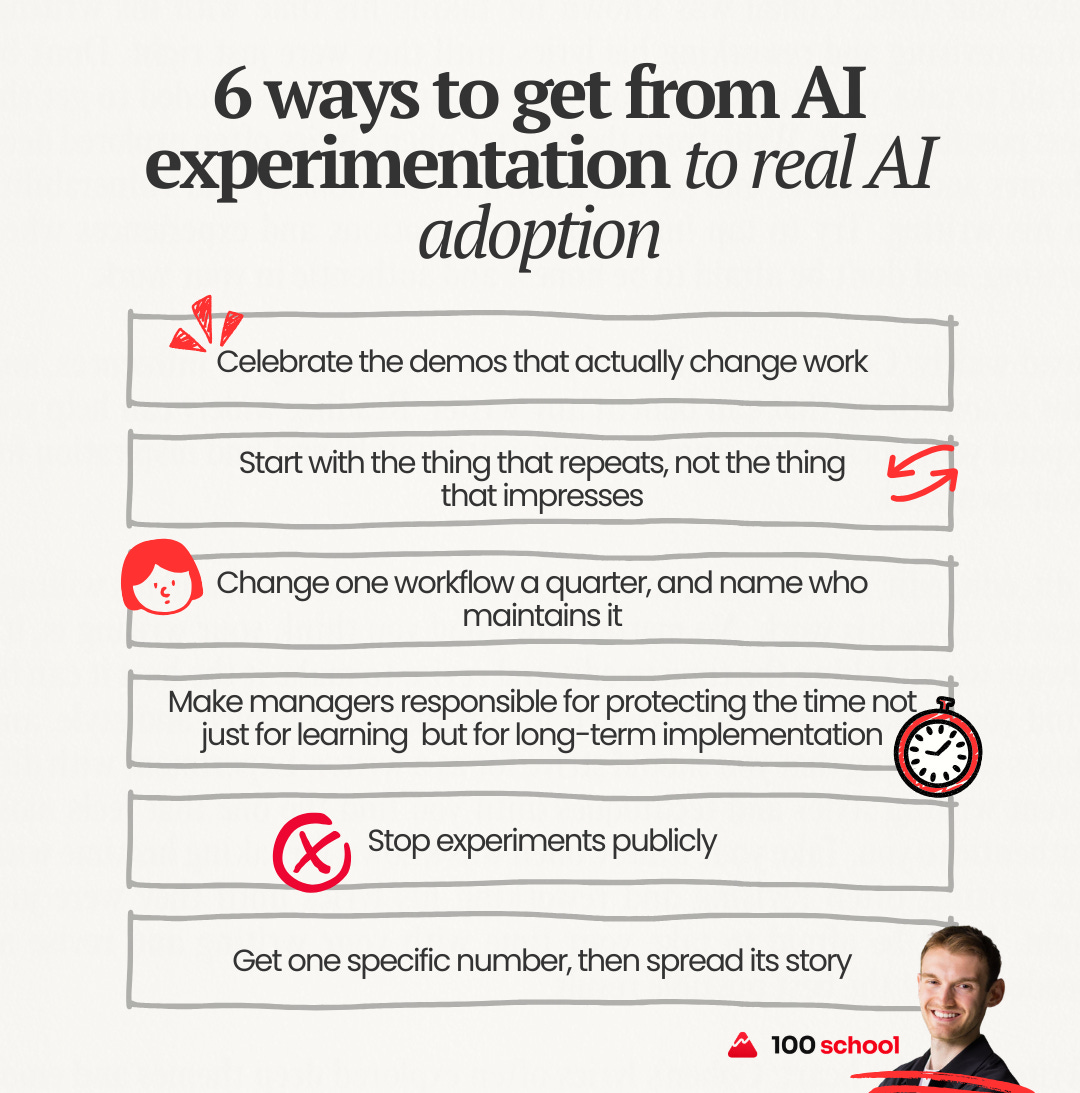
Celebrate the demos that actually change work. Something that works once, for one enthusiastic person, in a quiet moment, is a demo. A process is something that works every week, for the whole team, including the sceptics, without the enthusiast in the room. Most “adoption” celebrated on dashboards is demos. The honest question to ask of any experiment: who does this without you?
Start with the thing that repeats, not the thing that impresses. The instinct is to point AI at the biggest, most visible problem: the board deck, the strategy process. Those are the worst starting points. They are infrequent, messy, high-stakes. Process change needs repetition to take hold, so start with the unglamorous weekly thing everyone quietly resents. Frequency is the flywheel; if it doesn’t recur, there’s nothing to change.
Change one workflow a quarter, and name who maintains it. This is the mechanism 100school now runs in every engagement: each AI champion commits to visibly changing one real workflow per quarter (chosen by them, because they know where the pain is) with a named owner who keeps it working after the novelty fades. It sounds slow. It’s dramatically faster than a hundred people prompting occasionally, because it produces something that changes work on a daily basis.
Make managers responsible for protecting the time not just for learning, but for long-term implementation. At Ocado, one of the smartest moves in their company-wide rollout was making managers responsible for protecting the time to actually do the learning and the changing. Watch what an organisation protects in a busy fortnight and you’ll know whether its transformation is real. If the AI work is squeezed into evenings, it’s already dead.
Stop experiments publicly. Run a regular keep-or-kill rhythm: what’s your live experiment, does it stay or does it go? Killing experiments openly is what makes the survivors credible. Teams that never kill anything don’t have ten workflows; they have ten demos and a maintenance problem. Scale only what someone would fight to keep.
Get one specific number, then spread its story. One honest before/after — “this took 90 minutes, now it takes 20” — retold as a story, recruits the next team better than any adoption metric. On our BCG programme, activation and momentum came from people sharing what they’d actually changed, in the open, seniors included. Stories are how a new default spreads; dashboards are just how it’s audited.
All these rules can be applied to the way we adopt AI in our L&D teams, but also to how you support organizational adoption. Experimentation is fantastic, and it should definitely happen either when someone is just starting to use AI or when a new workflow is being redesigned, but if we want to see AI’s potential being realized, we need to make sure we don’t get stuck only experimenting with AI.
Surprise of the week
Each week, Offbeat brings you a new random surprise. Sometimes it might be big - a challenge you can join to win something nice. And sometimes it might be small, like a video or a nice Instagram account. Curious? Hit open!

