



Hey there 👋 I’m Lavinia, and each Sunday I write about modern ways of running L&D. If you want to learn more: Offbeat Fellowship | Offbeat Sparks | Offbeat Fest. Here are my favorite L&D people to follow, a list of L&D books you might want to check out, and a list of L&D conferences all around the world.
This issue of Offbeat is sponsored by our friends at Sana. Sana Learn turns your documents, decks, and recordings into a living, learning system. AI transforms your existing materials into structured courses, micro‑lessons, and an AI tutor that cites trusted sources. People can search, ask, and learn in one place, while the system keeps improving with every interaction. Knowledge stops getting buried and starts driving performance. If you’re curious to learn more, book a demo.
When we made the move to Substack, we also decided to make it a space where more peers can share their knowledge. So this week, Al Dea, Founder of The Edge of Work, jumped in to share his ideas about applying the scientific method to career development. I loved his thoughts, and I hope you will too. Enjoy! Lavinia
When I entered the workplace 2 decades ago, I expected that career development was going to work the way that school had: linear, sequential, and predictable. After freshman year is sophomore year; you want to always get the highest grades, and someone will always tell you what to do next. I quickly learned that the corporate world doesn’t work like that. I went looking for best practices and tried everything under the sun. Career plans, SMART goals, the 10-year plan, the career roadmap you build and work backward from. Each has merit, but they didn’t work for me.
I started my career at a management consulting firm, where the structure of the work was project-based, meaning I had different projects and after one project, I would go to the next one. This meant that every new client engagement was essentially an experiment. This was true in my early years, when I didn’t have much work experience to draw from yet. And that framing did something important, in that it gave me permission to accept that no project had to be perfect, so as long as I was willing to give it a try, immerse myself in it, and have it teach me something that I could carry to the next one.
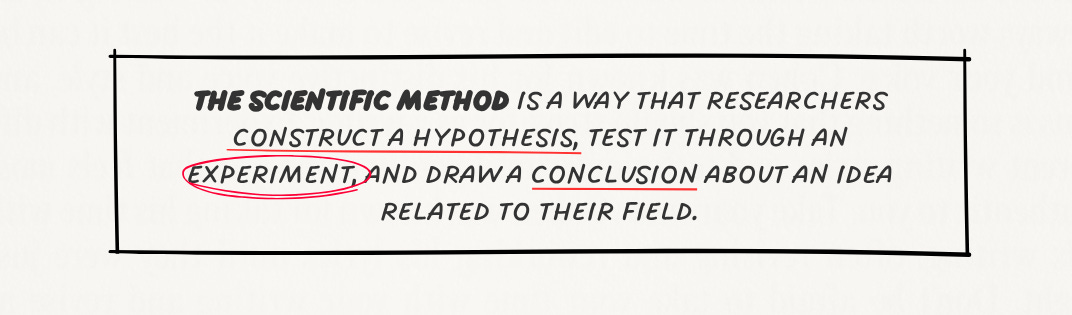
That reminded me of the scientific method that I learned from high school science class. To jog your memory, the scientific method is a way that researchers construct a hypothesis, test it through an experiment, and draw a conclusion about an idea related to their field. I took this approach and started applying it, first to my client work, and then to how I was managing my career.
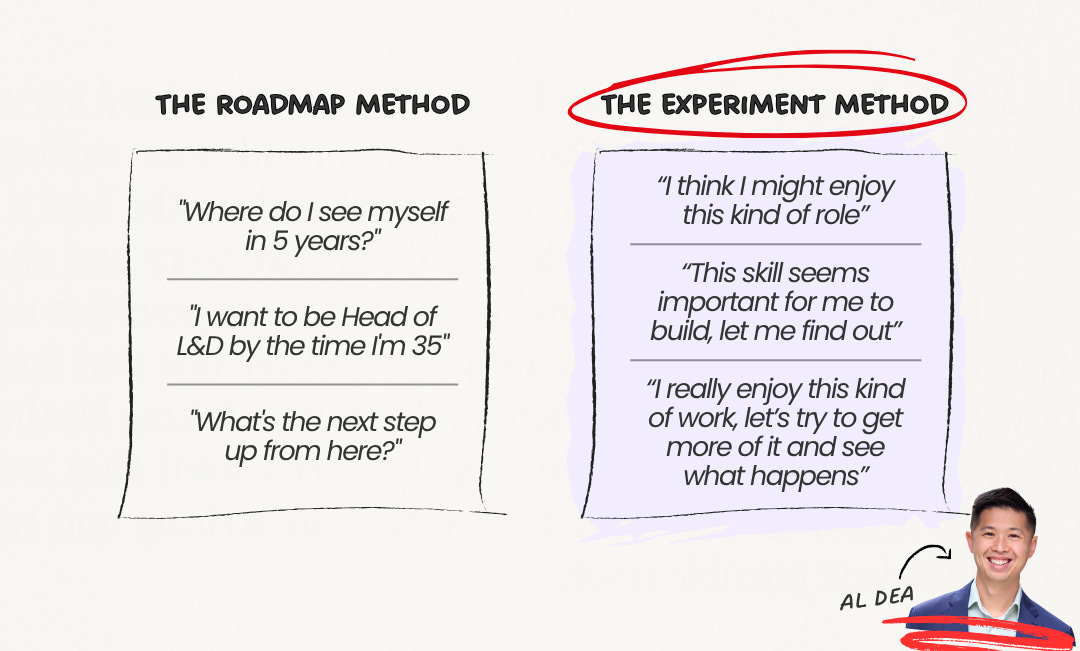
Instead of trying to build a roadmap, or trying to self-reflect my way into a 5-year plan, I could just run a career experiment: a small test of a specific hypothesis about an interest, skill, path, or opportunity that I wanted to explore. Instead of trying to map the future, I was testing out thoughts like: “I think I might enjoy this kind of role,” “This skill seems important for me to build; let me find out,” or “I really enjoy this kind of work, let’s try to get more of it and see what happens.”
Over time, I formalized that thinking into a framework that I teach to leaders called Career Experimentation. Career Experimentation is a dynamic, curiosity-driven approach to how to manage your career in a complex, changing, and iterative workplace. Given everything that is going on in the workplace right now, I think that career experimentation was meant for this moment. I know that I’m not alone in this: Offbeat friend, and NY-Times Best Selling Author- Anne-Laure Le Cunff and her work around Tiny Experiments makes a beautiful case for this approach for many things in life, not just careers.
Here’s what this looks like in practice:
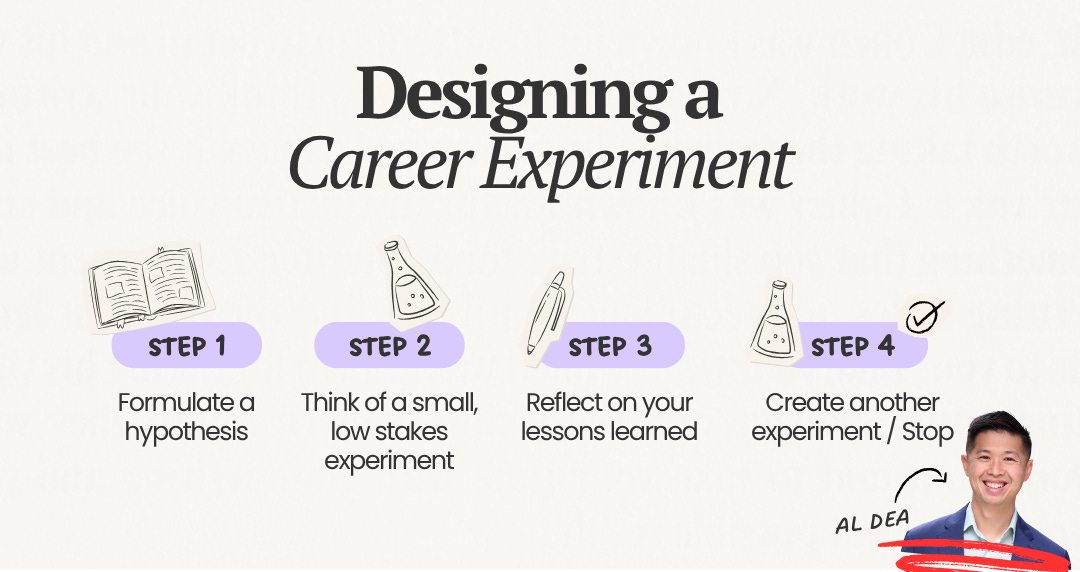
Step 1: Formulate a Hypothesis. It starts with a hypothesis. Not a plan, just a guess about an interest, curiosity, or thing you want to test. You don’t need proof, just the smallest thing you can test.
Step 2: Test. Then comes a test. A small, cheap, low-stakes action and experiment that provides insight. It could be a low-stakes curiosity conversation, a side-project this quarter with another team, or shadowing a colleague once a month. The point is to gather real insight rather than relying on guesswork through experimentation.
Step 3: Learning. Take the time to understand and document what you learned, process your experiment, identify what you learned from it, and how it informs what you want to do next
Step 4: Action. Based on what you learned, what’s the next step? Sometimes, it means going further with another similar experiment. Sometimes, it means stopping because you learned all you need to know. Sometimes it means running an adjacent experiment. The key is the follow-through.
In my speaking and advising work, I spend a lot of time thinking about the idea of the liminal space - that in-between period where the old way of doing things hasn’t fully ended, but the new way hasn’t solidified as well. Right now, it feels like every part of the workplace is in a liminal space, including how we think about managing our careers. On one side is the past, which is legible and clear, but also becoming less relevant by the day. And on the other side is the future, which we can sort of see, but feels very unclear. This gap makes it hard to know how to act, what action to take, or what to anchor decisions to. This is exactly the moment where career experiments become relevant.
One of the pieces of feedback I get around Career Experiments is about what isn’t needed. You don’t need a stable ladder or career leveling guide. You don’t need a leader or manager to tap you on the shoulder or build you a plan (although I encourage all leaders to support their employees to run career experiments). You just need the willingness to tap into your curiosities, run small tests, and use those learnings to take action.
Einstein is credited with saying, “You cannot use an old map to explore a new world.” I think about that line a lot when it comes to how we manage our careers. We keep pulling out the same map when we talk about career development, wondering why it doesn’t seem to get us anywhere. It’s not that we’re reading the map wrong. It’s that the world it was drawn for doesn’t really exist anymore.

I think this is the opportunity that is hiding in the uncertainty. We don’t have to keep indexing to that map that’s no longer helping us. We can treat this liminal space for what it is - An opportunity to check our priors about careers, and to build a model for that that is more honest, more human, and more dynamic to what suits us today.
In a constantly changing and evolving world of work, maybe the honest thing is to admit that we don’t have the map anymore. Instead, we just have to create the next experiment worth running.
3 L&D Resources Worth Exploring
How to figure out your next career move
Cliff Maxwell (with Bobby Moesta, of Jobs to Be Done) turned 1,000+ interviews with people changing jobs into a six-question process for figuring out your next move. The part worth stealing: the “energy profile”. Audit a month of your calendar, mark what energised you and what drained you, then do the same for your last two roles. It’s an interesting career conversation starter you can run for yourself or your development programs.
The Coaching Loop: How Great Managers Leverage One-to-Ones
Most manager training teaches coaching as a skill set. This piece teaches it as a meeting. The arc is Explore, Focus, Commit, Follow up, and the whole thing hinges on the last step: opening every one-to-one with “Last time you said you’d do X, how did that go?” There’s a five-item starter list for new managers at the end that’s worth considering if you’re onboarding new managers any time soon.
16 ways to evaluate the impact of learning
In a pile of AI Slop on LinkedIn, Matt is for me a beacon of light at the end of a very shitty tunnel. In this particular post, he lays out 4 categories of metrics: changes in knowledge, self-rated behavior change, other-rated behavior change, and organizational results. If you’re deep into “How can we improve the way we measure our impact?” you might find this very interesting.
The AI Find: What leads to AI Slop?
The complaint about AI Slop has intensified quite a lot over the past couple of years. When it’s not about the fact that everybody’s using vibe coding to create all sorts of apps, it’s about who writes and doesn’t write with AI, or visual assets and decks created with AI but never reviewed by the human who created them.
This is a problem in many organizations, as well as L&D teams, so I think it’s important to discuss it publicly. I’m not here to tell you what’s AI Slop and what’s not. What I wanted to explore is what leads to AI Slop being created in the first place.
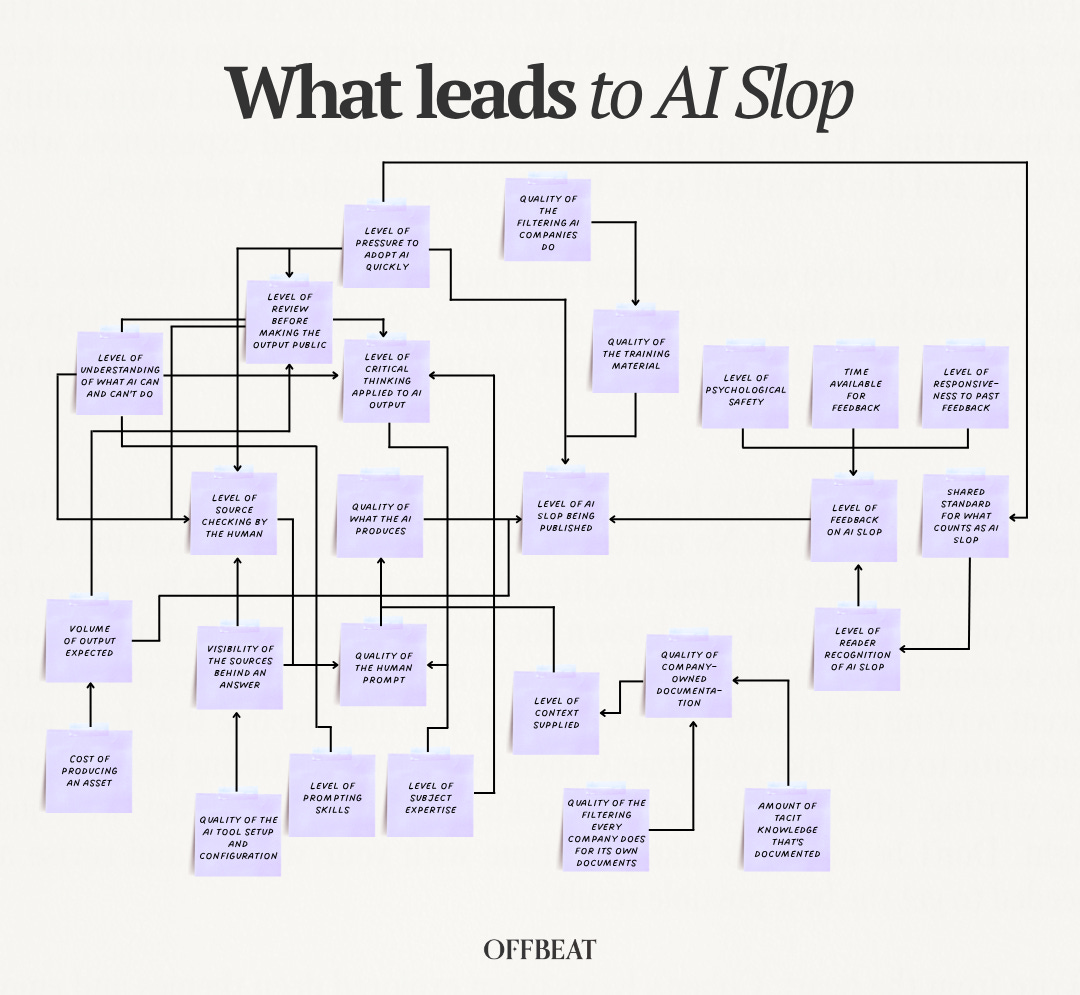
I spent this entire week reflecting on this, which also led me to create a rather complicated diagram. I tried capturing how AI companies are influencing this, how companies using AI tools can create environments where AI Slop is accepted (if not encouraged), and how each of us, individually, can let it slip and actually create more of it. To see the details of the diagram, don’t hesitate to open it in a new tab.
I wanted to spend a bit of time on a few of the chains in the diagram I find important and also under a company’s control.
1. Many companies exercise a lot of pressure over AI adoption, without considering the way that pressure can backfire. If the company is in a hurry, it rarely considers reviewing the output of an AI tool. So people end up exercising less critical thinking themselves, reducing the quality of their individual interactions with available AI tools and their prompts. This chain leads to worse AI output, hence more slop.
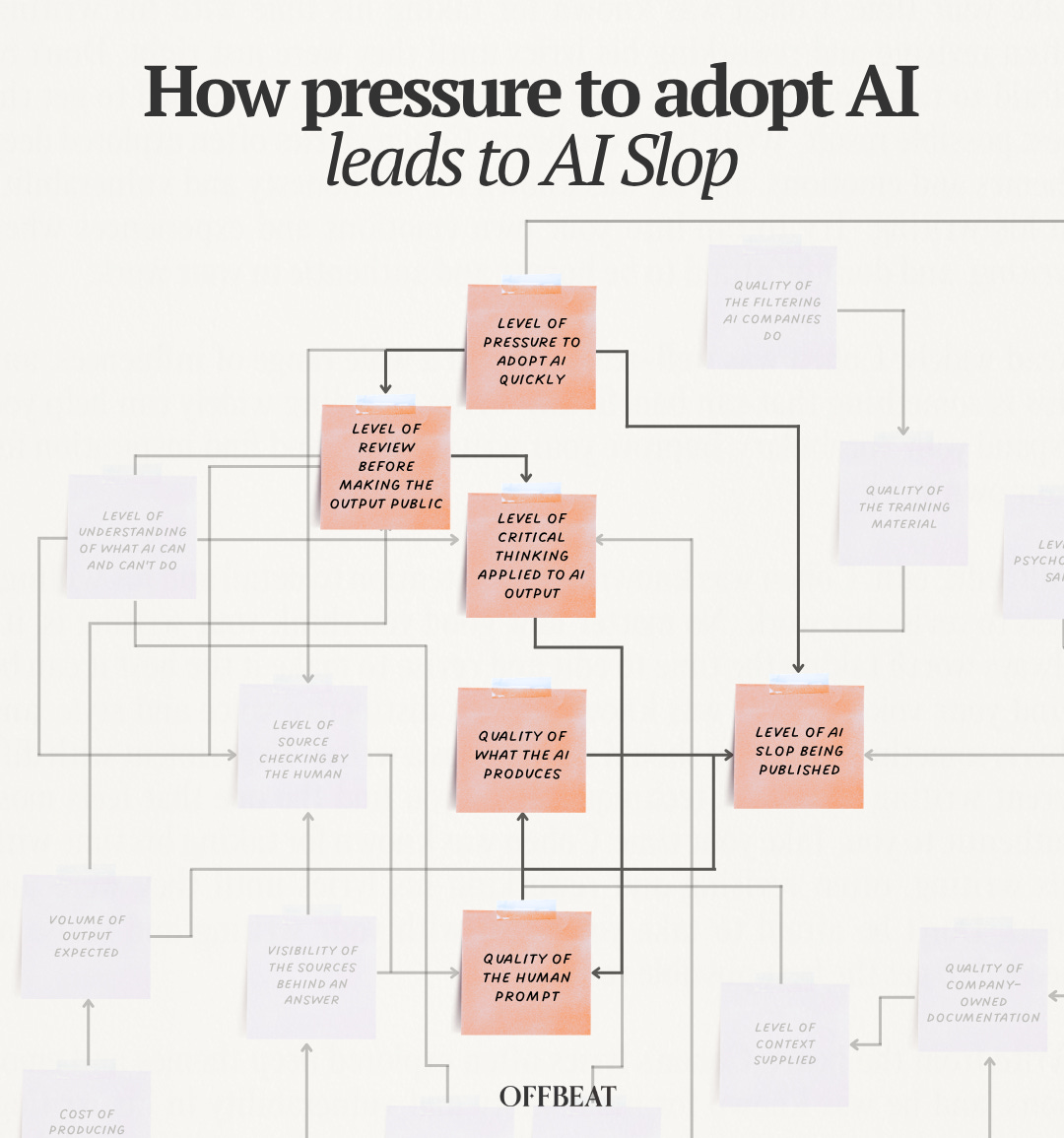
Action: One action would be for companies to implement review processes for AI output. I’m not an expert, but I’m pretty sure this can be done in a human-AI partnership. The important thing is for more than one “eye” to look over the produced output, and ideally one of the eyes should be human.
2. Another way in which pressure to adopt AI can backfire is when a company doesn’t have the time or the desire to create standards for what even counts as AI Slop. Without any shared standards, it’s harder for people to even recognize when AI Slop slips into everyday work. People can’t offer feedback on what they can’t agree on, and even if they do, when people hold different opinions, feedback is simply subjective and holds no shared meaning. And if nobody tells me, “Hey, it’s not acceptable to create a deck with AI and not review it closely before you send it to the team”, there’s a higher chance that I will do it again, creating more AI Slop.
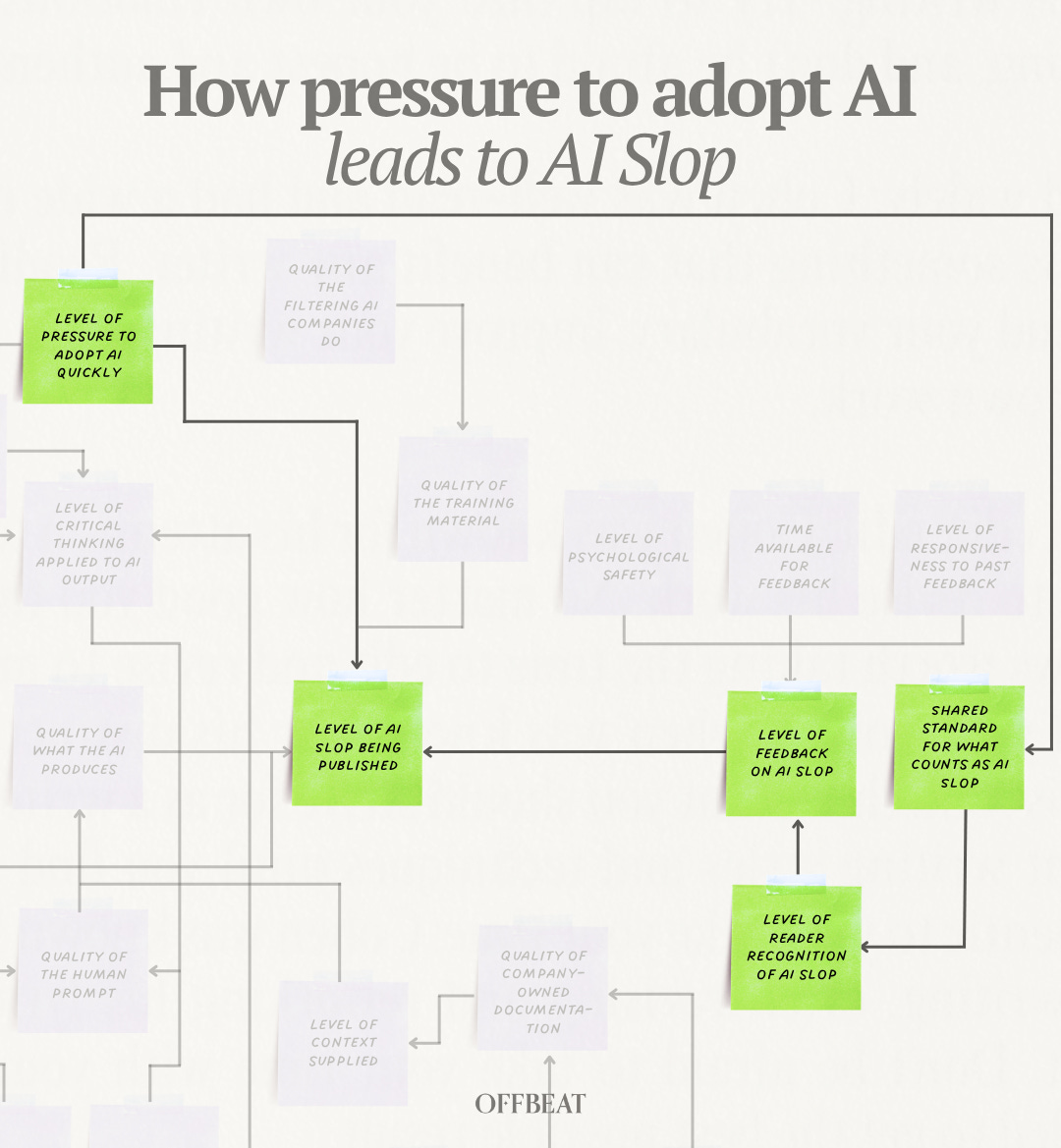
Action: Create shared standards for what type of AI output is good enough and put it in a Claude Skill, for example. Standards alone won’t lead to more feedback, but it’s a starting point.
3. Companies usually drown in documentation. This doesn’t mean its quality is high. Some documents are outdated, or some have failed to capture tacit human knowledge. We all know by now how important context is in producing a high-quality AI output. But when the documentation that should provide part of that context is subpar, the quality of the output is lower; hence, more AI Slop.
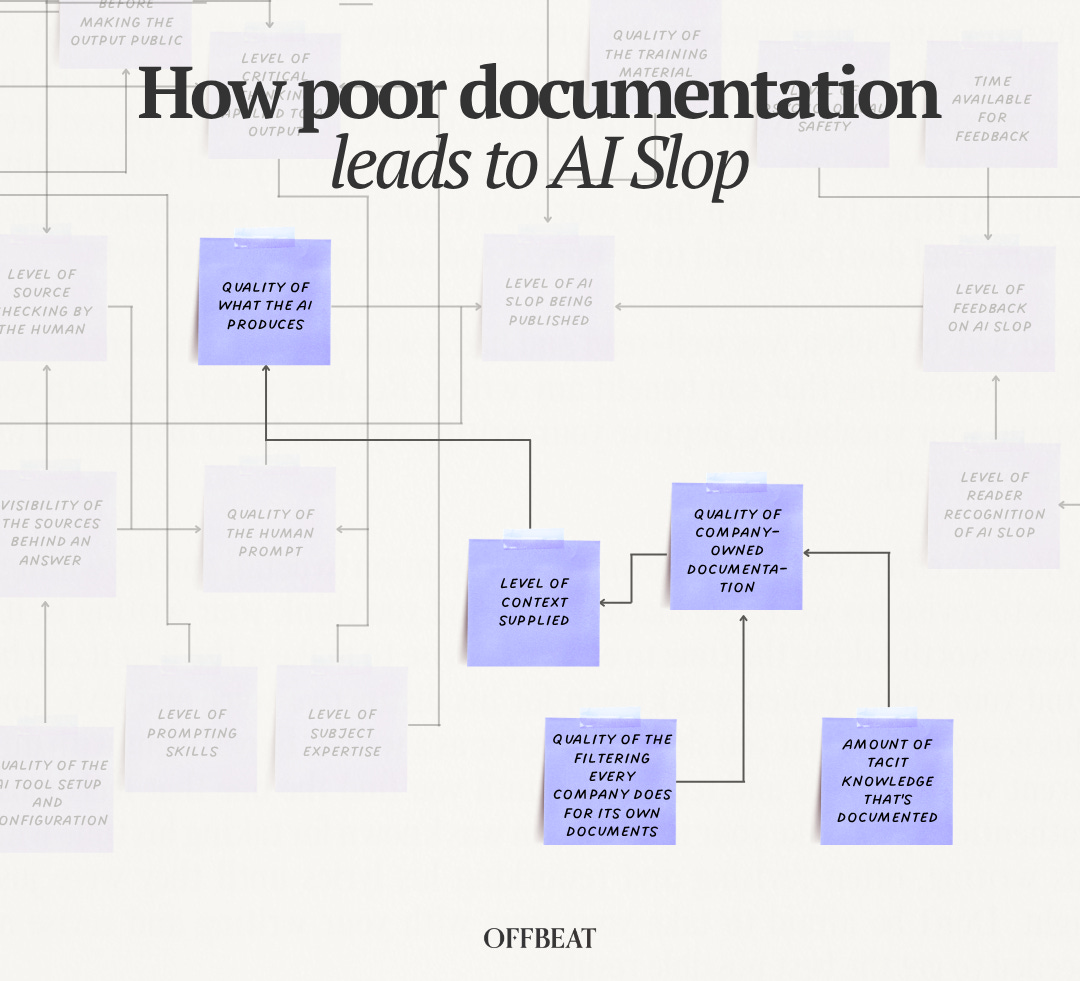
Action: Creating filters for what company documentation you allow into your models is obviously extremely important, but also something I feel is a temporary problem. AI jumping into meetings, reading emails and Slack/ Teams messages, keeping itself up to date by default, and capturing tacit knowledge will improve its memory. How ethical that is, that’s another problem.
4. As AI use cases expanded and the technology evolved, it opened up doors for everyone. You can now create apps with no engineering background. You can write about all sorts of topics. You can create decent visual assets with no design expertise. Lowering the cost of producing an asset also led to companies increasing their expectations around what and how much humans can produce. Focusing on speed and volume reduces time for critical thinking and increases AI Slop.
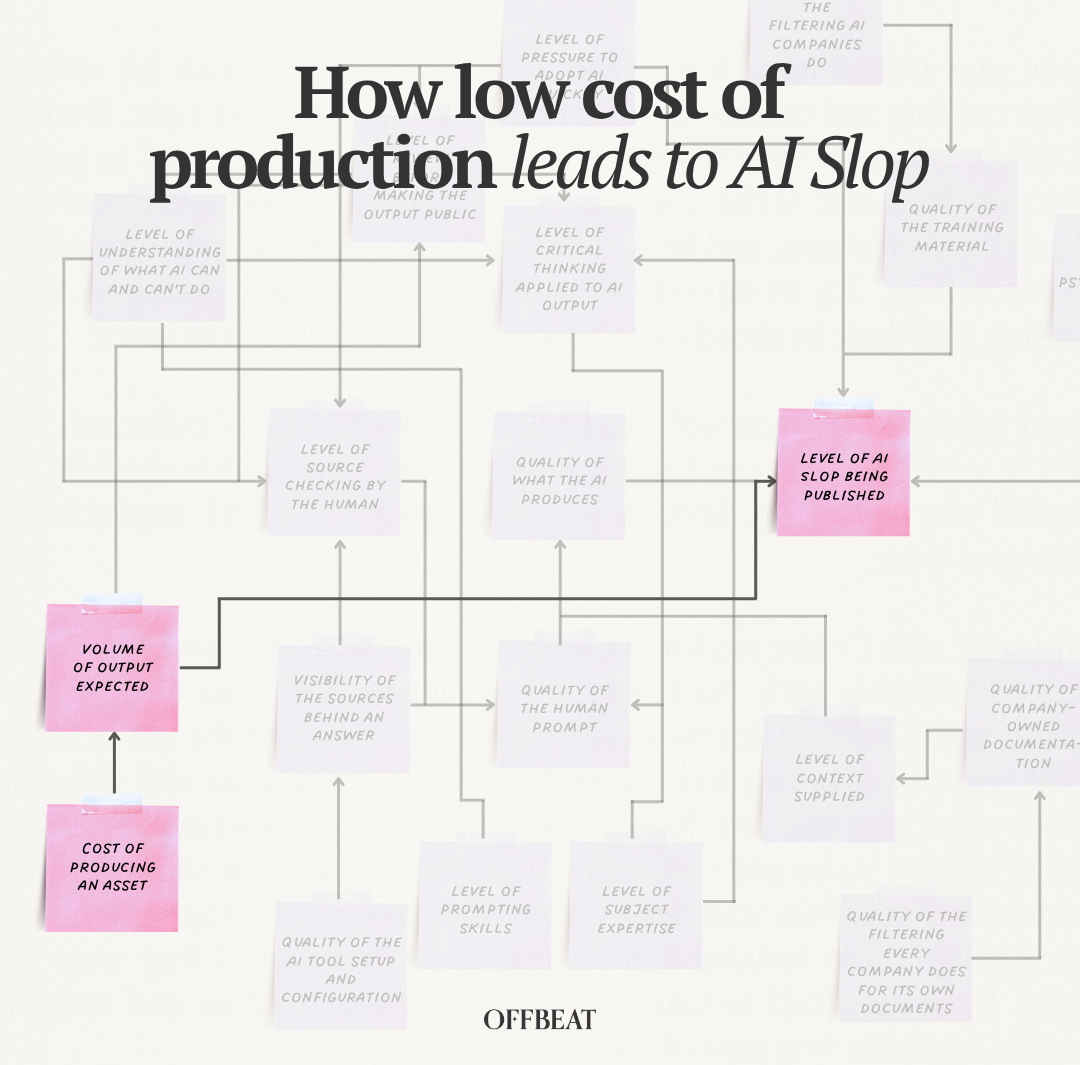
Action: The cost of producing an asset will only go lower from here. That’s not where we should intervene. Focusing less on how much we create versus why we create might be the most important question we need to answer this century.
5. In direct correlation with the democratization of different capabilities like engineering and design, is human expertise. While I can now create a product in Lovable, it doesn’t mean I will create a good product, a product that’s actually useful, and people might want to use. The level of human expertise combined with prompting skills can increase or decrease the quality of AI output, and how much Slop we let out into the world.
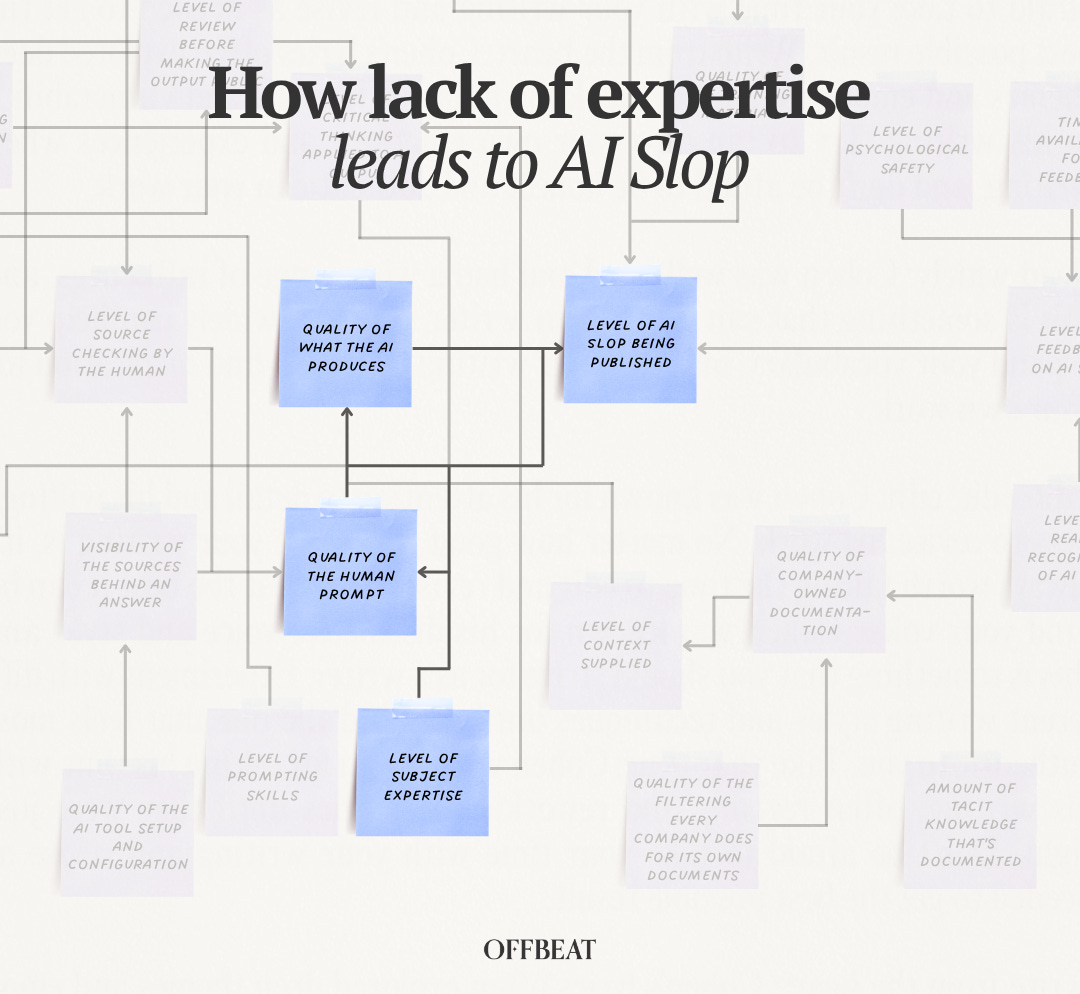
Action: For now, continuing to invest in human expertise is important. I hope that will always be the case, although our definition of expertise might change in the future. Every company having a realistic view on what AI can do and what humans should oversee is extremely important.
This is my first draft. It’s a conversation I wanted to open up, to see how other people define AI Slop, what else leads to it, and even if it is as big of a problem as I’m perceiving it.
Looking forward to hearing your thoughts!
Surprise of the week
Each week, Offbeat brings you a new random surprise. Sometimes it might be big - a challenge you can join to win something nice. And sometimes it might be small, like a video or a nice Instagram account. Curious? Hit open!


Thanks for the opportunity to team on this. I really appreciate it, and hope it's a helpful way for people to think about how they can, in this liminal space, find a new and more relevant model for thinking about their career growth!
This week's newsletter is kismet! As someone battling burnout and questioning my entire career, this was a very useful read.