


Hey there 👋 I’m Lavinia, and each Sunday I write about modern ways of running L&D. If you want to learn more: Offbeat Fellowship | Offbeat Sparks | Offbeat Fest. Here are my favorite L&D people to follow, a list of L&D books you might want to check out, and a list of L&D conferences all around the world.
We’ve officially started our second round of Offbeat Sparks this year with Seattle, and we’re continuing with Iasi, where registrations are officially open here. Big thanks to D’Jeanne, Armina, and Victoria, Slalom, speakers, and participants for the second Offbeat Sparks in Seattle! Good luck to Andreea and all the Iasi speakers for September 17th!
A few weeks ago, on a hot Wednesday morning, I joined a group of over 70 L&D professionals from Romania to discuss the connection between learning functions and business impact. Many interesting ideas were shared, and today I wanted to report one of them.
Iulia Buciuman came in after 4 other speakers, myself included, to ask the ultimate question: how strategic is your L&D function?
The question was already interesting enough, but Iulia went on and presented a diagnostic she designed and used with some of her clients. The presentation was in Romanian, but I’ll do my best to share its main ideas here.
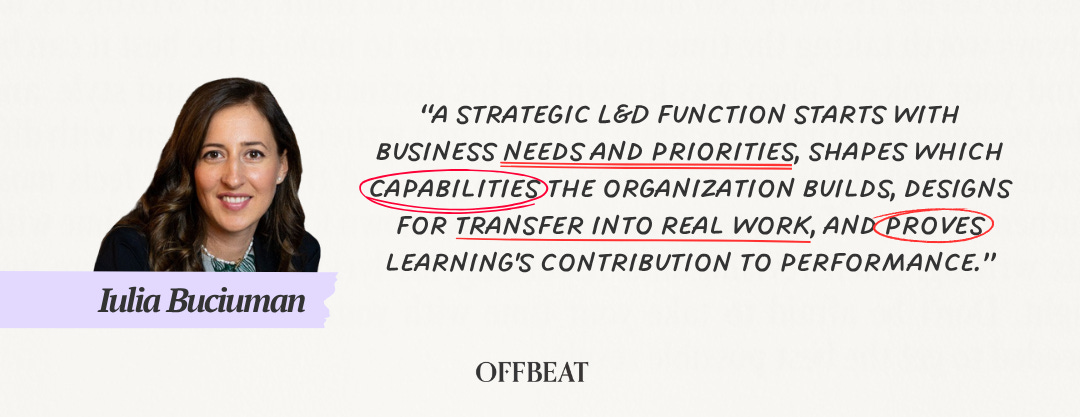
Iulia defined a strategic L&D team as one that “starts with business needs and priorities, shapes which capabilities the organization builds, designs for transfer into real work, and proves learning’s contribution to performance.”
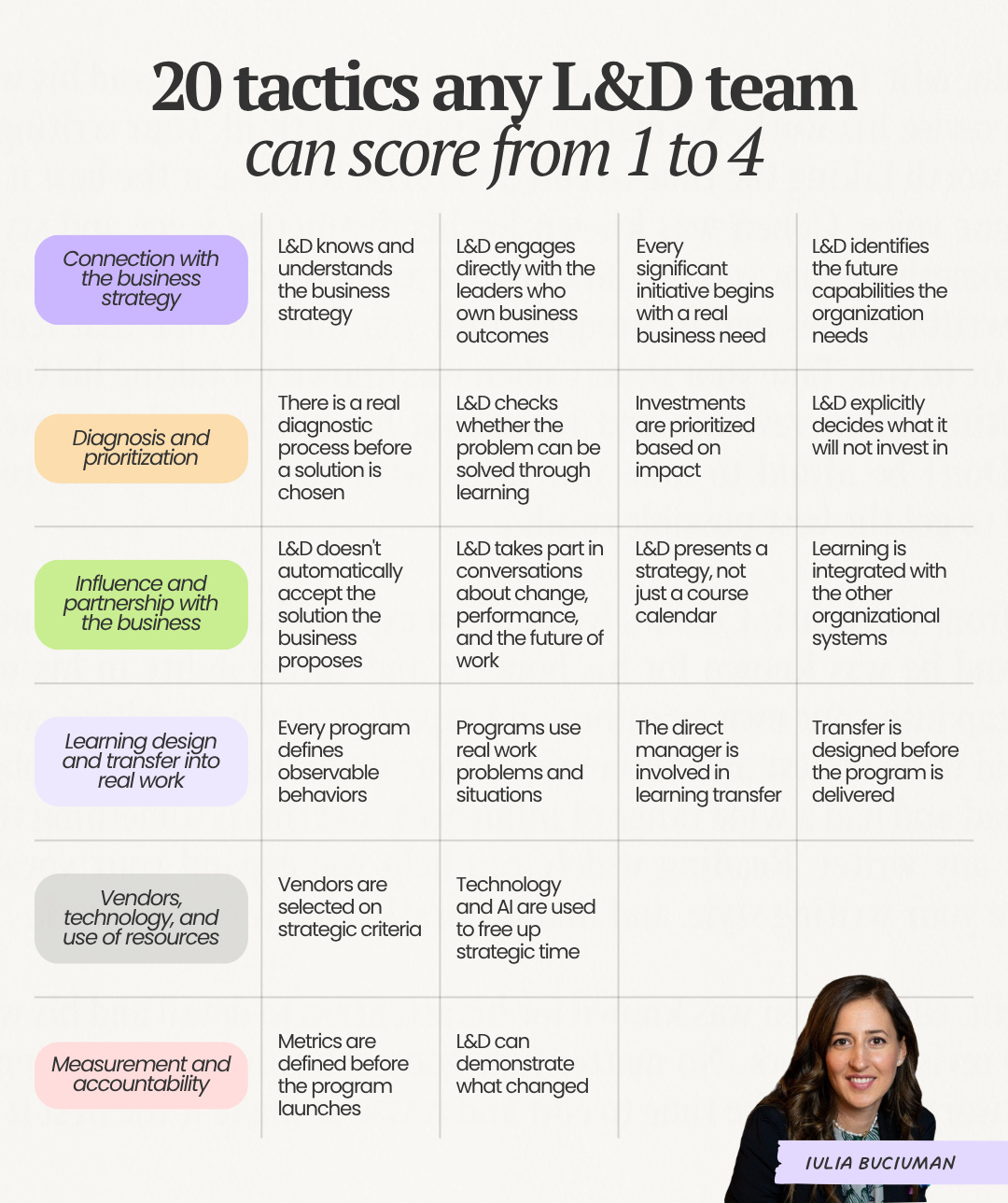
She then went on to present a set of 20 tactics any L&D team can score from 1 (this doesn’t happen) to 4 (it’s a systemic practice that can be proven) to start diagnosing how strategic they are. I won’t go in depth with the tool, but I wanted to share its 6 categories, and 20 tactics:
1/ Connection with the business strategy
– L&D knows and understands the business strategy
– L&D engages directly with the leaders who own business outcomes
– Every significant initiative begins with a real business need
– L&D identifies the future capabilities the organization needs
2/ Diagnosis and prioritization
– There is a real diagnostic process before a solution is chosen.
– L&D checks whether the problem can be solved through learning.
– Investments are prioritized based on impact.
– L&D explicitly decides what it will not invest in.
3/ Influence and partnership with the business
– L&D doesn’t automatically accept the solution the business proposes.
– L&D takes part in conversations about change, performance, and the future of work.
– L&D presents a strategy, not just a course calendar.
– Learning is integrated with the other organizational systems.
4/ Learning design and transfer into real work
– Every program defines observable behaviors.
– Programs use real work problems and situations.
– The direct manager is involved in learning transfer.
– Transfer is designed before the program is delivered.
5/ Vendors, technology, and use of resources
– Vendors are selected on strategic criteria.
– Technology and AI are used to free up strategic time.
6/ Measurement and accountability
– Metrics are defined before the program launches.
– L&D can demonstrate what changed.
Depending on your own answers, your L&D function might be anywhere from Course Admin (just administers training), Training Provider (designs or works with suppliers to deliver learning programs), Business Partner (is involved in diagnosing the gap and figuring out the best solution to close it), or Strategic Function (is involved in deciding the capabilities the business needs, plans for solutions, and measures performance).
There are a few interesting things about this diagnostic. Firstly, it forces an L&D team to agree on a definition of what strategic work requires. Secondly, when starting to think of shifting an L&D team from order-taker to strategic partner, it clarifies the most pressing issues that need to be addressed first. And finally, it can be taken in time to see if the needle has truly shifted.
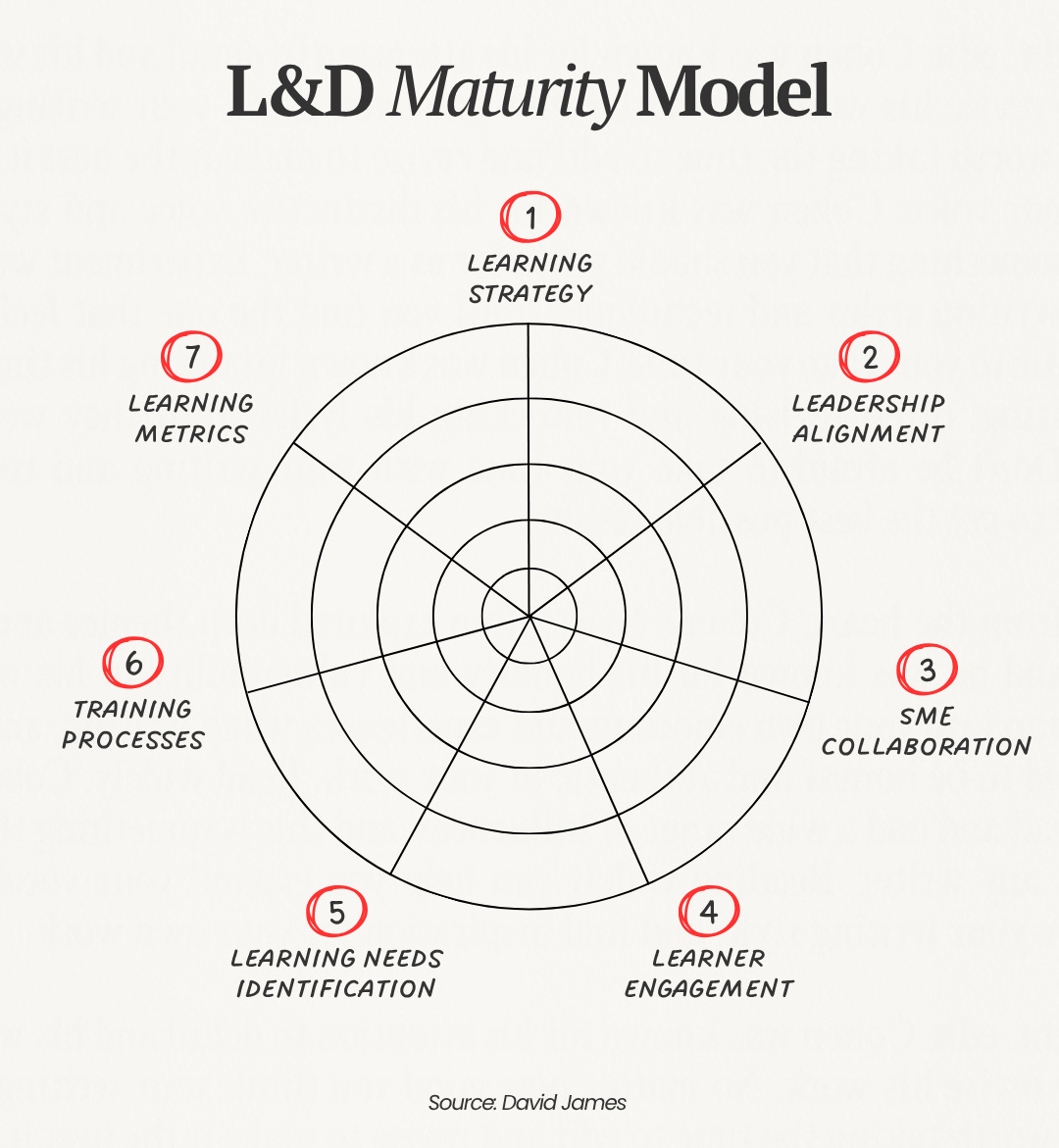
It also reminded me of the more complex L&D Maturity Model developed by David James and 360 Learning. Wherever you decide to start, as an L&D Manager, you shouldn’t start alone. Bring your entire team together to think things through, learn, and make decisions as a unit.
Good luck!
3 L&D Resources Worth Exploring
Building a Culture of Curiosity. If you’re making a case for building curiosity in your organization, this toolkit might come in handy. Scott Shigeoka argues that curiosity shouldn’t be just a soft-skill training, but should be treated as an organizational initiative. He put together five areas where curiosity shows up (creativity, bridging difference, wellbeing, belonging, and emerging technology), each one with a real case study, a short list of practices, and reflection questions you can use however you want.
Mind the Belief Gap. Leaders know what good leadership looks like, yet they still don’t align their behaviors to their knowledge. Why so? A study conducted by BCG found that the gap might come from some limiting beliefs. For example, 41% rank empathy in their top three qualities; only 16% say their leaders are good at it. The belief between knowledge and action is that empathy erodes accountability. Our leadership development programs can surface those beliefs by asking leaders to finish sentences like “We’re doing this because we believe…” and showing them the consequences of their actions.
The case for outgrowing your user manual. I remember being really excited by the idea of having a user manual. This piece challenges a bit how we’re using these manuals, and proposes keeping it, but as one block inside Tim Clark’s Work Model Canvas, which maps your whole working life and counts stress and damaged health in the cost column alongside your hours. Worth reading if you’re rethinking onboarding or career conversations.
The AI Find: The CRISP Framework
I started the 100School 15 Days of AI course this week, and have been enjoying it quite a bit. Every day, I receive a lesson with very little theory and a lot of practice that I can get done in less than an hour. Having just come back from my holiday, I had to stack 3 lessons in one day, which wasn’t ideal, but in a normal week, I could’ve gone through all of them daily, as I should have.
Anyway, the course starts with the basics of prompting, feeding your LLM of choice with context about yourself and building personas to get diverse perspectives on the same piece of work. Overall, it was a fantastic reminder of how my prompting determines the results I get from Claude, ChatGPT, Gemini, or any other LLM. You might have heard of the principle as Garbage-in-Garbage-out.
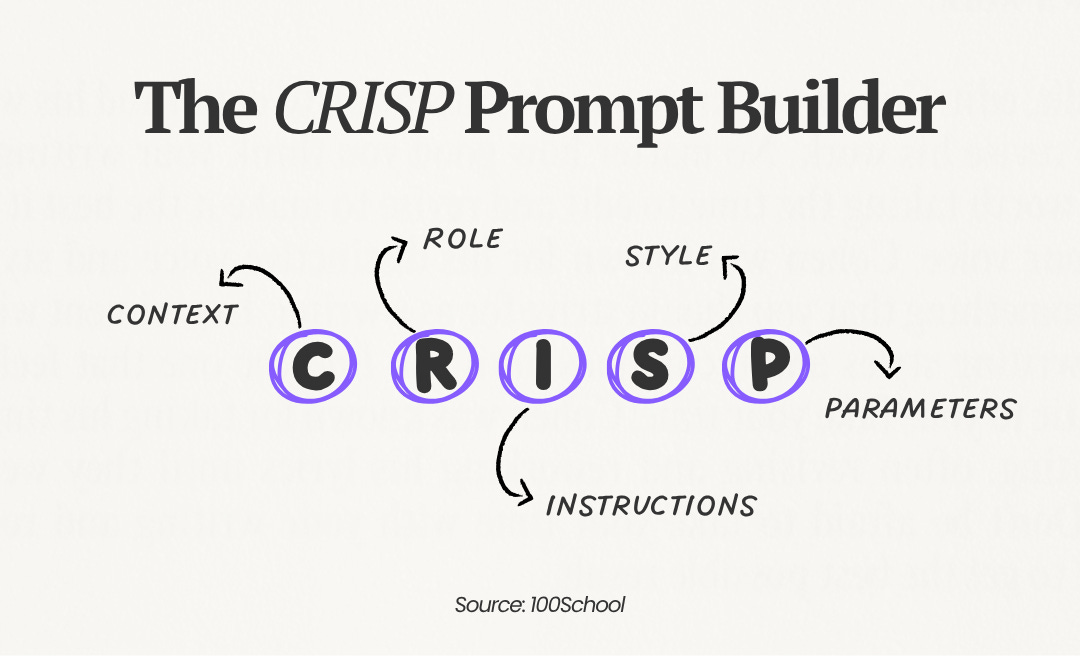
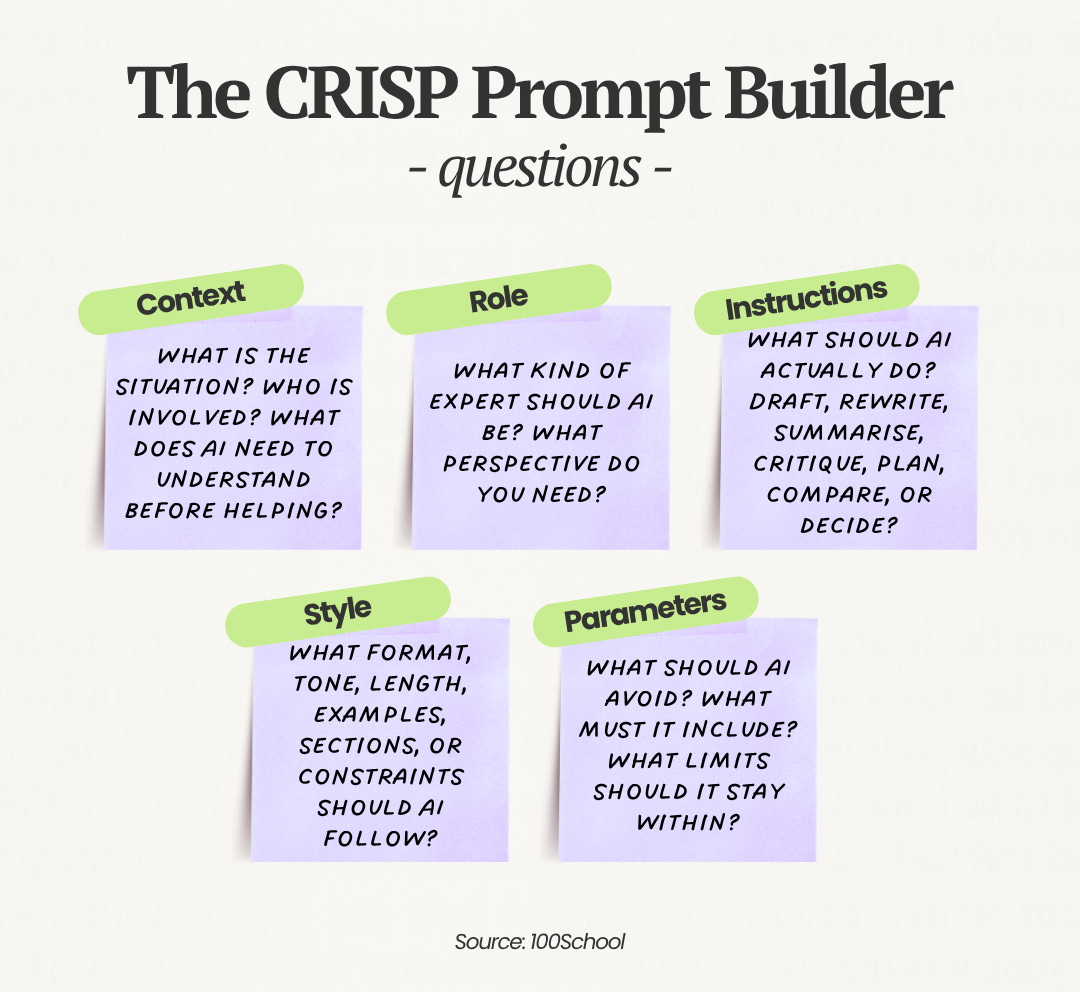
One of the tools the course shares to counter Garbage-in-Garbage-out is called CRISP: Context, Role, Instructions, Style, and Parameters.
While it sounds very 2024, since I felt this to be a good reminder for myself, I thought it might be a good reminder for you as well. I don’t know about you, but I still have a tendency of using AI like it’s Google because I feel like I’m always in a hurry, and then get frustrated by the results, and spend a lot of time afterward giving Claude (my LLM of choice) the context I should’ve given it from the beginning.
As much as we’re trying to make AI this wizard that can do a shit-ton for us, in reality, its results are still dependent on our prompting skills. That’s maybe one of the constants of the past few years in a very chaotic AI world. While models have improved, good prompting still hasn’t decayed as a skill. So here’s a detailed overview of CRISP, together with an example.
– Context: What is the situation? Who is involved? What does AI need to understand before helping?
Example: “I’m an L&D business partner at a 400-person fintech. A sales director has asked for “negotiation training for the whole team” after a bad quarter. I’ve run six 30-minute conversations with four sales reps, one manager, and one enablement lead, and have raw notes. I need to send the director a short diagnostic before we commit the budget.”
– Role: What kind of expert should AI be? What perspective do you need?
Example: “You are an experienced L&D partner who is sceptical of training as a default solution. You separate skill gaps from system problems, and you say so plainly without being difficult about it.”
– Instructions: What should AI actually do? Draft, rewrite, summarise, critique, plan, compare, or decide?
Example: “Read my notes and produce: (1) what people actually said, grouped into themes, (2) which themes point to a skill gap and which point to something else, like process, incentives, tooling, management, (3) a recommendation with one training and one non-training component, (4) two things I still don’t know and should check before we spend anything.”
– Style: What format, tone, length, examples, sections, or constraints should AI follow?
Example: “Direct, collegial. Written for a sales director, not an L&D audience, so avoid L&D terminology. Quote the reps’ own words where they make the point better than a summary would. Short paragraphs.”
– Parameters: What should AI avoid? What must it include? What limits should it stay within?
Example: “Under 400 words. Don’t recommend a solution the notes don’t support. If a theme only came up once, label it as such rather than presenting it as a pattern. Flag where my sample is skewed.”
There’s another reason why I thought this to be a good reminder. AI has been here for a while, and everyone and their mom talks about it. We might have been using it for years at this point. This doesn’t always mean we’ve had the time to polish our skills properly. In fact, talking with more and more people makes me realize there’s still a lot of room for improvement. So regardless of whether you’re a heavy AI user or just starting out, a reminder is always helpful! I know it’s been for me.
P.S. This is not a paid ad for 100school and their 15 Days of AI course. They’ve been kind enough to enroll me for free to test it out, and I want to share with you what I’m learning in the process. If you decide this would be an interesting course for you and your company, please do your due diligence to figure out whether this is a good choice for your context.
Surprise of the week
Each week, Offbeat brings you a new random surprise. Sometimes it might be big - a challenge you can join to win something nice. And sometimes it might be small, like a video or a nice Instagram account. Curious? Hit open!

