


Hey there 👋 I’m Lavinia, and each Sunday I write about modern ways of running L&D. If you want to learn more: Offbeat Fellowship | Offbeat Sparks | Offbeat Fest. Here are my favorite L&D people to follow, a list of L&D books you might want to check out, and a list of L&D conferences all around the world.
Before jumping into the newsletter, quick announcement! Thanks to D’Jeanne, Armina, and Victoria, our community is gathering in Seattle for an Offbeat Sparks on August 20th! If you’re in Seattle or know someone who is, check the registration page right here. If you’re in another city and want to host an Offbeat Sparks, let us know here. Now enjoy Offbeat!
Tomorrow, I’m turning 32. So it’s that time of year when I’m pondering my life, reflecting a lot, being amazed by how fast time flies, yada, yada, yada. One of the things I always do around this date is thinking about all the things I’m learning about learning. I’m not talking only about the lessons I take from books, talks, or scientific papers. I’m talking about what I’m learning about learning from learning as much as I can, every year.
I allow myself the grace to change my mind, and I invite you to challenge me. It turns out it’s one of the ways I learn best. So feel free to comment with your own thoughts and lessons learned! Now, let’s dig in.
In no particular order, here are 32 lessons learned about learning in my 32 years:
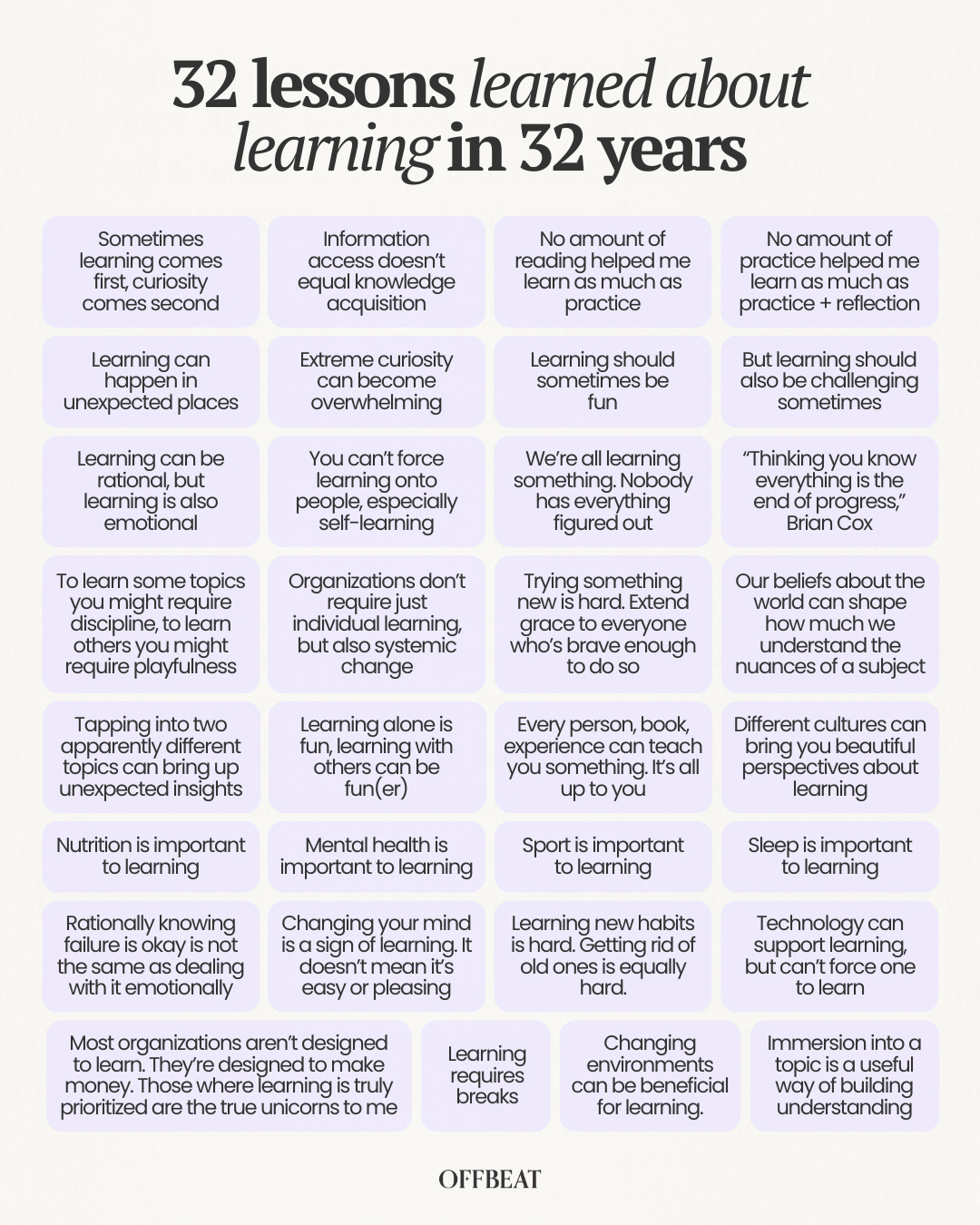
Sometimes learning comes first, curiosity comes second.
Information access doesn’t equal knowledge acquisition.
No amount of reading helped me learn as much as practice.
No amount of practice helped me learn as much as practice + reflection.
Immersion into a topic (through communities, books) is a useful way of building understanding.
Learning can happen in unexpected places.
Learning alone is fun, learning with others can be fun(er).
Our beliefs about the world can shape how much we understand the nuances of a subject.
Tapping into two apparently different topics can bring up unexpected insights.
Extreme curiosity can become overwhelming.
Learning should sometimes be fun.
But learning should also be challenging sometimes.
Learning can be rational, but learning is also emotional.
To learn some topics you might require discipline, to learn others you might require playfulness.
You can’t force learning onto people, especially self-learning.
Different cultures can bring you beautiful perspectives about learning.
Every person, book, experience can teach you something. It’s all up to you.
We’re all learning something. Nobody has everything figured out.
“Thinking you know everything is the end of progress,” Brian Cox.
Trying something new is hard. Extend grace to everyone who’s brave enough to do so.
Rationally knowing failure is okay is not the same as dealing with it emotionally.
Learning requires breaks.
Changing environments can be beneficial for learning.
Learning new habits is hard. Getting rid of old ones is equally hard.
Changing your mind is a sign of learning. It doesn’t mean it’s easy or pleasing.
Technology can support learning, but can’t force one to learn.
Mental health is important to learning.
Sport is important to learning.
Sleep is important to learning.
Nutrition is important to learning.
Most organizations aren’t designed to learn. They’re designed to make money. Those where learning is truly prioritized are the true unicorns to me.
Organizations don’t require just individual learning, but also systemic change.
I look forward to hearing your lessons learned about learning.
3 L&D Resources Worth Exploring
Your team doesn’t need an all-knowing leader. They need a transparent learner. Short read from Brian Glaser, Google’s Chief Learning Officer, on three shifts leaders need to make right now. From expert to sense-maker, from building trust through certainty to building it through navigating uncertainty openly, and from process manager to organizational architect. His warning about layering AI tools onto legacy workflows is one we should probably repeat more often in L&D. Each shift comes with something to try this week, which makes it easy to lift into a leadership session.
What if you’re not supposed to have a long-term plan? Molly Graham makes the case for emergence as an alternative to the career ladder. The idea comes from nature, where starlings follow three simple local rules and a murmuration appears without anyone choreographing it. Applied to careers, it means getting clear on your own principles, following your energy, and trusting the pattern to reveal itself rather than optimizing toward a destination. She collects the guiding principles of people like Claire Hughes Johnson, Adam Grant, and Patty Stonesifer, and shares two exercises for finding your own, including scoring the energy of every 30-minute block of your week. Relevant for anyone doing career conversations or coaching.
Building expertise in the age of AI: Who trains the next generation? The routine tasks we automated away were also the tasks juniors learned from, and a third of employers already report that AI has reduced the foundational work early-career people build judgment on. This piece lays out a four-part response covering knowledge management, role design, learning in the flow of work, and manager coaching.
The AI Find: 10 ways to get senior leaders to use AI
One of the lessons we learned in our L&D x AI Week a few months ago was that activating senior leadership is important to drive AI adoption. While most leaders rely only on telling people to use AI, those who choose to use AI themselves seem to be coming across as more trustworthy and inspiring. So the hard question is — how do we get leaders to use AI more?
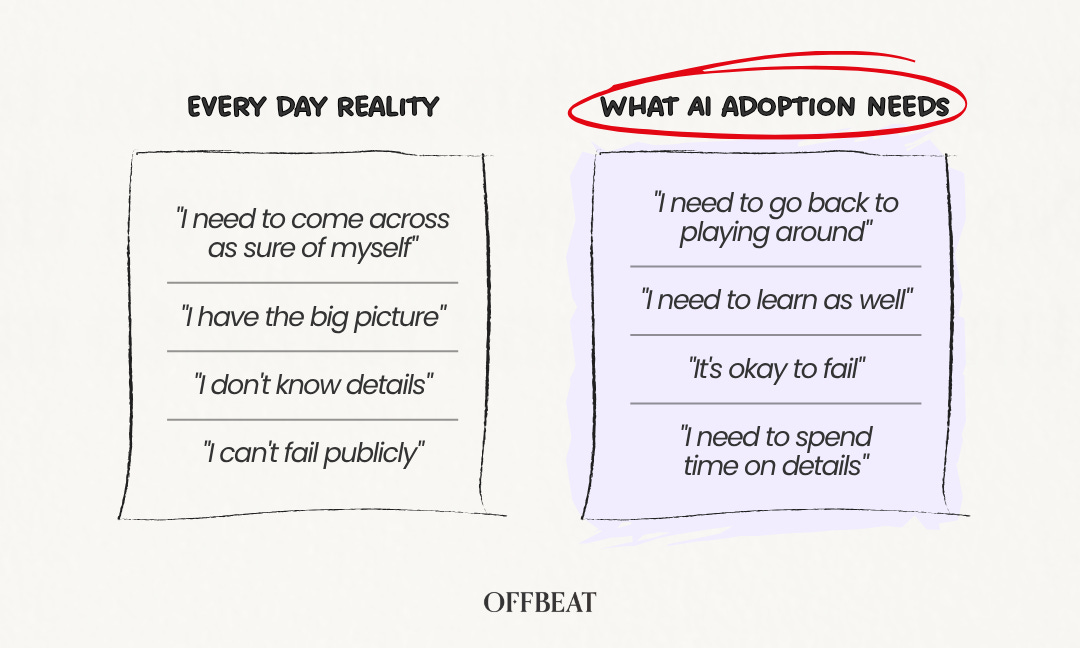
Using AI requires a lot of experimentation, playing around with different tools, encountering errors, fixing them, failing, and learning in the process. But given the nature of their roles, senior leaders tend to be removed from the day-to-day messiness of thinking about detailed workflows, fixing bugs, and hands-on work. Additionally, senior leaders are used to coming across as know-it-alls, a posture that doesn’t pair well with experimentation. So getting this target audience to actually use AI is not an easy task.
In the L&D x AI Week event, we already got some advice from L&Ds who are already pushing through the barriers:
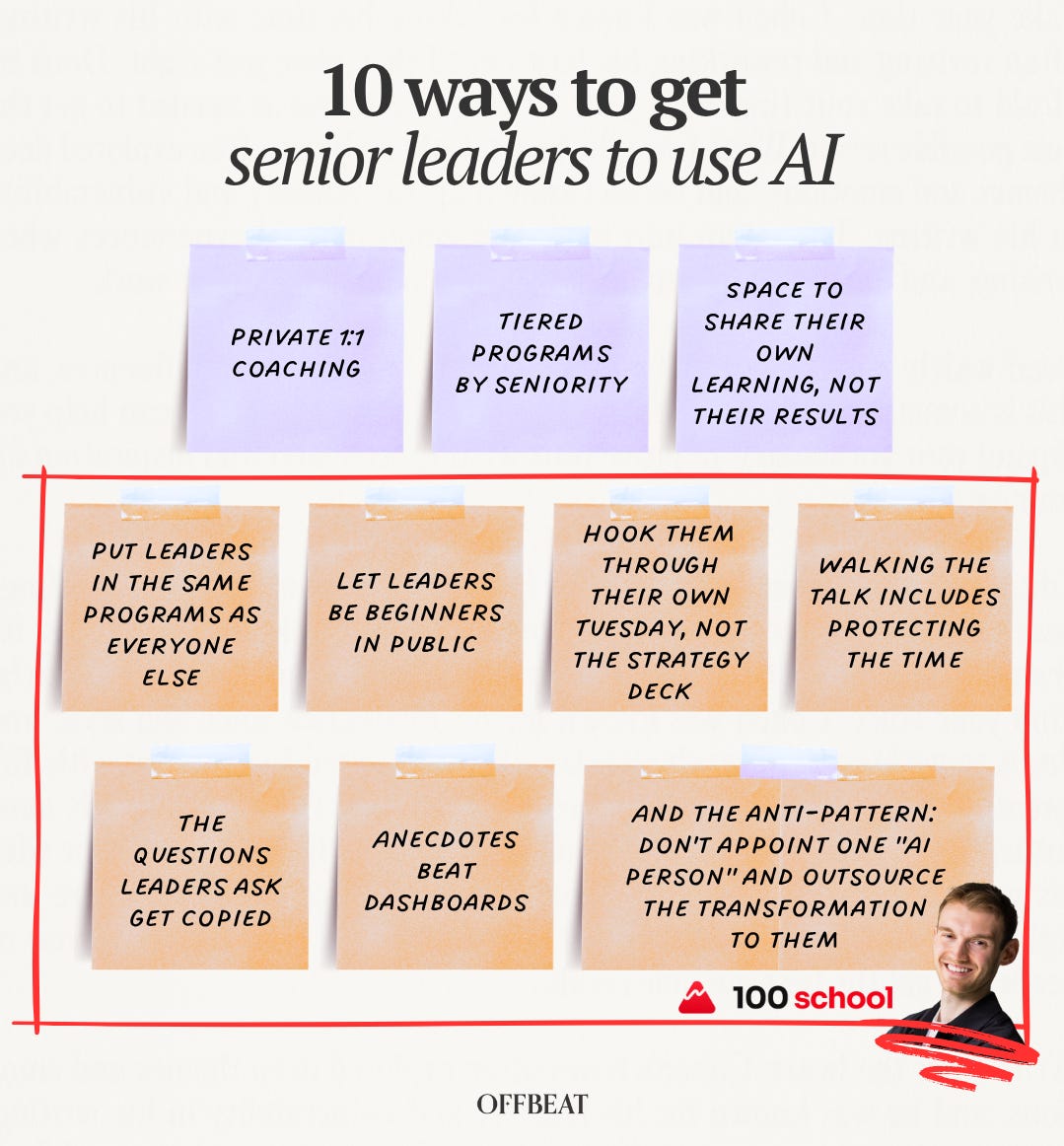
Private 1:1 coaching. Several teams invested in coaching individual executives away from the crowd. The turning point was almost always value. The moment a leader built their own “thought partner” or got an AI-generated daily brief of their inbox and open action items, that was when “it opened their eyes.”
Tiered programs by seniority. One company designed distinct tracks: an exercise for the executive committee on rebuilding the company from scratch if AI disrupted the model, a track for VPs on how to set and lead a strategy, and one for managers on how to enable their teams to adopt it. Different levels of complexity, same direction.
Space to share their own learning, not their results. One CEO openly shared what they’d tried over a weekend. Another company explicitly asked its executive team to model being on a learning journey, with the message “we’re also just learning here,” rather than performing mastery. At this stage the goal is establishing a learning culture, not showing off outcomes.
Our friends at 100school, led by Max Haining, jumped in with more lessons they’ve learned from the work they’re doing with clients. Here’s what they’ve got to say:
Put leaders in the same programs as everyone else. On one of our enterprise programs (BCG’s Legal & Risk function), directors and senior managers did the exact same 15-day program as their teams and shared their progress in the same Slack channels. No exec track, no watered-down version. Leadership participation was one of the things that created momentum for everyone else — a director posting their day-4 experiment is the loudest permission signal in the company.
Let leaders be beginners in public. The biggest blocker we see isn’t capability, it’s fear — of looking silly, of putting in the wrong data, of getting it wrong. A leader sharing “I tried this, it was rubbish, here’s what worked on the second attempt” does more to unlock experimentation than any polished demo. Vulnerability travels further than proficiency.
Hook them through their own Tuesday, not the strategy deck. Leaders don’t adopt AI because transformation matters; they adopt when it takes an hour off something they personally resent — board prep, meeting synthesis, first drafts. Find each leader’s one real task, get AI into it, and usage sustains itself. Evangelism doesn’t survive a busy week; self-interest does.
Walking the talk includes protecting the time. At Ocado, visible senior involvement was a participation nudge — but the bigger move was making managers responsible for protecting time for people to actually do the learning. A mandate without protected time quietly signals it doesn’t really matter. Less “telling everyone AI is important”, more making space for it.
The questions leaders ask get copied. When a leader asks “Did we try AI on this?” in an ordinary meeting — not an AI meeting — it does more than any town-hall announcement. What leadership is curious about becomes what the organization practices.
Anecdotes beat dashboards. Senior leaders repeating one specific, personal win (”this saved me two hours on Thursday, here’s how”) move an organization more than an adoption dashboard ever will. Stories are the unit of culture change; give leaders one of their own to tell.
And the anti-pattern: don’t appoint one “AI person” and outsource the transformation to them. We see this constantly — AI adoption dumped on a single People/L&D/AI hire with an impossible remit while leadership watches from a distance. Walking the talk means the opposite: distributed ownership, leaders included. If the whole transformation can be delegated to one job title, it isn’t a transformation.
We hope these 10 ideas are useful. If anything else worked for you, we’d love to hear your story! Don’t hesitate to comment below.
Surprise of the week
Each week, Offbeat brings you a new random surprise. Sometimes it might be big - a challenge you can join to win something nice. And sometimes it might be small, like a video or a nice Instagram account. Curious? Hit open!


Thankyou for letting us chime in on this one!! Great read 💯
Happiest of Birthdays, you L&D queen! 👑