


Hey there 👋 I’m Lavinia, and each Sunday I write about modern ways of running L&D. If you want to learn more: Offbeat Fellowship | Offbeat Sparks | Offbeat Fest. Here are my favorite L&D people to follow, a list of L&D books you might want to check out, and a list of L&D conferences all around the world.
On September 1st, together with Aki, Milica, and Frank, I’ll be discussing AI Adoption. We’re bringing pretty diverse perspectives to the table, but I bet we’d learn even more if you’d join us and also share yours. You can register here — 404 people already did. If you’re interested in more sessions about the intersection of L&D and AI, check out the event this session is part of: The AI-Native L&D Leader.
Learning comes up as the skill of the future everywhere you look. McKinsey defined it as self-development. The World Economic Forum created an entire category for a series of skills related to learning called “learning and growth”. And BCG spoke extensively about learning how to learn.
Now, in all honesty, even without reading all these reports, so many of us who’ve ever dealt with continuous change have seen how important learning is. Companies have experienced it firsthand in their push for AI adoption. Many gave employees access to the tools and then found that few people rushed to use them or to learn how to use them well.
So we know learning is important. That doesn’t mean learning happens at the pace life demands. That intention-to-action gap deserves attention from L&D professionals.
We know from COM-B that behavior, in this case learning, is a combination of capability, opportunity, and motivation. And the question I have for you today is “are your colleagues motivated to learn?” Of course, the question can be asked in general, to see whether your colleagues are generally motivated to learn in your organization, but also in specific situations:
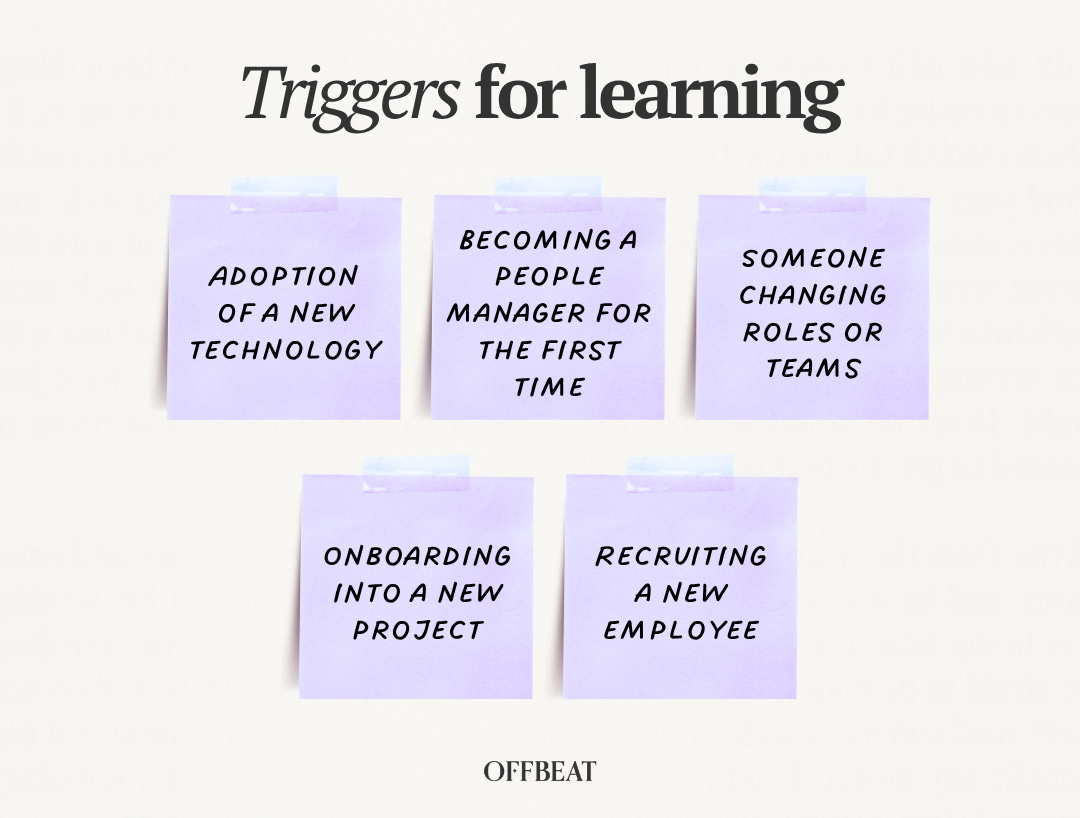
– Adoption of a new technology
– Becoming a people manager for the first time
– Someone changing roles or teams
– Onboarding into a new project
– Recruiting a new employee
All these moments will require people to learn, and whether they are motivated to do so or not is not something to be dismissed with a simple yes or no answer.
The COM-B model treats motivation as a changeable characteristic and splits it into two components: reflective motivation and automatic motivation.
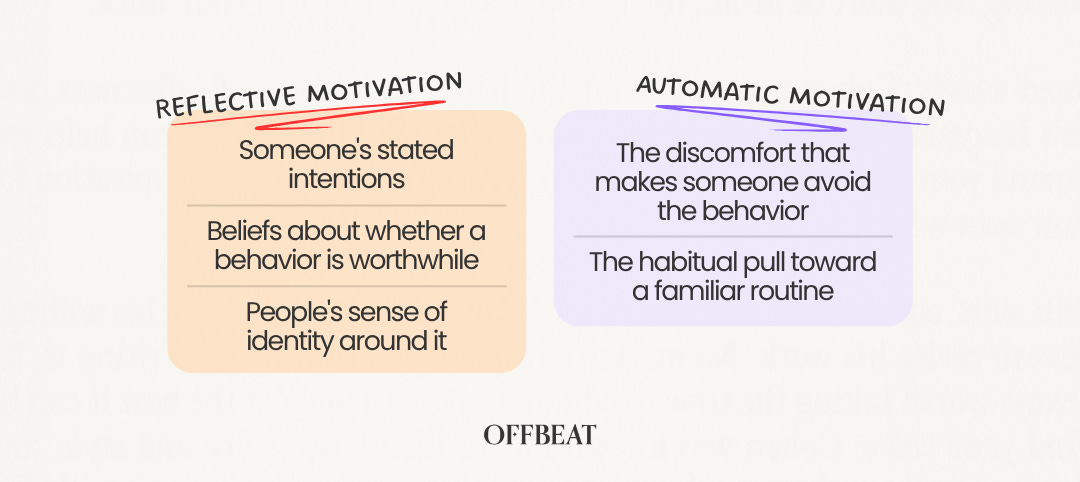
– Reflective motivation includes someone’s stated intentions, their beliefs about whether a behavior is worthwhile, and their sense of identity around it. If someone decides “I should learn more often” and believes it matters, that’s reflective motivation at work.
– Automatic motivation covers things like the discomfort that makes someone avoid the behavior, or the habitual pull toward a familiar routine even when a person has consciously decided to change it.
Before any of the triggers above, you can ask people a series of questions to diagnose their motivation levels:
1/ What would change for you if you spent 30 minutes a week to learn/ try [X]? -
2/ How would you prioritize spending 30 minutes learning/ trying [X] this week against other tasks?
3/ Does anything happen if you learn/ try [X], and does anything happen if you don’t?
4/ Is learning [X] part of what you think your job is now, or is it something on top of the job?
5/ How are you handling things right now without [X], and how long have you worked that way?
6/ Do you intend to spend 30 minutes learning/ trying [X] this week?
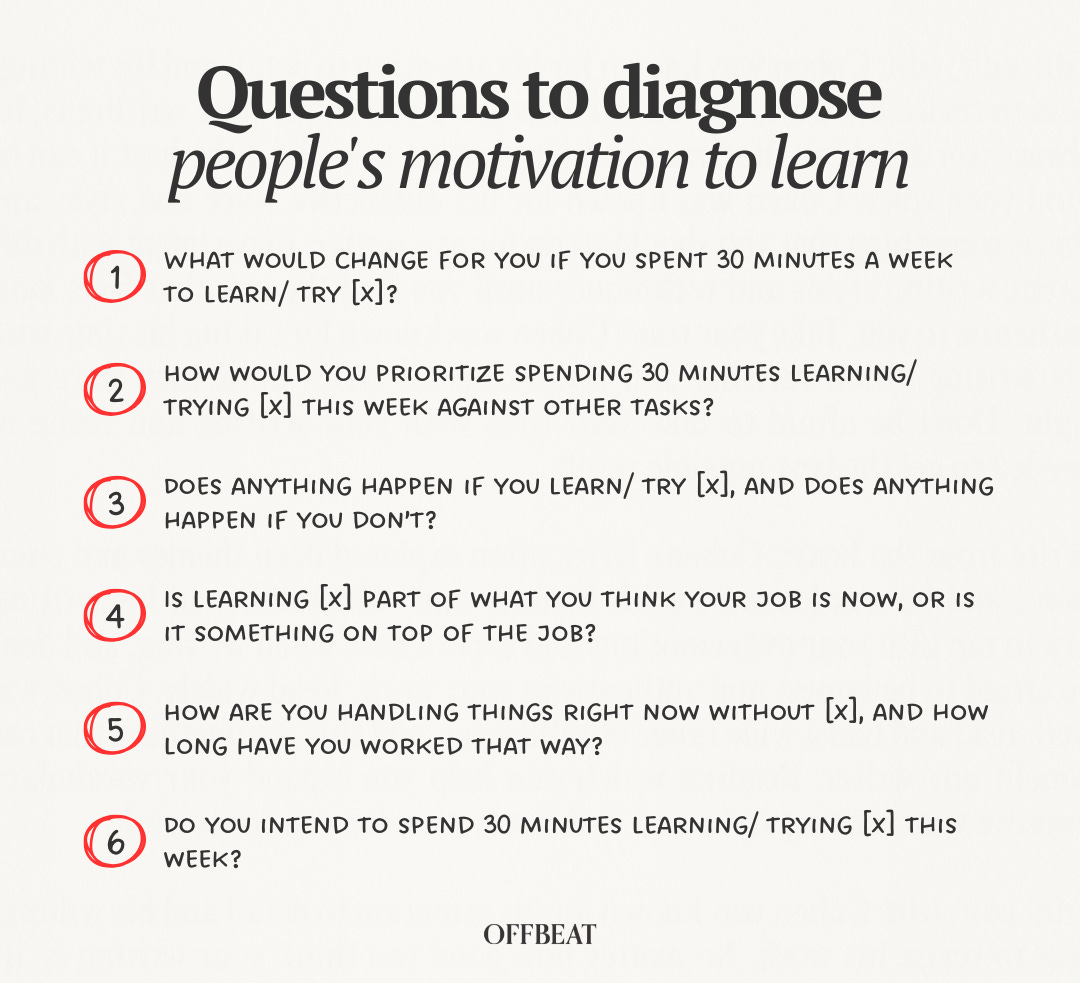
All the answers to these questions will give you an overview of whether what blocks people from learning is motivation. If it’s not, you can move on to investigating capability or opportunity.
But if it seems to be a big problem, it might be a good idea to think of ways to support people and design their environment in a way that motivates them — and running a training on motivation doesn’t count. For more diverse solutions, you can check:
– The Ten Conditions for Change
And maybe, an important question for you is: are you motivated to learn [X]?
3 L&D Resources Worth Exploring
What It Means to Develop Leadership Instead of Leaders. Organizations spend an estimated $366 billion a year on leadership development, and most of it goes into instructor-led training that happens far away from the actual work. The Ready argues the problem starts earlier, with our definition. If leadership is a title given to a few people with authority, then development means fixing individuals. If leadership is creating the conditions for an organization to fulfill its potential, then development means changing how teams set priorities, clarify roles, and run their operating rhythm. The three worked examples near the end are the useful part, showing what a typical L&D response would be to burnout or role confusion, and what a systemic one looks like instead.
Culture Rot: Who Owns It? And Why It Can't Be Delegated. Ask most companies who owns culture, and you get a shrug, or a pointed finger toward HR. This guide from Tim Clark's team argues that handing culture to the Chief People Officer is abdication rather than delegation, and that ownership is nested, with every leader accountable for the culture inside their own span of control. It offers three signals for diagnosing a culture quickly, including what happens in the two seconds after someone disagrees, and describes the two directions cultures rot in: pathological compliance and pathological conflict.
Designing Spaces for Thinking. Stefy Bolaños starts with her nephew scrolling through The Deep Sea on her phone, completely absorbed, and asks why our learning environments so rarely feel like that. She borrows interface design principles from Peps McCrea, progressive disclosure, one action at a time, immediate feedback, consistency, and then adds three of her own from redesigning lessons at 100 School. The one that stuck with me is the question she started asking before adding any interaction: what cognitive job is this actually doing?
The AI Find: The anatomy of a good AI Tutor
One of the most common learner-facing tools I’ve been hearing about over the past couple of years is the AI Tutor. Quite a few vendors in your industry have rushed to create their own tutors, so you might be in a position to be sold one. So I took a bit of time to better understand:
What an AI Tutor is and how it’s different from any other AI learner-facing tool
What the anatomy of a good AI Tutor is
Let’s start with the first question. We often talk about AI Tutors, AI chatbots, AI Coaches, AI Simulators, or AI Recommendation Systems. So many freaking terms. I wouldn’t blame you for being confused. I damn sure was. Here’s how I understood the differences:
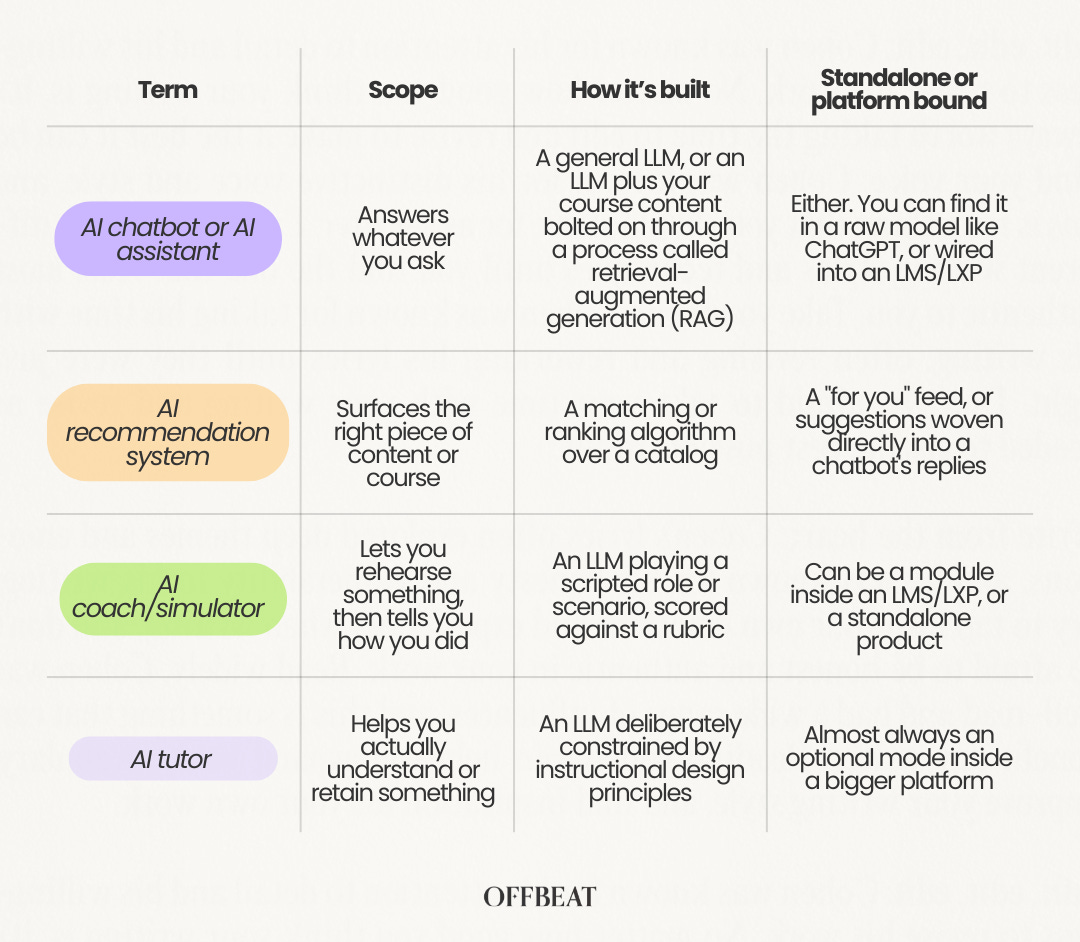
Now, a few weeks ago Carl Hendrick from The Learning Dispatch wrote a piece about what research tells us about AI and Learning. Scott H. Young also picked it up and wrote his own article, called We need guidelines for learning and AI. Having read those, I became curious about what a good AI Tutor should look like based on what research tells us, not what vendors are promising.
The anatomy of a good AI tutor
In the table above, I described a good AI tutor as an LLM “deliberately constrained by instructional design principles.” Scott Young already sketched a version of what that means. He frames good learning as a loop: see (get instruction, a worked example, something to guide you), do (practice on your own), feedback (find out how it went), and argues AI can genuinely help with the first and last step, never the middle one:
Translate that into what a tutor should actually be built to do, and you get something close to this:
It pushes you to solve the problem first. When you hand an AI Tutor a problem you’re facing, it shouldn’t hand you back an answer, but it should nudge you to try to solve the problem yourself first.
It doesn’t reply with answers, but questions and hints. In a study done in 2025, a group of students was split into three: a control group, a group that got an AI Tutor that answered questions directly, and one that got an AI Tutor that only gave hints. The two groups that used the AI Tutor both did well during practice. But when the time for the real exam came, the group with the AI Tutor that gave answers did worse than the control group, while the group with the AI Tutor that only gave hints showed no such drop. Just being handed answers doesn’t help.
It should be able to calibrate itself to what you already know. Beginners and experts shouldn’t be treated the same by an AI Tutor. A beginner needs more guidance. An expert needs less of it, maybe narrower, more targeted, with room to reflect rather than being walked through fundamentals they already have.
It’s generous with alternatives, stingy with certainty. Instead of giving you one “right” answer, a good AI Tutor should be able to surface ideas, resources, or approaches you might have missed, broadening your thinking, not narrowing it down.
It treats itself as fallible, and makes checking a habit. A tutor that acts like it knows everything gets taken at face value. One that expects you to double-check important claims teaches you to think critically in the process.
It flags mistakes, but doesn’t fix them. While AI can help you flag mistakes, it shouldn’t correct them, but rather push you to practice again and correct yourself.
It sends you back to retry, without support, and gives you feedback. The conversation with an AI Tutor shouldn’t stop after one round of practice. A good Tutor will hand you another problem, let you solve it without support, and provide feedback on how that went.
It resurfaces what you’re likely to have forgotten. New sessions with an AI Tutor shouldn’t start with a blank slate, but with old materials and problems you already got through.
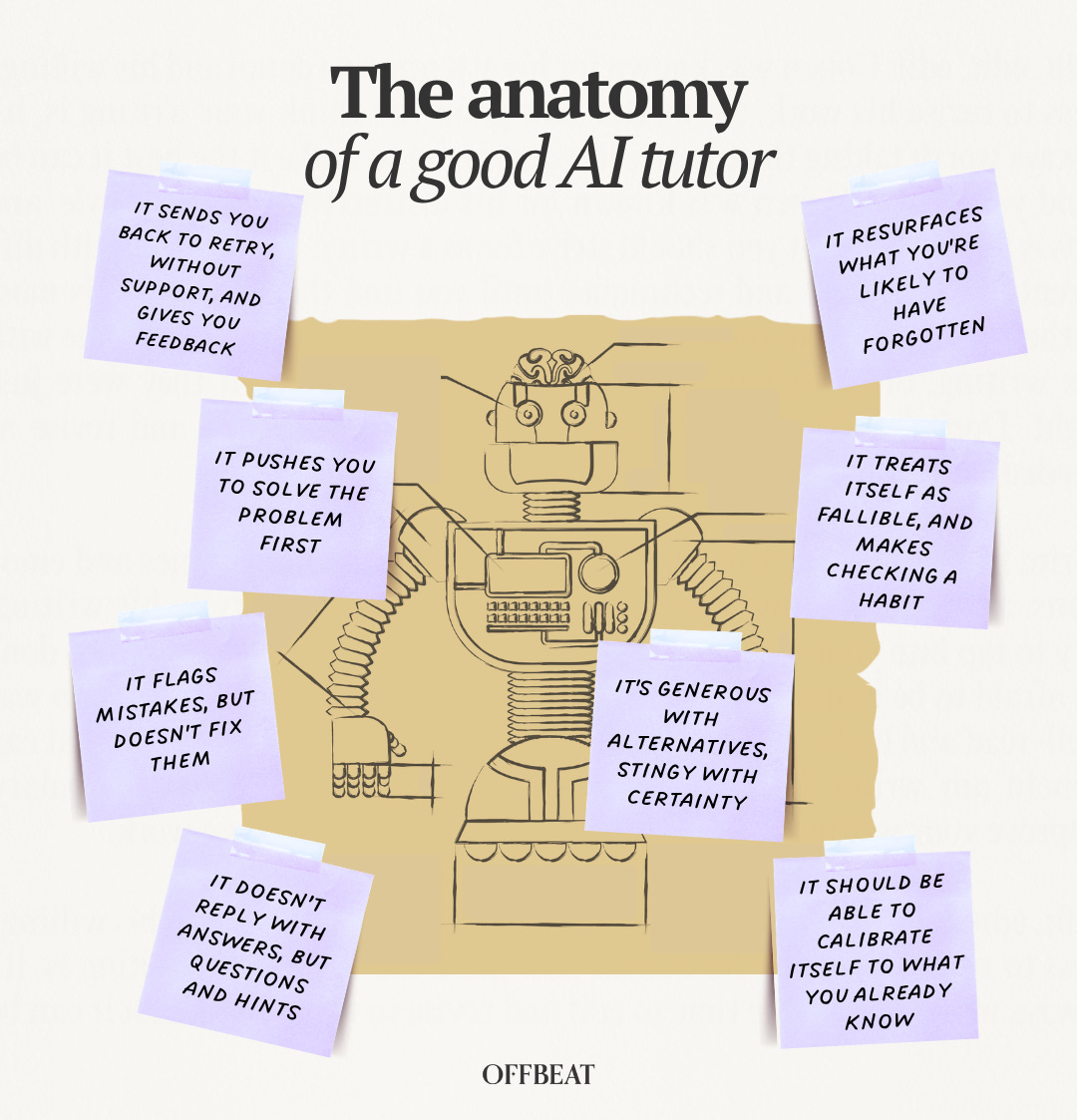
Given all of the above, my conclusion is that a good AI Tutor will be built by someone who understands both the subject and how people actually learn it. Or maybe in partnership by a subject expert and a learning expert.
A couple of final thoughts:
1/ Let’s not forget that at the end of the day an AI Tutor is still a knowledge-builder. Especially in the corporate world, where practice happens mostly in the real world, we should treat it as a “first-step” support tool that can help with building understanding and knowledge retention, not as the answer to all our problems.
2/ Most of the research in the field has been done on K12 and university students, not the corporate world. So if vendors claim their products are science-backed, I would be cautious and ask for the research papers they referenced.
3/ We all know this technology is moving fast! What’s true today might be false tomorrow. This is my first attempt at clarifying what the deal with AI Tutors is, so I welcome feedback and any thoughts and experiences you may have. Drop them in the comments below.
I’m looking forward to hearing from you, as always.
Surprise of the week
Each week, Offbeat brings you a new random surprise. Sometimes it might be big - a challenge you can join to win something nice. And sometimes it might be small, like a video or a nice Instagram account. Curious? Hit open!

