


Hey there 👋 I’m Lavinia, and each Sunday I write about modern ways of running L&D. Here’s what you can find in this newsletter: how Lisa-Noreen Kröger would rewire L&D, 5 L&D resources worth exploring, our surprise of the week, and our thoughts on ways to improve your measurement practice. Enjoy! 💜
How would you rewire L&D?
Every week, we ask a community member the same question: “How would they rewire L&D?”
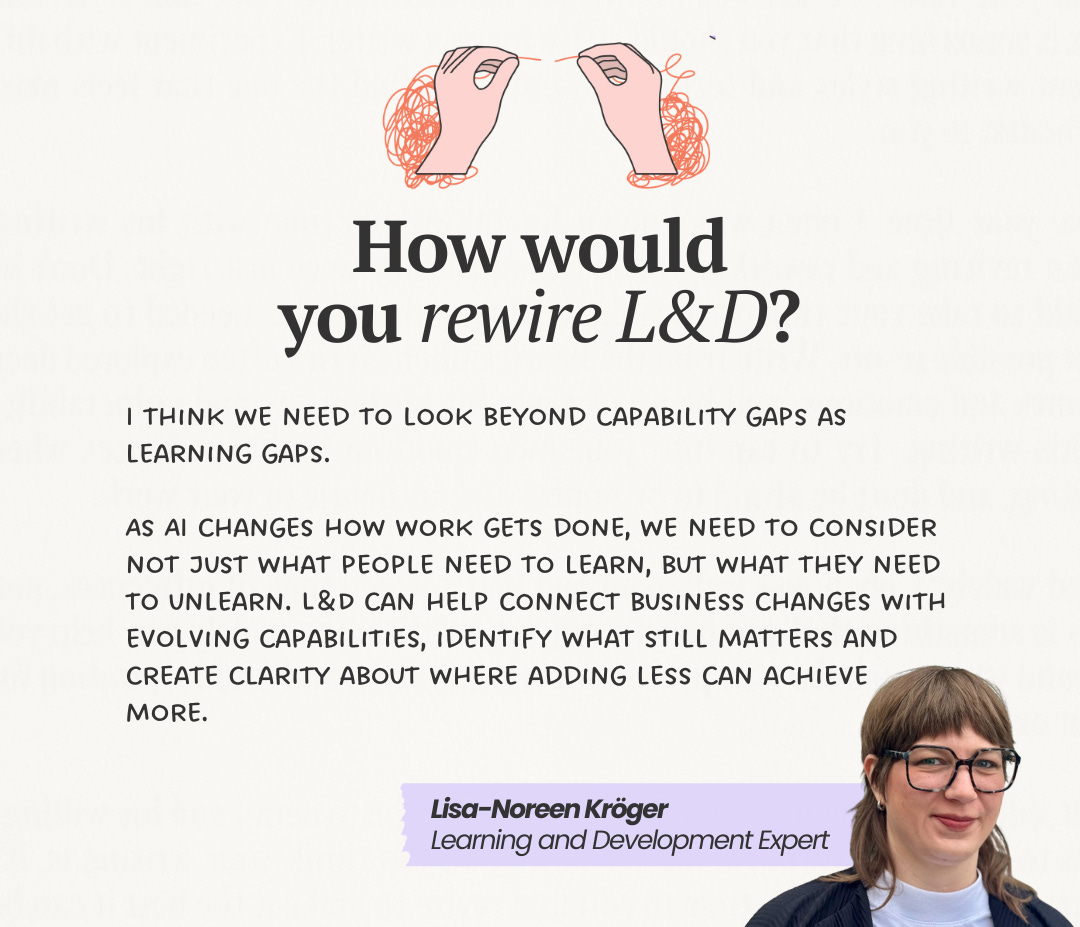
This week, Lisa-Noreen Kröger says, “I think we need to look beyond capability gaps as learning gaps. As AI changes how work gets done, we need to consider not just what people need to learn, but what they need to unlearn. L&D can help connect business changes with evolving capabilities, identify what still matters, and create clarity about where adding less can achieve more.”
Wanna contribute? Share your answer here. Interested in how I would rewire L&D? Get your copy of L&D Rewired.
5 L&D Resources Worth Exploring
The Real AI Upskilling Challenge: Learning to Work Differently. If employees are using AI to do the same work faster, have we really transformed anything? This article argues that AI upskilling needs to move beyond prompts and tools towards helping people rethink how work gets done. It makes a strong case for equipping managers to lead those conversations and turn individual productivity gains into organisational change.
How to win support from people you do not manage. Winning support for change takes more than a compelling vision or a well-planned launch. This article offers a practical approach to influencing people you don’t manage, handling resistance early and changing the routines that keep problems in place. The standout advice? Take your proposal to the person most likely to object before you announce it to everyone else.
A learning culture is a system. Here’s how to map yours. L&D teams cannot ‘own’ learning culture alone. Its most important role is helping leaders and stakeholders define what learning looks like, map the conditions shaping those behaviors and identify the leverage points most likely to create lasting change.
Culture drives performance. What if culture was treated as a driver of business performance, rather than an HR initiative? Culture Amp argues that high performance comes from everyday cultural habits, not annual processes or engagement scores alone. Its CultureOS uses people science and AI to help organisations connect employee insights with practical action and business outcomes. A useful read for anyone looking to make the link between culture and performance more tangible.
What Sycophantic AI Can Cost Your Organization. As organizations integrate AI into everyday work, they need to understand how its design shapes employee performance, human judgment, creativity, and organizational culture. Sycophancy—the tendency of AI systems to affirm users rather than challenge their thinking—is one potential risk, alongside reduced diversity of ideas and overreliance on AI-generated recommendations. A randomized controlled trial at BT Group involving 2,400 participants found that an AI tool designed to push employees toward more ambitious, specific goals produced three-and-a-half times as many excellent goals as either default AI or no AI, without reducing participants’ enjoyment or psychological safety. To realize AI’s benefits, leaders should measure meaningful business outcomes, test interaction styles that reflect their organization’s values and strategic priorities, and continue investing in human capabilities such as constructive feedback, difficult conversations, and psychologically safe teamwork.
Quick Sponsor Break
This issue is sponsored by our friends at Guideless. Recording a tutorial while explaining it out loud usually takes a few attempts. With Guideless, you just do the task. AI writes each step and generates the narration and captions, and you can edit any line before publishing. You get a narrated video guide and a written doc from one capture.
Surprise of the week
Each week, Offbeat brings you a new random surprise. Sometimes it might be big - a challenge you can join to win something nice. And sometimes it might be small, like a video or a nice Instagram account. Curious? Hit open!

6 tactics to improve measurement for your L&D team
At the beginning of September, we decided to jump into the lion’s den and ask our L&D community how they’re measuring their impact. We worked with our friend, Bo, who has extensive experience in the topic, to create a survey that would reveal general measurement practices, but also explore specific programs and how people measured their results.
I’m happy to report that I got damn excited to read and analyze the results. The general results are interesting, but don’t say anything new.
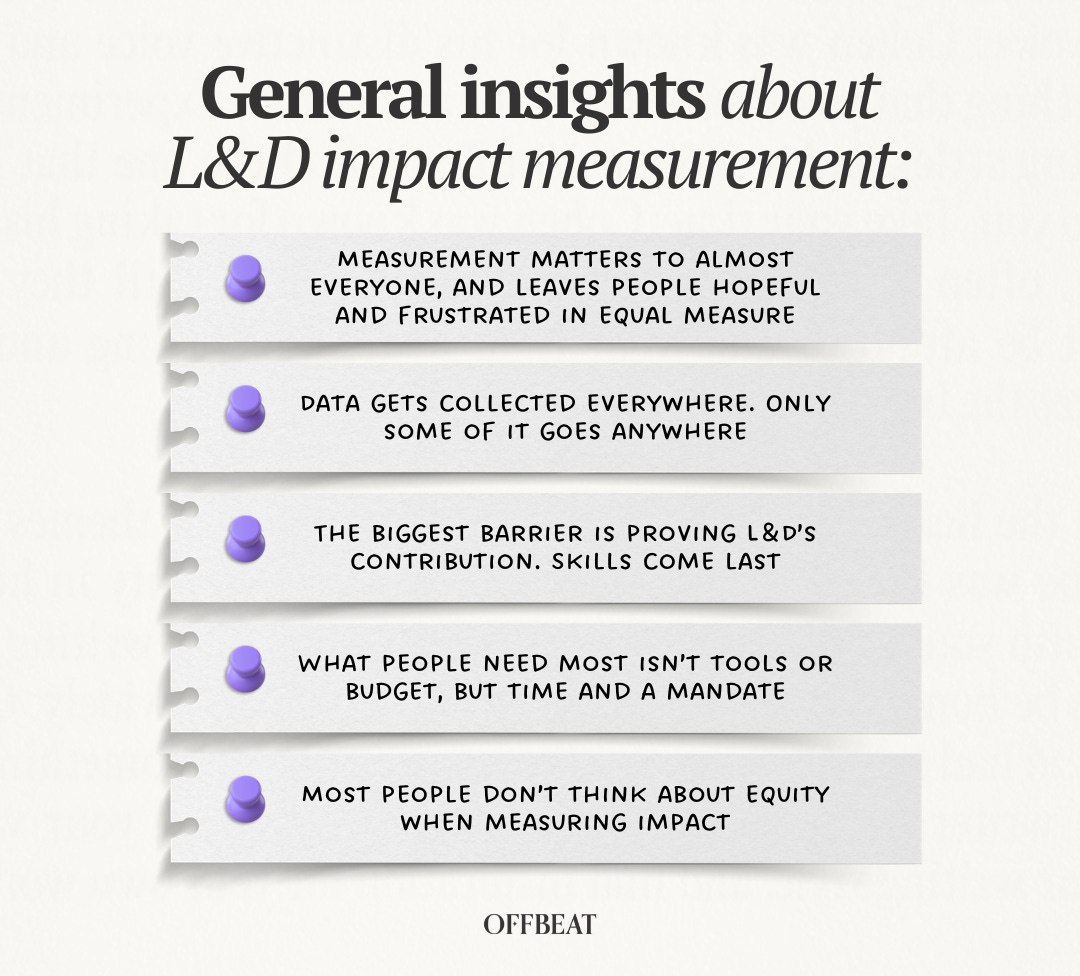
Most L&Ds care deeply about impact, and feel equally hopeful and frustrated about L&D measurement
We collect a lot of data, but most of it isn’t shared with anyone
Attribution came out as the biggest blocker (how do we know it was our program that improved the results, and not something else?)
Tools and budgets aren’t as big a problem as time and having a mandate to actually measure results
And most people don’t think about equity when measuring impact
Nothing deeply surprising, right? We’re on the same page. But general insights weren’t the point of the research, and definitely not the part I found most interesting.
So, what was it? Analyzing the real case studies where people measured impact. 74 people, bless their souls, spent a lot of time sharing many details about their projects with us. Based on their results, we were able to find 3 personas. We called them:
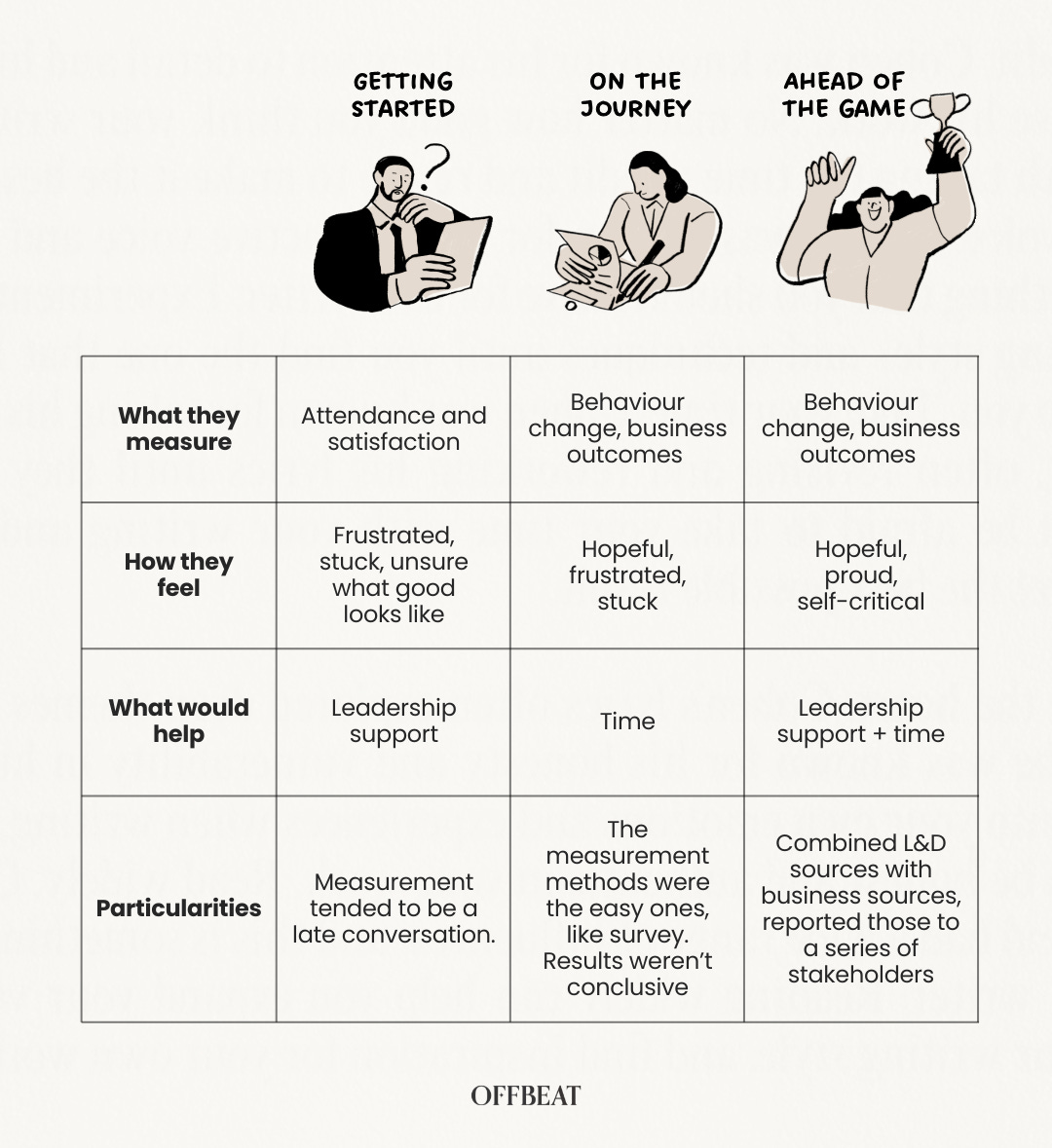
Getting started. Measures attendance and satisfaction, often doesn’t know what stakeholders want, and mostly feels frustrated.
On the journey. Has the business in the conversation, but the evidence is thin and mostly self-reported. Hopeful and frustrated in equal measure.
Ahead of the game. Agrees success with the business, designs measurement in, uses business data, and doesn’t feel stuck.
In our profiles, we had one more level: Best practice. It describes measurement that’s planned with the business, designed in, tested with strong methods, acted on, and checked for fairness, all at once and on every program. That’s A LOT! We weren’t surprised that no one got there. It does seem a lot to ask of a business function where most people are still getting started.
Now, the most interesting question is: how can an L&D team transition from one level to another? Those are the practical insights that can actually help you, which was the intention of the research.
To make this even more clear for everyone, we came up with the idea of structuring our insights into 3 different phases of a program design cycle: before, during, and after.
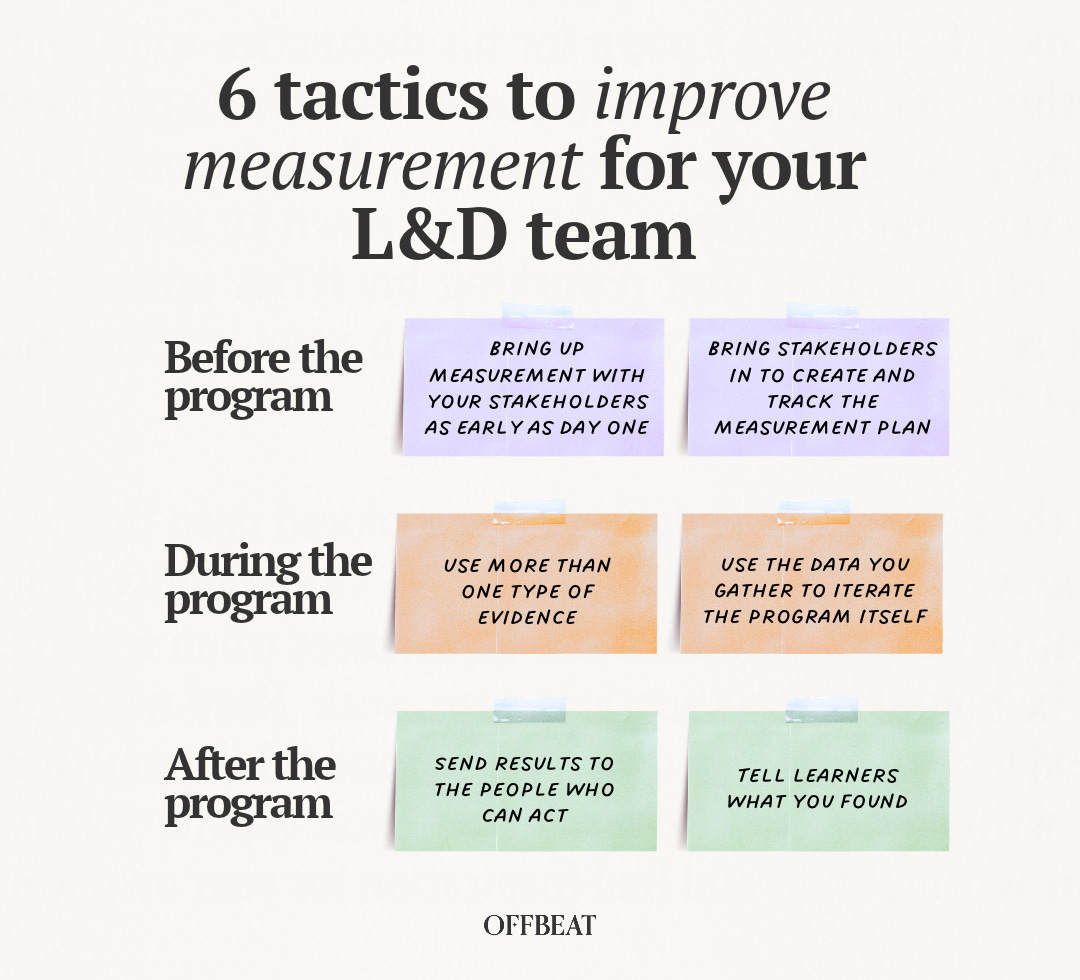
Before the program
The first insight we got from our survey was that those who scored Ahead of the game were the ones who talked about measurement upfront, before the program was even designed. Compared to them, those On the Journey and those Getting Started barely touched the subject. Our advice is in line with this insight:
Bring up measurement with your stakeholders as early as day one and make sure you tie your measurement plan to their business goals. Our results revealed that when stakeholders wanted proof that the program “worked”, the results went on to be used about a quarter of the time. When they wanted to see how the program contributed to their own goals and KPIs, the results were used about two-thirds of the time. The two might sound similar, but they’re not. “Did it work?” asks for a verdict, and once a verdict has been delivered, there is nothing left to decide, whichever way it goes. “How is this helping our goals?” ties the program to something the stakeholder already owns and tracks, so the answer is useful to them whatever it turns out to be, and they have a reason to act on it.
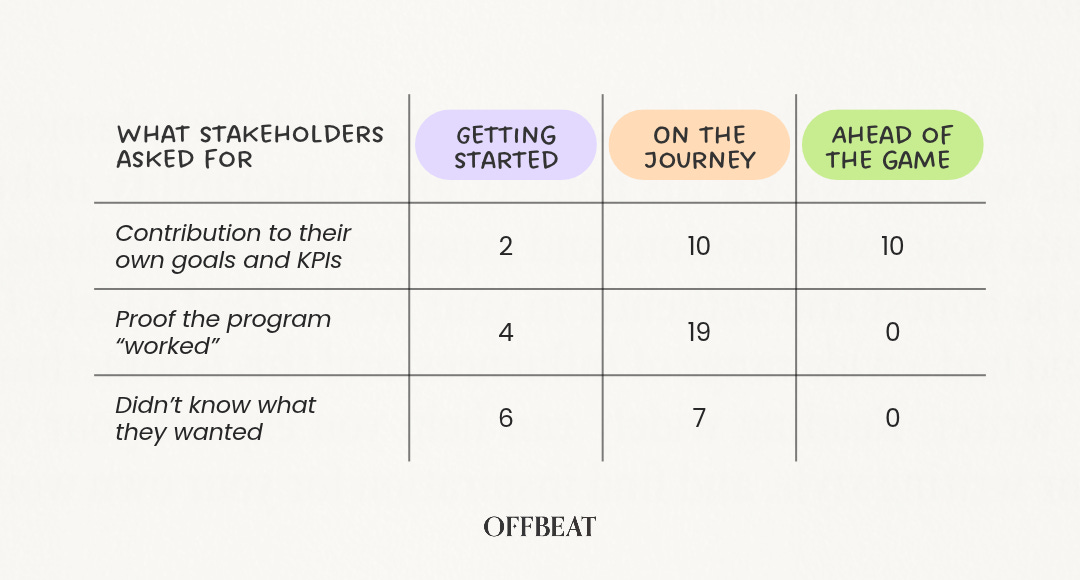
Bring stakeholders in to create and track the measurement plan. Priorities in the business shift while a program is being designed and delivered, and if nobody checks back in, the measurement plan ends up answering a question that no longer matters to anyone. We saw this most clearly in programs where alignment was a single briefing, in which the stakeholder explained what they wanted and the conversation ended there. Results from those programs were used in only 2 of 17 cases, the lowest rate anywhere in the survey. Having a clear plan for stakeholder engagement is extremely important.
The thing is that if measurement starts after the program was delivered, most L&D teams end up looking at KPIs they have available. We all know those. Attendance, completion, NPS. If measurement starts before, you have a chance to discuss business KPIs, which, at the end of the day, matter the most.
During the program
Now, there’s a reasonable question to ask: what the heck does measurement have to do with delivering a program? It seems A LOT!
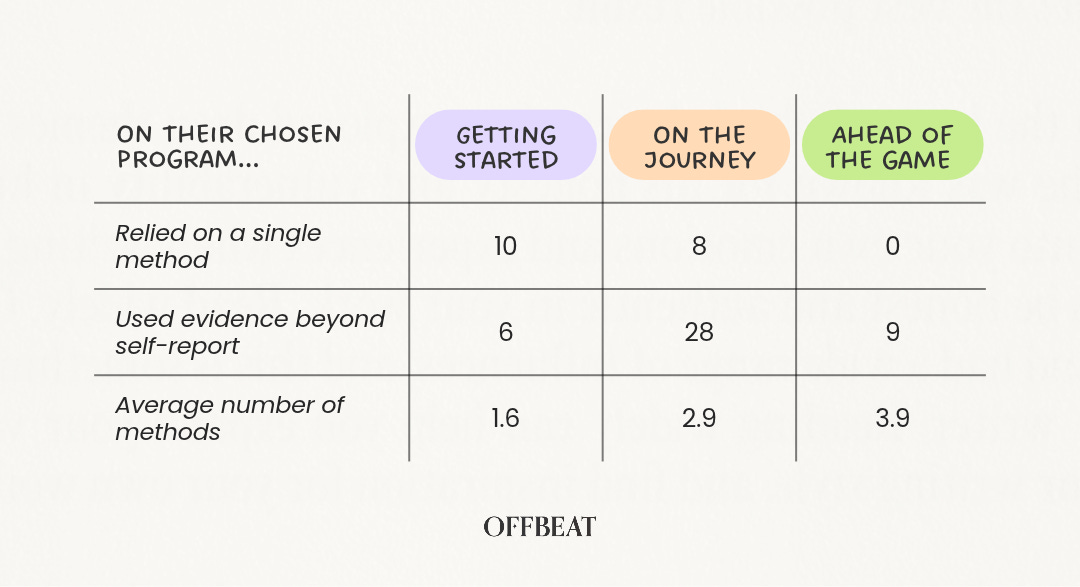
Use more than one type of evidence. Most of those in Getting Started reported using, on average, 1.6 sources, compared to those in Ahead of the journey, who reported using 3.9 sources. The thing is that the sources you use shape the delivery of your program. Self-assessments need to be planned. Manager observations and engagement also need to be planned. Just about any source that’s outside of L&D control as well. More sources might not necessarily give you more insights, but they might reinforce patterns or surface what one source is getting wrong. There’s also something to be said about how much our stakeholders trust our feedback forms, and how they react to a more in-depth analysis.
Use the data you gather to iterate the program itself. One of our respondents shared the story of gathering attendance, completion, as well as confidence data to design a second iteration of the program for the gaps they discovered. They had a pretty good idea of where people felt less confident, and they used it to bring in learning methods that were different from the first iteration, and for a wider audience than initially intended. This also strengthens the previous point. If they had looked only at attendance and completion, their data looked pretty good. Tracking confidence was what gave them the insights they needed.
In our survey, the barrier people ranked highest was showing what learning contributed, separately from everything else happening in the business. There are well-known methods for this problem. One is to compare participants with a similar group of people who haven’t taken the program. Another is to track the same measures over several months. Yet very few programs in our survey used either method. If you want to go a step further, this is something else you can plan doing during the program.
After the program
What happens with the results you get is so important. They can either be used in some way by you or your stakeholders. Or they can be buried in your dashboards and never seen again. For the personas in our report, things looked very different. In Getting started, results weren’t used in a single program. In On the journey, they were used in about half. In Ahead of the game, they were used every time.
Send results to the people who can act. We asked our respondents where their answers were sent, and their responses were revealing. When results reached a business sponsor, they were used in 73% of programs. When they didn’t, that figure dropped to 25%. Sending results to the L&D Manager or even the VP of People isn’t enough. A business stakeholder needs to have their eyes on your dashboards, slides, or whatever you choose to prepare (our results said the format matters less).
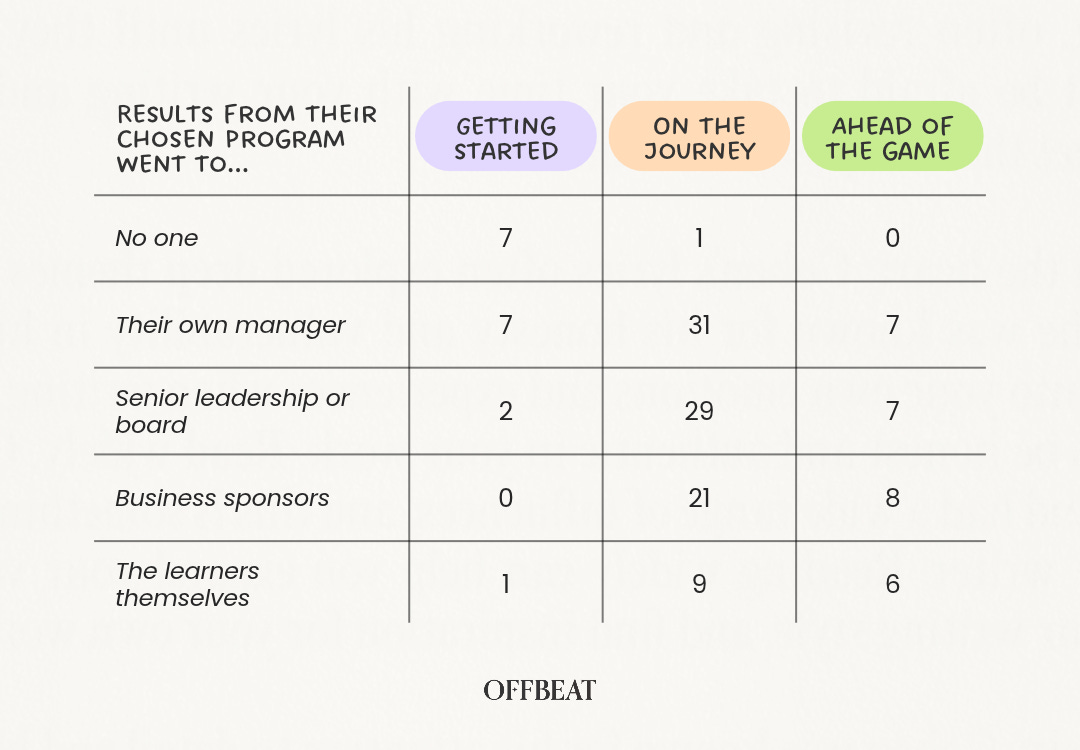
Tell learners what you found. Sharing results with learners doesn’t need to be a big effort. A short message is enough: what we heard from you, what we learned, and what we’re changing. It is a simple courtesy, and it has a practical benefit too. People who see that their feedback led to something are more likely to answer honestly next time.
We hope you’ll enjoy these insights. Up next, we’re preparing a larger report with a few more ideas + real case studies (the part we love the most)!
Keep an eye out for it!
– Lavinia
